


Science Fiction · Complete book
ONE
New illustrated edition · Read the full book below
By Human Shahil
Audio reading
Listen to ONE
Select any passage to hear it in English; with no selection, playback begins at the first line.
My name is Human Shahil.
I have never believed that a human being is defined only by where he comes from—but origins do leave quiet fingerprints. I grew up in a household where discipline mattered more than comfort. My father served in the Air Force in Bapatla, and luxury was never part of our vocabulary. Pocket money was rare, but values were not. I learned early how to work, how to wait, and how to respect what little I had.
Like most children, I dreamed loudly. I once wanted to be an actor. I made short films, chased frames, and imagined different lives. But life, as it often does, chose a different script for me. I turned toward studies, toward structure, toward certainty—and eventually found myself working as an automation engineer at TCS. Systems, logic, precision: a world where everything must behave as expected.
Yet, something in me never stopped observing.
Photography became a habit. Travel became a teacher. I explored much of India and travelled to Dubai twice, as well as Thailand and Malaysia. Ladakh, especially, changed the way I listen to silence. I returned from that land with more than images—I returned with questions. About people. About systems. About why we live the way we do.
I do not believe in the existence of God.
I do not pray out of faith.
And yet, every Friday, without fail, I go for Namaz. For me, it is about the positive energy that comes from praying in silence.
I am not religious.
But I am a human made up of cells and bones.
I love a woman I will marry soon. Out of respect, commitment, and choice, I began showing up—standing among others, listening, bowing not to a deity, but to the idea of responsibility toward one another. When I pray, I ask for nothing for myself.
I pray for children who sleep hungry.
For elders whose pain is invisible.
For strangers who carry silent burdens.
For animals, insects, lives we overlook because they are small.
I ask for safety. I ask for shelter.
I ask for freedom from suffering.
And at the very end, I say something that surprises even me:
God—if you exist—be safe, be happy, be healthy.
Because if God exists, then even God should not be alone.
One Friday in namaz, as the priest spoke and the room moved in practiced rhythm, my mind stepped away. I did not fall asleep. I did not drift. I arrived somewhere else.
A thought unfolded—not as imagination, but as clarity.
What if there existed a town where all houses were the same?
Not by force, but by understanding.
Intro
A place with no selfishness, because comparison never learned to exist.
A place where people did not believe in God, not out of denial, but because no one ever felt abandoned enough to invent one.
No temples. No masjids. No churches. Only life, shared.
A town with no machines, only walking, cycling, horses.
Where agriculture was not a job, but a collective rhythm.
Where currency had no meaning, because nothing was owned more than it was needed.
In that moment, standing still among praying bodies, I understood something quietly powerful:
Perhaps the problem was never belief.
Perhaps it was separation. And somewhere between logic and silence, between doubt and compassion, “OMNIA” began.
ONE
The beginning —
One night, far from chaos and the restless glow of cities that never sleep, Omnia rested beneath a sky that seemed painted by unseen hands. The darkness was not empty but layered-- Stars shimmered like scattered embers, some steady, some trembling, and the moon cast a pale silver path across the ocean that looked almost like a bridge between worlds. The waves moved in slow, luminous curves, their edges catching traces of moonlight and reflecting hints of soft turquoise and liquid pearl before dissolving into the shore. The air felt cool and alive, brushed with salt and distant earth, and for miles around there was nothing but the breathing of the sea and the quiet certainty that this place belonged to stillness, not to noise.
From the far edge of the coastline, a line of flickering red lights began moving slowly toward the beach. They were not flames of alarm, but of celebration. A procession walked barefoot across the sand, holding long wooden sticks wrapped with oil-soaked cloth. The firelight danced against their white handwoven garments, casting golden shadows on smiling faces. Their voices rose together in a low chant that travelled with the wind.
“New birth… new breath… new life…”
The words were not shouted. They were offered.
At the centre of the gathering sat Ravi and Jhansi. They had chosen a place where the tide reached gently but not forcefully, where the sand was cool and smooth. Jhansi cradled the newborn against her chest as he drank his mother’s milk. The baby was wrapped in cloth spun and stitched by the women of the village only days earlier. His face was small and calm, eyes closed, breathing softly as if the ocean itself had taught him how.
Ravi’s hands trembled slightly, though he tried not to show it. He looked at the child, then at the sea, then back at the elders approaching slowly from the circle.
One of the elders, an old man with skin shaped by years of sun and salt, knelt carefully in front of them. He scooped a handful of ocean water and let it fall gently onto the baby’s forehead. The child stirred but did not cry.
“Every life must first be known to the sea,” the elder said softly. “Because the sea existed before all of us, and it will remain when we are gone.”
Another elderly woman stepped forward and pressed her palm lightly into the sand, then touched the baby’s tiny feet. “May you stand steady wherever you walk,” she whispered.
The chant grew softer, slower. Torches flickered in the wind.
Ravi leaned closer to Jhansi. “Are you ready?” he asked quietly.
She smiled, though her eyes were wet. “He has already chosen us,” she said. “Now we must choose his name.”
The elder looked at them patiently. “What will this child be called?”
Ravi inhaled deeply. For a moment, the waves seemed to pause.
“Raghav,” he said, placing a few grains of rice in the baby’s hand as part of the ritual.
The name spread through the gathering like warmth.
“Raghav…” someone repeated.
“Raghav…” another voice echoed.
Jhansi pressed her forehead gently against the baby’s. “Welcome, Raghav,” she whispered.
The ocean responded with a slightly stronger wave that reached closer to their feet, soaking the edge of their white garments before slipping back again.
As the ritual concluded, the group began walking slowly away from the shoreline, torches still burning. The baby was now fully awake, eyes blinking at the moonlight.
A young boy walking beside an elder tugged at his hand.
“Why do we only come to the beach when someone is born and why can’t we come normally?” he asked curiously. “Why not for festivals? Or gatherings?”
The elder chuckled softly. “Because the beach is not ours to use for celebration,” he said. “It is a pure soul. We do not disturb it for noise. When a new life comes to earth, we bring that life here so the sea may witness it. Just as we come to live, the ocean too has its life. We share our happiness with it, not our chaos.”
The boy thought for a moment. “And when someone dies?”
The elder looked at the horizon. “When someone dies, the sea already knows.”
The wind grew slightly cooler as they walked back toward the village. In Omnia, seasons did not follow calendars but moods of the climate. Six months the waves sang in gentle rhythm. Six months the winds turned sharper, colder, and the sea roared louder at night. The people did not fight these changes. They moved with them.
Behind them, the ocean continued its music, brushing the shore again and again as if memorizing the name that had just been offered to it.
Far beyond the visible horizon — beyond Omnia’s knowledge — another world lived differently. There, lights never dimmed, noise never rested, and birth rarely touched the sea.
But here, in this small town where no one owned more than another and no house stood taller than the next, a child named Raghav had just been introduced to the oldest witness of all.
The torches faded into the darkness. The stars remained. And Omnia breathed quietly, unaware that one day the ocean would return something it had taken — and connect lives that had once been separated by ideology, ambition, and time.
After the ritual ended and the torches (fire sticks) dimmed into embers, the children of Omnia did not hurry home. Nights like these carried a special energy. They gathered near the old banyan tree at the edge of the village, where the sea breeze met the land. At the centre of them sat an old man known simply as Thatha. His voice had guided many seasons, and his stories carried both warmth and warning.
“Tell us how Omnia began,” one child insisted, settling cross-legged in the sand.
Thatha leaned back slowly, his eyes reflecting moonlight. “I heard this story from my grandmother,” he said. “I do not know if every word is true. But in Omnia, truth is not always in facts. It is in lessons.” The children leaned closer.
“Far from here,” he began, “beyond where even our fishermen dare to sail, there exists a part of the ocean where the waters freeze for months. The sky there looks different — sharper, colder, almost metallic.” He paused.
“A hundred years ago, something fell from the sky into that frozen ocean. It was no ordinary meteor. Something special inside it was named Nysa—a round-shaped fragment unlike anything they had seen before.” The children gasped softly.
“Scientists believed it carried rare minerals. They said if they could retrieve samples, they might discover cures for diseases that have haunted humanity for centuries.” He drew a slow line in the sand with his finger.
“So, a great ice-breaking research ship was sent. It sailed for thirty-eight days across violent waters. On board were five researchers — brilliant minds.”
He counted them one by one.
“Aravind. A calm and dignified man, respected in his field. Jotika, sharp and fearless. Manasa, whose knowledge of biological systems was unmatched. Mark Kllenz, a foreign geologist with sharp instincts. And young Joseph, the marine analyst.” Aravind and Manasa are married and they carry their five-year-old child with them in the same ship.
The children listened in complete silence……….
“Aravind believed science must serve people, not corporations. He did not chase fame. He chased purpose.” Thatha paused. “But where there is purpose, there are always those who see profit.” Unknown to the scientists, powerful investors had funded the mission not for medicine, but for monopoly. They wanted control over whatever the asteroid held. “When the ship reached the coordinates,” Thatha continued, “they located fragments of the fallen object beneath thick sheets of ice. Nysa was real. Strange metallic veins glowed faintly within the frozen mass.”
For days, the team worked tirelessly. Aravind documented everything carefully. He suspected something unusual about the mineral’s structure — it did not behave like earthly elements. Then one night, something shifted.
Crew members who had accepted bribes slipped sleeping tablets into the scientists’ meals. Aravind and his team collapsed quietly in their cabins, unaware of betrayal.
“When they woke,” Thatha said, lowering his voice, “they were not in their rooms.” The children held their breath.
“They were bound. Not harmed — but silenced. Placed inside reinforced containment sheets. Loaded into a small emergency vessel.” The children’s eyes widened. The ship did not change course. It did not announce anything. Officially, the scientists had ‘disappeared during research complications.
But the truth, Thatha whispered, “was that they were abandoned along with the kid”.
The emergency vessel was released onto the frozen ocean. No signal. No coordinates shared. The main ship sailed away. “For the world,” Thatha said, “Aravind’s family and his team became a mystery.” The emergency vessel carried only seven days of food and a few oxygen cylinders.
The children stared at the old man, stunned.
“But oceans have currents stronger than human plans,” he continued. “Storms rose unexpectedly. The small vessel, meant to vanish in icy silence, was carried far off course.” Weeks passed. Ice melted. Waters warmed.
The vessel drifted across unseen pathways.
“Some say they survived because they were meant to,” Thatha said. “Some say the ocean chose them.” The children leaned even closer.
“And one day,” he said softly, “far from frozen waters, far from chaos, a broken vessel touched a quiet shore.” He looked toward the sea. This shore.
Silence spread among the children. Those five were not the founders of Omnia alone, Thatha said finally. They were the first to choose it.
The waves rolled gently in the distance, as if confirming the memory.
“And remember,” the old man added, “The Nysa that fell from the sky did not disappear. Some say its secret still lives in this land.” The children turned instinctively toward the dark fields beyond the village. The sea breathed steadily. The story had only just begun.
Chapter 1 — OMNIA
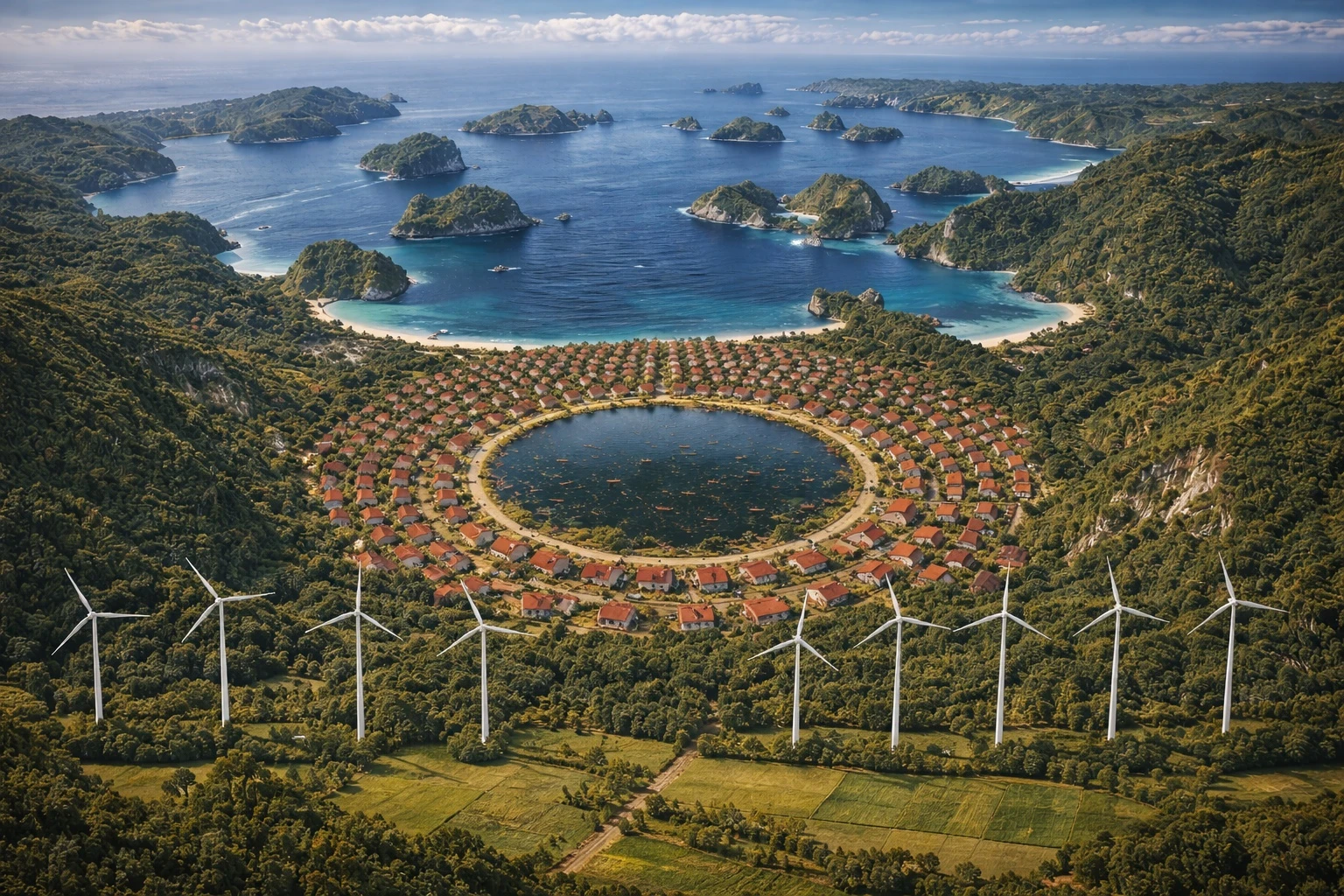

One fine morning, as the sun slowly rose from behind the mountains, Omnia came alive.
The sun did not hurry. It appeared gently, slipping out from between the dark silhouettes of the hills. Its first rays travelled quietly, touching the town evenly. They fell on every house alike. The red clay tiles on the rooftops caught the light and began to glow, each roof reflecting the same warmth, the same shine—no house brighter than the other.
Those same rays reached “Jeeva Kunta”, the pond at the centre of Omnia. The surface of the water shimmered softly. Ducks moved calmly from one end to the other, their paddling creating small ripples that spread and disappeared without disturbance.
Beneath them, colourful fish stirred awake. One by one, then many together, they leapt out of the water as if stretching their bodies after sleep. Water clung briefly to their scales before slipping away, obeying gravity—an unchanging rule that worked here just as it did everywhere else. As the fish fell back into Jeeva Kunta, droplets scattered into the air. Sunlight struck those falling drops, turning them into tiny mirrors. Reflections flashed for a moment, then vanished.
This happened every day.
For the reader, it may have been 5:30 in the morning, but the people of Omnia did not know such numbers. They did not measure time. They only knew this:
When the sun rose from behind the mountains, it was day.
When the moon appeared, it was night.
When darkness came without the moon, they did not know what to call it.
On such nights, people stayed indoors.
This knowledge was not written anywhere. It was passed gently from elders to children, from one voice to another. In Omnia, learning did not happen in buildings. It happened in living.
There were no families here—at least not in the way the outside world understood them. The entire town was one family. Generations did not belong to houses; they belonged to Omnia itself.
Hens announced the morning before any human voice could. Their calls echoed through the narrow paths between homes, moving from courtyard to courtyard. Adults rose easily. Children resisted, turning lazily beneath thin sheets, bargaining silently for a few moments more of rest.
In Omnia, toothbrushes did not exist. Men and women stepped outside holding neem sticks, snapping their tips before brushing slowly. The bitterness was familiar. Nearby, women swept the ground around their homes using brooms made from dried coconut leaves. Dust gathered neatly. Fallen leaves were cleared. Some children were already awake. Laughter rose from one corner of the street. A boy named Raghav dragged a long coconut leaf across the soil. Three other children sat on it, gripping tightly as he pulled them forward. The leaf scraped against the ground, jumping over small stones. The children laughed without restraint, their joy spilling freely into the morning air. Their faces glowed—not because of medicine or supplements—but because they lived outdoors. Their bodies already carried what others searched for. In Omnia, a pure and honest smile was considered enough for good health.
Let us step inside one house.
Jhansi had just returned from the garden. In her basket were carrots, beetroots, radish, sweet potatoes, and a few cucumbers. She washed the vegetables carefully, her hands still carrying traces of soil. She cut them into pieces and placed them into a mud stove, using a well-used mud vessel, No oil. No packaged food. Only patience. The vegetables boiled slowly. Her husband, Ravi, sat nearby, eating slices of sweet potato and carrot. He picked up a cucumber and bit into it. “Where are the children?” he asked. “Raghav is outside,” Jhansi replied. “Playing with the neighbour’s kids. Coconut leaves.” Ravi nodded. That was enough. In Omnia, one rule was never questioned:
no two people shared the same name. Names were not repeated. Identity mattered. Ravi gathered his farming tools and stepped outside. He called out to his neighbour Somesh, who joined him without hesitation. As they walked, they called Kiran and Vignesh. Soon, they were together, moving toward the fields. This was Ravi’s routine.
And it was the same for almost everyone in Omnia.
The days did not surprise them. The sameness did not bore them.
They walked—no vehicles, no noise—just footsteps pressing into soil that recognised them. Behind them, Omnia continued its morning.
Children laughed.
Fish leapt.
Ducks drifted across Jeeva Kunta.
The sun climbed higher. And life flowed—quietly, equally, and whole.
Ravi, Somesh, Kiran, and Vignesh walked together toward the fields. The soil was still cool beneath their feet. Dew clung to the edges of grass, brushing against their ankles as they moved. For a while, they walked in silence. That too was normal here. Then Somesh spoke.
“Raghav looks taller every few days,” he said, smiling. Yesterday he was pulling coconut leaves. Today he’ll start pulling people. Ravi laughed softly. He already does. Jhansi says he doesn’t walk anymore. He runs everywhere, like the ground is chasing him. “Children grow fast here,” Vignesh added. “Too fast sometimes. Feels like yesterday they were learning to sit.” Kiran nodded. “They grow because they’re never afraid. No fear eats them from inside.” They walked a few more steps. Did you check “Annam Kendram” yesterday? Ravi asked.
“Yes,” Somesh replied. “Plenty of sweet potatoes left. Greens are enough for two days. Radish needs harvesting again.” Kiran stretched his arms. “Good. Today we should send more spinach. Yesterday I saw only half the baskets filled.” Vignesh smiled. “You worry like it’s your own house.” Kiran shrugged. “It is. It’s everyone’s house.” They all nodded. That was obvious.
In Omnia, when the harvest was ready, everything went to Annam Kendram. Vegetables. Grains. Medicines made from roots and leaves. Mats to sleep on. Brooms. Clothes stitched by hand. Even simple tools. Nothing was stored at home beyond daily need. People walked in. Took what they needed. Walked out. No counting…. No watching…. No judging.
If one woman took an extra potato, another never noticed. Even if she did, the thought never formed—why more for her, less for me? That thought had no soil to grow in here.
“We should plan the next crop,” Ravi said. “If we keep the same pattern, Annam Kendram will stay full.” “It always does,” Somesh replied. “Even when crops fail a little, no one takes more.” Vignesh grinned. Except you. You eat like two people. Ravi laughed. Only because I work like three. They walked a little farther. Kiran slowed down slightly. Somesh noticed. Thinking of Afreen again?
Kiran smiled, not denying it. She was at Jeeva Kunta yesterday evening. Teaching the younger ones how to float. “Good heart.”
Vignesh teased, “So when are you both becoming one house?” Kiran looked confused for a second. When she feels ready. Somesh chuckled. You speak like an elder already. “In Omnia,” Kiran said calmly, “love decides. Not age. Not people.” Ravi nodded. That’s how it’s always been. Vignesh laughed, you should stop smiling at the ground like this. We can see it. Kiran shook his head. Better the ground than her eyes. I’ll forget where I’m walking. They all laughed. Ahead of them, the fields opened wide—green, waiting, familiar. This will be the same tomorrow, Somesh said, almost to himself. Yes, Ravi replied. And the day after. None of them sounded bored. They sounded content. They walked on— toward the farm, toward work, toward another day that didn’t need to be different to be meaningful. While the men disappeared into the fields, Omnia continued in its own rhythm. Afreen stood near Jeeva Kunta, calm and steady. Children gathered around her without being called. She did not command them—she attracted them. There was maturity in the way she listened, and a quiet warmth in the way she spoke. Her beauty was not loud; it rested in her presence. Every morning, Afreen gathered twenty-five children. Today was no different. They moved through the town together. At each home, children learned how to tend small gardens—loosening soil, plucking vegetables only when ready, never pulling in haste. Carrots, gourds, tomatoes, Kelp & Kombu, Nori, Dulse, Arame this are marine condition vegetables —just enough for the day. What they gathered was carried back to Annam. From there, they moved to flower patches. Turtle Grass, Shoal Grass, Eelgrass wild blooms. The children plucked them gently, tied small bundles, and began their rounds. There were six hundred houses in Omnia.
Nearly five thousand people.
Afreen’s group served one hundred houses. Other groups did the same elsewhere. By the time the sun climbed higher, flowers had reached every doorstep. No house received more. No house received less. Inside the homes, women worked steadily. Some wove cloth on handmade looms—curtains, bedsheets, dresses, and doormats. Others braided coconut fibres into brooms and floor mats for sleeping. Everything used in Omnia was made here, by hand, by people who knew the value of patience. Children moved through these tasks daily: one day weaving, one day farming, one day cooking, cleaning, or building. This was their school. Near Annam, elders worked quietly. They prepared dry-pressed architectural bricks called B2 bricks, designed to withstand salt corrosion; with these bricks, they built almost everything in Omnia. One old man shaped mud pots, his fingers pressing gently into wet clay, forming curves that had not changed for generations. Nearby, another heated iron, hammering it into simple farm tools—handles, hooks, blades. Nothing was rushed. Nothing was wasted. Whenever a newborn ritual took place at the beach, anything useful that had washed ashore was carried back to the village and repurposed.
The children waited.
When the floor was clean, the elder sat with them. Paper folded. String tied. The kite took shape. Soon, it rose into the sky, catching the wind easily. The children lay flat on the ground, watching. The kite climbed higher higher still.
The string grew thin against the sky. The kite steadied, then tilted, then—
Everything turned white: clouds all around, heavy winds.
For a moment, it no longer looked like a kite.
Its shape sharpened.
Its movement changed.
The sound of wind deepened.
The kite dissolved into sky.
A huge object broke through the clouds: a plane.
It felt as if the kite had turned into the aircraft itself.
Inside, a man in a well-tailored suit sat by the window. His posture was straight. His shoes polished. A leather briefcase rested neatly beneath his seat.
He unfolded a newspaper.
Chapter 2 — EMERGE(EON)
THE TIMES OF INDIA…….
Stock markets climbed and crashed in bold numbers. Political debates sprawled across columns. Scams involving businessmen. Corporate mergers. Sports results. Celebrity affairs. Faces smiled confidently beside headlines that would be forgotten by the next morning. He skimmed. He nodded. He turned the page. Outside the window, clouds passed like unfinished thoughts. A flight attendant approached. She was well dressed. A crisp white shirt tucked perfectly into a red skirt. Every movement precise. Practiced. Controlled. She stopped beside him and smiled. “Food, sir?” she asked.
“Gandhi” looked up. “Yes, please,” he said. “Vegetarian. Rice, if you have it. Avocado juice would be good. And… a small cake, if possible.”
“Certainly,” she replied, nodding once before moving down the aisle. Gandhi leaned back in his seat. Behind him, two elderly passengers sat close together, their voices low, meant only for each other—but close enough to be heard. “Our son is in New York now,” the woman said quietly. “Ten years already.” Her husband nodded. “He keeps saying we should visit. But flights are long. And hospitals here know us.” She sighed. “Last month, when I was unwell… he called every day. But calling is not the same as being there.” The man stared ahead. “We gave him freedom. Education. Choice.” After a pause, he added, “Sometimes I wonder what it cost us.” The woman didn’t answer. She simply held his hand. The conversation faded—not because it ended, but because silence felt heavier. A few rows back, in economy class, the mood was different. Chitra and Alex leaned toward each other, excitement spilling out between words. “Can you believe it’s been five years?” Chitra said. “Five years since college.” Alex laughed softly. “And now New York. New jobs. New life.”
“Automation developers,” she said, smiling proudly. “Who would’ve thought?”
“And after that,” Alex said, lowering his voice playfully, “marriage.”
Chitra rolled her eyes but smiled. “One thing at a time.” They checked their documents again. Passports. Visas. Offer letters. Everything was in place. Their future felt mapped, scheduled, achievable.
Across the aisle, a man stared at his phone, scrolling endlessly. Another passenger slept with earphones plugged in. A woman typed rapidly on her laptop, her face tense, jaw tight. A group of young girls near the emergency exit were nervous about an upcoming chess competition in New York.
In the aisle, Sonia and Lalita lowered their voices. Sonia, the flight attendant who had offered Gandhi food, spoke first. “This job drains you,” she said softly. “The smiling. The pretending. Even when you’re exhausted.”
Lalita nodded. “And the fear. Every turbulence reminds me of that Air India crash in Ahmedabad. I try not to think about it.”
They paused as a service trolley rolled past. At the far end of the aircraft, beyond the last row of seats, the washroom door remained locked longer than usual. Inside, the space was tight, barely enough for two people to stand comfortably. Emiliya pressed her forehead lightly against the cool wall, her breath uneven. Robin stood close—too close for strangers, close enough for promises whispered without words. They had stolen this moment—not out of passion alone, but out of loneliness. Long flights. Long distances. Lives lived between schedules. Robin lifted her gently, not rushing, as if the world outside had briefly paused. Emiliya laughed quietly, covering her mouth, her heartbeat loud in her ears. Their closeness was urgent but fragile, balanced between desire and fear of being discovered. For a while they enjoyed the pleasure it’s due the closed cabin and created closeness and the position possible there.
For a few seconds, they forgot where they were.
Then—
A child’s cry pierced through the cabin.
Sharp. Sudden. Unavoidable.
Emiliya froze.
The sound cut through the moment like cold air. Robin lowered her immediately. They stood still, breathing, reality rushing back in. From outside, footsteps passed. A mother whispered urgently. The cry softened, then rose again. Emiliya adjusted her clothes, her hands slightly trembling—not from shame, but from the reminder of life continuing around them. Robin unlocked the door. They exchanged a look—no words, just an understanding that this moment would stay unfinished. They stepped back into the aisle separately with their heads down and took seats. The plane moved on. Sonia glanced toward the sound of the child and sighed. “That cry… it stays with you.” Lalita nodded. “Some sounds do that.” Across the cabin, Gandhi unfolded his newspaper again, unaware of the small stories unfolding behind him. Outside the window, clouds drifted endlessly. Inside, lives overlapped—
love, desire, regret, responsibility— all moving forward, whether ready or not.
Far below, somewhere untouched by engines and schedules, Omnia followed the sun. So many lives were unfolding inside that plane at the same time.
From business class to economy, from silent regrets to loud dreams, stories were colliding every second. If this much could happen inside one flying machine, one could only imagine how many stories were being lived, lost, and remembered across the world in just a single minute.
Gandhi wiped his fingers with the napkin and pushed the tray forward. Sonia appeared almost instantly, lifting the plate with the same polite smile she had worn all day.
“Thank you, sir.”
Gandhi nodded. He checked his phone.
2:30 PM. He slipped the eye mask on, adjusted his seat, and leaned back. The hum of the engines became softer, rounder, almost comforting. Conversations dissolved into distant murmurs. The world dimmed.
Everything went dark. Then— Movement.
The darkness softened into grey. Grey into white.
Clouds.
But something felt wrong. The sound was no longer an engine. It was wind.
Clouds filled everything. The kite whipped violently in the wind. Far below, back in the fields—
Ravi and his friends paused their work. Not a break, just hunger.
They washed their hands at a small stream nearby, splashing water over their faces and laughing as droplets ran down their necks. Nearby, a cluster of mud pots hung from a tree branch, tied together with rope and swaying gently in the breeze. Inside were boiled potatoes, sweet corn, beetroot, boiled groundnuts, and a small pot of ragi java that Afreen had brought fresh before lunch, still warm when hunger arrived. Ravi asked her to eat with them. She stayed.
Somesh: Why do we always feel hungry the moment we sit down?
Ravi: Because hunger respects seating arrangements.
Vignesh: Then next time let’s stand and see if it leaves.
Kiran: If that worked, Ravi would never sit.
Ravi: I sit for food. I stand for farming. Balance.
Afreen: You call that balance? You ate my share too.
Ravi: I was protecting it from getting cold.
Somesh: Very brave of you. Such sacrifice.
Vignesh: Someone write his story. The Man Who Saved Food.
Ravi: Only if food agrees.
Afreen passed food quietly. Someone cracked a joke. Someone laughed too loudly. Kiran looked at Afreen for a second longer than needed.
Then—
A shout.
“Anna! The kite!”
Ravi looked up.
Far from field near to omnia Raghav stood holding the kite string. The kite was already high—higher than usual. Children crowded around him, shouting, pulling, laughing.
“Let me hold!”
“No, my turn!”
“Pull harder!”
The kite surged upward, catching a strong current.
Higher.
Higher than it had ever flown.
The string stretched thin, vibrating.
“Careful!” an elder shouted from a distance.
Too late.
Another child tugged suddenly. The rope snapped. For a moment, the kite didn’t fall. It rose. As if freed.
It spun once, climbed higher—almost touching the sun—then began to shake violently, torn between wind and gravity.
Raghav froze.
His eyes filled.
“It broke…” he whispered.
In the fields, Ravi’s chest tightened.
For a moment, everyone in the field fell silent over lunch.
It caught speed suddenly, the wind pressing hard against its paper skin. The sound of air tearing past it grew sharper, faster, impatient. The kite shook, struggling to keep its shape, stretching beyond what it was ever meant to endure. Suddenly, everyone in the cabin screamed as violent turbulence struck.
A sudden jerk threw bodies forward, then back again. Trays rattled, seatbelts pulled tight against waists, overhead bins shuddered. Voices rose together — sharp, unplanned, afraid. The kite spun wildly now. One corner bent inward. The paper fluttered violently, the edges trembling as if they already knew what was coming. A small tear appeared, barely visible, but enough to change everything. Cabin crew moved quickly through the aisle.
“Please remain seated.”
“Fasten your seatbelts.”
“Stay calm.”
Their voices were steady, trained — but urgency leaked through the spaces between words.
The kite dropped faster.
The tear widened, ripping further as the wind forced its way through. What once moved smoothly now fought against itself, losing balance, losing direction, losing dignity.
The plane shook again.
A deeper jolt this time. Luggage slid. Someone cried out. A child screamed without understanding why. Hands reached for armrests, for strangers, for anything solid.
In the cockpit, warning lights blinked.
The pilot leaned forward, fingers tightening around the controls, voice cutting sharply through the radio.
“Mayday. Mayday.”
Static answered, then voices overlapping, instructions fast and clipped, words meant to hold something together.
The kite tumbled now.
No control left. Just falling — faster, harder — the sky no longer supporting it.
In the cabin, panic peaked.
The pilot leaned forward, fingers tightening around the controls, voice cutting sharply through the radio.
“Mayday. Mayday.”
Static answered. Then overlapping voices. Instructions came fast, clipped, urgent — words trying desperately to hold something together that was already slipping. Below the open sky, the kite tumbled.
It had lost all control now, spinning faster as gravity claimed it. The torn paper fluttered violently, making a dry cracking sound as it twisted through the air. Children ran beneath it, shouting, throwing small stones upward, trying to knock it down before the wind could carry it farther. Each stone missed at first. The kite kept drifting, caught stubbornly in the branches of a tall tree.
Inside the cockpit, alarms continued flashing. The pilot adjusted thrust. Pulled back. Corrected angle. Tried again. The aircraft did not respond the way it should. Something was resisting. Something was wrong. The kite struggled in the tree branches, half-torn, stuck between sky and earth. Raghav picked up a slightly larger stone this time and threw it with both hands. It struck the frame. The paper ripped wider. One more throw from another child, and the fragile structure gave way.
The kite dropped.
In the plane, the nose dipped sharply.
Passengers felt the sudden change — not turbulence now, but direction. The aircraft was no longer gliding forward. It was descending faster than comfort allowed. The pilot tried once more to stabilize, pushing every trained instinct into the controls. The plane resisted, drifting off its path, choosing its own line through the sky. The cabin tilted.
Overhead bins rattled violently. Oxygen masks fell. People grabbed hands — strangers holding strangers. A prayer rose from somewhere near the middle rows. Another voice whispered the name of a child. Some closed their eyes. Some stared forward, refusing to blink. Gravity took over. ATC ground staff understood that plane lost its direction and moving some random direction The plane dropped harder now, the engines roaring against inevitability. It tilted further — almost upside down overhead compartments burst open, sending bags and loose equipment crashing into passengers, leaving blood across frightened faces — and the world inside the cabin became disoriented, loose objects lifting, bodies straining against belts, the air thick with fear and disbelief. People wanted to believe it was a nightmare. Unfortunately, it was happening. Ground control lost contact. Signals flickered, then vanished. Screens showed nothing but blinking uncertainty. Controllers called again and again. No answer came back. Below, the ocean stretched wide and indifferent.
The aircraft struck the ocean with a force that silenced everything. Metal met depth. Sound collapsed inward. Motion ended. And in that instant — before thought, before memory — everything turned blank and black.
Far above, beyond cloud and atmosphere, something shifted in the silent vastness of space. Debris, asteroids, fragments of metal, particles drifting in slow arcs — for a brief, unexplainable moment — aligned in a peculiar formation. A shape emerging without intention. Without instruction.
It resembled Nysa.
After the birth of galaxies, after the shaping of stars, after ages of formation — something new had appeared. A rare alignment. A pattern that had never been seen before in that arrangement.
No one on Earth saw it.
No one understood it.
But it happened.
And it lingered — suspended in the quiet, like a message waiting to be read.
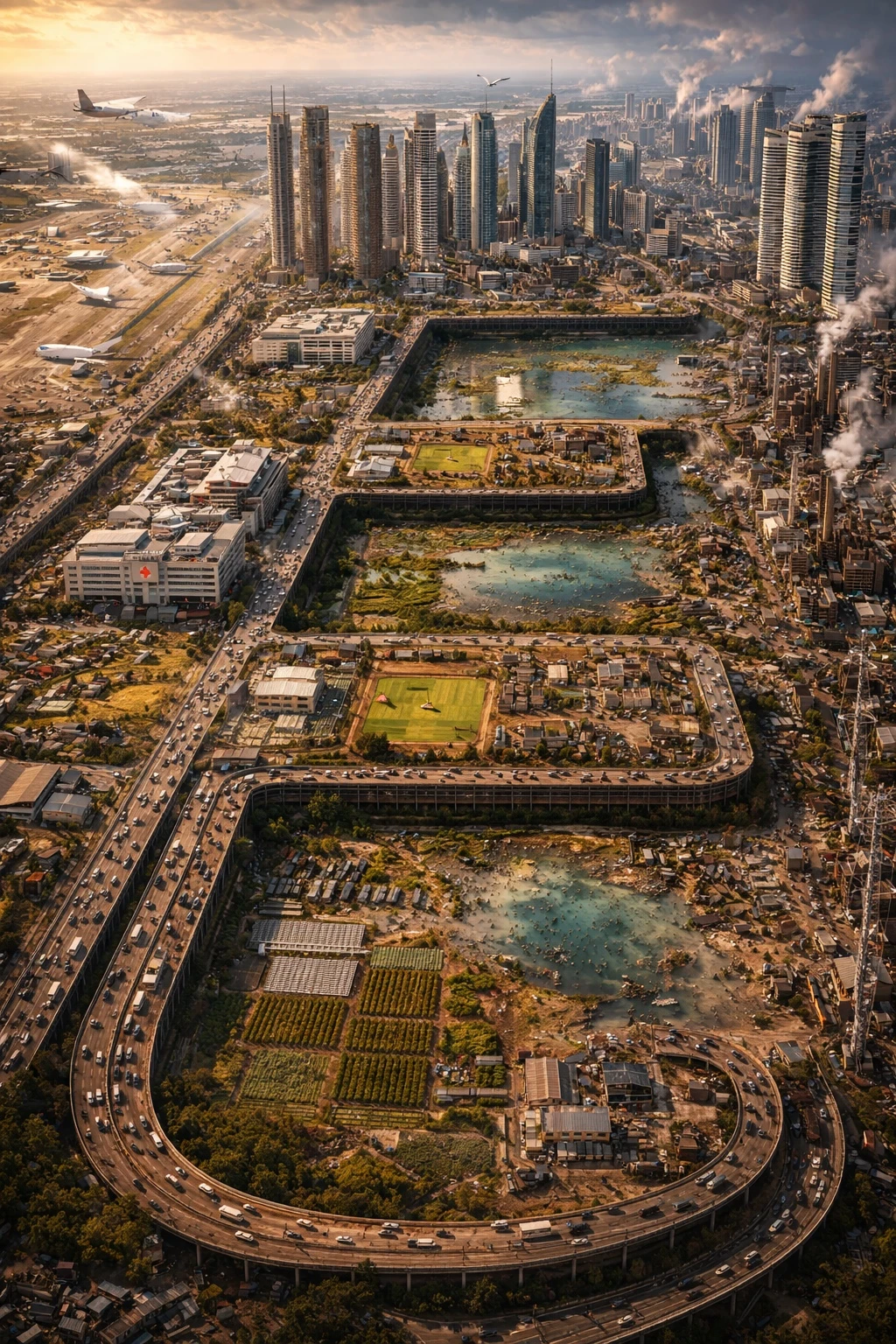
After that strange alignment in space—metal, dust, and distant fragments forming a brief, unexplainable pattern—life on Earth did not pause to notice. In Eon City, time did what it always did: it moved forward without waiting for meaning.
At Kelvin Eon International Airport, the ground operations room was no longer calm. Screens that had been filled with moving dots and steady flight paths now showed a blinking absence. Boeing 307 had vanished from the radar grid. Controllers leaned toward their monitors, fingers moving rapidly across keyboards. Calls were made. Signals were traced. Coordinates recalculated. Nothing stayed stable long enough to confirm a location.
“Try the last recorded vector.”
“It’s not holding.”
“Send two jets toward the previous altitude range.”
Jets were dispatched, cutting through cloud layers in widening arcs, searching for something that no longer answered back. The aircraft had drifted off its expected path, and without transponder response, the sky felt suddenly enormous and directionless.
While panic quietly spread through airport control rooms, in another part of the city, life moved in domestic rhythm.
At No. 18, Crescent Heights, Maple Avenue, Eon City, Helen unlocked the front door with one hand while balancing grocery bags in the other. She placed them on the kitchen counter and exhaled softly. Fresh vegetables rolled gently across the surface. A neatly wrapped pack of fish rested at the edge. She had stopped by the nearby 7-Eleven on her way home—Gandhi liked fresh fish on weekends, and though today was not a weekend, she wanted to surprise him.
It was a love marriage. They had chosen each other, not because of convenience or arrangement, but because of certainty. She still remembered how stubborn he had been when convincing both families. She smiled faintly at the memory as she rinsed the fish under hot water. She arranged vegetables inside the refrigerator with care. Washed coriander. Cut lemon. Set rice aside for later. Everything was measured. Everything was planned. The city outside continued humming—traffic, elevators, distant construction.
At Kelvin Eon Airport, voices grew sharper.
“We’ve lost primary and secondary radar.”
“Satellite relay?”
“Intermittent. Then nothing.”
A supervisor pressed his palm against his forehead. No confirmed crash. No confirmed landing. Only absence.
Helen finished in the kitchen and stepped into the bathroom for a shower. Steam filled the small space. Hot water ran down her shoulders, easing the tiredness of the day. She had no idea that somewhere far from her, water had already swallowed something else. She changed into comfortable clothes and walked into the hall. The apartment was quiet. She picked up the remote and switched on the television. The familiar theme music of Friends lingered in her mind—she had paused at episode four and planned to continue while waiting for Gandhi’s return. Before selecting it, she began flipping through channels absentmindedly. News. Sports highlights. A cooking show. Advertisements.
Then she paused.
A red banner scrolled across the bottom of the screen.
“BREAKING NEWS: BOEING 307 MISSING AFTER LOSING CONTACT OVER INTERNATIONAL WATERS.”
The words didn’t register immediately. She watched casually at first. A news anchor spoke with controlled urgency. Airport visuals appeared. A blurred image of an aircraft. A timeline of departure. Something in her body stiffened.
She leaned forward slightly.
Flight number. Departure time. Destination.
Her heartbeat skipped. She swallowed.
The anchor repeated the details.
Gandhi’s flight.
Her fingers tightened around the remote. The plastic felt slippery. For a moment, she couldn’t process the information as something personal. It felt like any other breaking news—tragic, distant, unrelated. Then her mind began connecting pieces one by one. Departure city. Time of take-off. Business class manifest pending confirmation. Her breathing changed. “No…” she whispered, though no one was there to hear it. Her heart seemed to pause mid-beat. The room felt suddenly smaller, the air heavier. She tried to blink but forgot how. Her hands began to tremble. The remote slipped slightly from her grip and hit the couch cushion. Sweat formed at her temples and slid slowly down her forehead. Her mouth dried instantly. She reached for her phone with shaking fingers, but her hands would not steady enough to unlock it. On the screen, the news shifted to footage from Kelvin Eon Airport—officials moving quickly, reporters gathering, microphones rising. Helen’s eyes remained fixed on the television. Her husband was supposed to land in a few hours. And for the first time since she switched on the TV, she understood. Something was terribly wrong. Her chest tightened. She could hear her own heartbeat louder than the news anchor’s voice. And fear—raw, unfamiliar, unstoppable—rose to the surface. In Eon City, the same news entered hundreds of homes at the same time. But it did not enter all hearts equally. Just across the street from Crescent Heights, in a modest apartment on Willow Lane, Jackson, his wife Mubeena, and their son Joseph were sitting in front of the television. The red banner appeared again.
BREAKING NEWS: BOEING 307 MISSING AFTER LOSING CONTACT.
Jackson looked up briefly while taking a sip of soda.
“Plane missing,” he muttered.
Mubeena glanced at the screen. “Where?”
“International waters, it says.”
Joseph asked, “Will it crash?”
“Don’t know,” Jackson replied, already reaching for the remote. “These news channels exaggerate everything.” Within thirty seconds, the channel changed.
Cartoons.
Then sports.
Then a music channel.
“It doesn’t concern us,” Jackson said casually. “Let’s go out. I’m not cooking tonight.” Joseph’s face lit up. “Burger?” “Burger,” Jackson confirmed. Mubeena grabbed her jacket. Life continued. Outside, the air had turned cooler. The sky glowed orange as the sun began to sink behind Eon City’s tall glass buildings. Then something softer happened—almost unnoticed at first.
Tiny flakes drifted down.
The first snow of the season.
People paused. Faces tilted upward. Phones came out instantly. Laughter rose in the streets. The first fall was always special here. It meant new beginnings, photographs, warm drinks, crowded cafés. Food trucks lined the sidewalks. Steam rose from grills. The smell of fried chicken, loaded fries, sugary waffles, and hot chocolate filled the evening air. Couples walked hand in hand. Children ran across pavements trying to catch snowflakes on their tongues. Street musicians played louder than usual. Jackson’s family joined the crowd, blending into the moving warmth of the city. Joseph tugged at his father’s sleeve, pointing at a truck selling extra-cheese burgers. Mubeena smiled, brushing snow from her coat. In this part of Eon City, the night felt festive. The missing plane was just another headline. But only a few blocks away, inside No. 18 Crescent Heights, Maple Avenue, the television light flickered across Helen’s frozen face. Her world had narrowed to a single line of text on a screen. Phones were ringing across the city—some with answers, some with silence. At Kelvin Eon Airport, families gathered behind barriers, eyes red, hands clasped together. Officials spoke carefully. Words like “search operation,” “no confirmation,” and “ongoing investigation” floated in the air without comfort. For most of Eon City, the evening was beautiful. For some families, it was the beginning of something they would never fully recover from. Snow continued to fall gently. The streets remained alive. The food trucks stayed open. Music played. And somewhere between celebration and fear, Eon City revealed its truth: Life does not stop for tragedy.
It only divides itself — into those who are touched by it, and those who are not.
Helen stared at the television as if staring longer would change the words.
Her hands trembled, but her mind refused to move.
“No… no… no…” she whispered, though nothing in the room responded.
She grabbed her phone.
Her fingers would not unlock it at first. She wiped her hands against her clothes, tried again. Gandhi’s name appeared on the screen. She pressed call.
Ringing……
Once.
Twice.
Three times.
Then silence.
She ended the call and tried again immediately, as if speed could force connection. This time, the call didn’t even ring. She stared at the phone as if it had betrayed her. Her breathing became shallow. She felt lightheaded. The room seemed farther away than it had been a minute ago. She dialled again.
Voicemail. Her lips trembled. “Pick up… pick up…”
She opened their message thread. The last text from him read: Landing in a few hours. Don’t wait for dinner.
Her chest tightened painfully.
She stood up suddenly, then sat back down just as quickly. She didn’t know what she was supposed to do. There is no training for this moment. No instruction manual for how to respond when the person you love might have disappeared between sky and water. She dialled his mother. The phone rang.
When the call connected, Helen couldn’t speak at first. Only air came out.
“Helen? What happened?”
“There’s… there’s news… the plane…” Her voice broke. On the other end, confusion turned to fear. Questions poured in. Helen had no answers to give.
She ended the call and dialled emergency services. “Yes, hello,” she said, trying to steady her voice. “My husband was on Boeing 307. The news says it’s missing. I need information.” The voice on the other end was calm, distant, procedural. “Ma’am, please contact Kelvin Eon Airport for official updates. We do not have confirmed details at this time.” Confirmed details.
The phrase felt cruel.
She hung up and tried the airline number. The line was busy. She tried again. Busy. Her hands shook uncontrollably now. Her heart pounded so hard she could hear it in her ears. Sweat gathered on her neck. She couldn’t feel her feet touching the floor. She walked to the door without fully deciding to. Grabbed her coat. Didn’t remember putting on shoes.
She needed to move.
At Kelvin Eon International Airport, families were already arriving. Some came in taxis. Some drove recklessly. Some ran inside without thinking about parking. The departure hall felt different now. No announcements of boarding. No cheerful welcomes. Just clusters of people standing together, faces pale, eyes fixed on airport staff who seemed suddenly small and overwhelmed. A young woman held a photograph in her hand. An older man kept repeating the flight number under his breath. A child asked why everyone looked scared. Officials tried to maintain order.
“Please wait here.”
“We will update you.”
“Search operations are underway.”
The words did not land anywhere.
One mother began crying openly, her body shaking as if something inside her had collapsed. Her son tried to hold her upright. Another family stood silent, not crying, not speaking — shock frozen into their faces. The large display board still showed: Boeing 307 — Delayed. The word felt almost insulting.
Helen arrived breathless, scanning faces desperately as if Gandhi might be standing somewhere among them, embarrassed for causing unnecessary panic.
But he wasn’t. She approached the information desk. “My husband… Gandhi… he was on that flight…” Her voice cracked again. The staff member behind the desk maintained a professional expression that barely masked exhaustion. “Ma’am, please stay in the designated waiting area. We are awaiting further confirmation.” Waiting area. The phrase echoed emptily. Helen walked toward the crowd of families and stood among them. Strangers, bound together by uncertainty. Phones rang and went unanswered. News vans began parking outside. Cameras were being set up. The story was growing. Inside Helen’s chest, something fragile had already broken. She didn’t cry yet. She just stood there — completely blank — because sometimes grief doesn’t arrive as tears. Sometimes it arrives as silence. And the night in Eon City continued outside — snow falling softly — unaware that for some people, time had stopped completely. On Park Street in Eon City, the night had just begun. Friday lights reflected off glass towers, neon signs flickered alive, and music spilled out from rooftop bars. Corporate employees walked out in groups, loosening ties, laughing louder than usual. The week was over. The city felt electric.
At James Signal, traffic halted in all four directions. When the pedestrian light turned green, nearly three thousand people crossed at once—suits, backpacks, delivery workers, street performers, tourists. It was one of Eon’s iconic intersections, a place where movement defined identity.
Three signals ahead stood Wall Street Junction, the financial heart of the city. Massive digital screens covered entire building facades, displaying stock prices, currency exchanges, and breaking news. Around five thousand people passed through every hour. Tonight, many of them stopped. The screens had changed.
Instead of market numbers, a red banner dominated the display:
BOEING 307 — MISSING.
A photograph of the aircraft appeared. Below it, scrolling updates. Faces in the crowd lifted upward. Conversations slowed. Phones came out. Some people recorded. Some read silently. A second headline followed.
CONFIRMED: SENIOR TRADE OFFICIAL AMONG PASSENGERS.
The name flashed briefly.
Gandhi.
Whispers moved through the crowd.
“Wasn’t he handling the international trade negotiations?”
“Government level?”
“This is serious.”
The missing flight was no longer just a tragedy. It was political. It was economic. It was strategic.
On another giant screen beside it, a live press conference began. A panel of Eon City scientists stood behind a podium. The lead researcher spoke carefully, choosing each word.
“In the last few hours,” he said, “we have detected unusual atmospheric and orbital disturbances. We are still analysing the data.” The crowd shifted uneasily. “We advise citizens to remain indoors for the next 48 hours until we gain clarity on the situation. At this moment, we cannot confirm whether these anomalies pose a direct threat.”
The words “unusual” and “anomalies” echoed louder than the explanation.
Some laughed nervously. Some rolled their eyes. Others grew quiet. Above them, the sky looked ordinary. But tension spread faster than evidence.
Phones began buzzing simultaneously. Alerts pushed through notification systems. News channels split screens between the missing aircraft and the scientific advisory. In the financial district, traders stood frozen beneath the glowing screens. The market numbers flickered uncertainly. International trade futures began to fluctuate in real time. On Park Street, music continued playing from a distant bar — but softer now. The city had not stopped. But it had paused. And somewhere beneath the lights, beneath the traffic signals and the towering glass, Eon City felt something unfamiliar — Not panic. Not yet.
But awareness.
Something had shifted.
On the uppermost level of the Orion Crown Tower, overlooking Park Street’s endless lights, stood one of Eon City’s most restricted establishments — The Apex Room. Access required pre-approved booking, biometric identity verification, and clearance through a discreet security checkpoint at the private elevator lobby. No names were announced. No cameras were allowed inside.
The rooftop opened into a space of calculated indulgence. Polished marble floors reflected dim amber lighting. A glass wall ran along the edge, giving a panoramic view of the glowing city below. Inside, servers moved between tables in minimal attire, their smiles rehearsed, their movements choreographed. Music pulsed low and heavy — not loud enough to disturb conversation, but strong enough to keep the atmosphere charged.
Near the centre of the room, a circular platform rotated slowly. A dancer moved around a chrome pole, her silhouette lit by shifting red and violet lights. From the street below, passersby could see a large illuminated display box attached to the building’s exterior — a young woman performing inside it, bathed in red neon, visible like a living advertisement of indulgence.
At the far end of the bar, private booths were separated by tinted partitions. Some guests leaned too close to each other, conversations dissolving into physical proximity. Others exchanged small packets beneath tables, quiet transactions disappearing into coat pockets. Laughter rose in bursts — sharp, excessive, untethered. Money moved quickly here. So did attention.
The air was heavy — not just with perfume and liquor — but with recklessness.
In some corners, lines of white powder disappeared from glass tables. Laughter grew louder, more unsteady. Eyes lost focus. Conversations dissolved into touch. Boundaries blurred.
A couple leaned across a velvet couch, locked in a kiss that was less about affection and more about urgency. Another pair disappeared behind a tinted partition, the curtain barely closing before shadows began to move behind it. He is banging the girl lifting her up he did in same position and changed to doggy but no one is bothering. Money slid discreetly across tables; attention followed instantly.
Yet in a darker corner of the rooftop, away from the music and the stage, two men sat across from each other with untouched glasses between them.
Grander adjusted his cufflinks while staring at his phone screen. Moulali Kane leaned forward, elbows on the table, jaw tight. The news notifications continued to refresh.
“Boeing 307 still missing.”
“Senior trade official confirmed onboard.”
“Scientists warn of unusual atmospheric anomaly.”
Grander spoke first, his voice low enough to be swallowed by the bassline.
“I just received internal clearance to review files from Area 17.” Moulali’s eyes lifted slowly. “You’re serious?” “I wouldn’t say it otherwise.” The dancer spun behind them. Applause erupted briefly. Neither man looked. “Area 17,” Moulali repeated quietly. “That research wing was supposed to be theoretical.” Grander shook his head slightly. “Not theoretical. Classified.” The screens above the bar switched momentarily from market data to the scientist’s press conference replay. The words orbital disturbance flashed again. Moulali leaned closer. “Do you think it’s connected?” Grander didn’t answer immediately. He stared at the skyline — at the same sky that looked calm above Eon City. “I saw preliminary reports,” he said finally. “There was an unidentified pattern in upper orbit. Not debris. Not satellite malfunction.” “Then what?” Grander’s voice lowered further. “They don’t know.” Moulali exhaled slowly. “And you think whatever they were testing at Area 17… triggered something?” Grander looked at him carefully. “Or something responded.”
An hour later, beneath the eastern edge of Eon City, the two men stood behind three layers of reinforced glass in Area 17. The room was colder than the winter outside. There were no windows, no clocks, and no networked devices. At the centre of the laboratory, inside a vacuum-sealed chamber, rested a black-silver fragment no larger than a human fist. A faded metal plate beneath it carried a designation that had survived for nearly a century: NYSA-01.
The fragment had been recovered from the original polar expedition before the research team disappeared. For decades, official files had described it as an unidentified mineral sample with no practical value. The classified record told a different story. Nysa was unusually dense, almost completely resistant to corrosion, and capable of holding an electrical charge far longer than any known natural material. More disturbing was the fact that its behaviour changed whenever living tissue was brought near it.
A scientist in a sealed suit placed two glass dishes inside the chamber. One contained ordinary saline water. The other held a culture of damaged human cells. “Baseline first,” she said. Sensors began recording temperature, magnetism, radiation, conductivity, and cellular activity. Nothing moved. The numbers remained flat. Then she activated a low-frequency electromagnetic pulse matching the strange orbital signal detected earlier that evening.
The effect was immediate. A faint blue line appeared inside the metallic veins of Nysa. The saline in the first dish began to tremble even though the chamber itself was perfectly still. On the second monitor, the damaged cells showed a sudden rise in metabolic activity. Not uncontrolled growth. Repair. Tiny ruptures in the cell membranes began closing faster than in the control sample beside them.
Moulali stepped closer to the glass. “Run it again.” The scientist did. The same response returned—but stronger. This time the magnetic sensors spiked before the pulse had fully reached the chamber, as if the fragment had anticipated the signal. Grander stared at the waveform on the monitor. It was not random. The peaks rose and fell in the same repeating geometry seen in the orbital disturbance above Eon.
“So Nysa is receiving something?” Moulali asked. The scientist hesitated. “Receiving, responding, or remembering. We cannot say which.” She reduced the power. The blue light faded. The cells slowed, but the repaired membranes remained intact. “Whatever this material is, it does not behave like an ordinary mineral. It stores energy, interacts with biological systems, and responds to a pattern we did not generate.”
Grander looked through the glass at the fragment that had outlived everyone who first touched it. “And the missing aircraft?” he asked. The scientist did not answer directly. She pulled up the final radar distortion recorded around Boeing 307. The same waveform appeared again, compressed into a few violent seconds. Three screens. Three events. One pattern.
For the first time that night, the laboratory became completely silent. Above them, Eon City continued to flash, trade, drink, pray, sleep, and search for a missing plane. Underground, Nysa gave one final pulse of blue light after every machine in the chamber had already been switched off.
The music grew louder for a moment as another song transitioned. A group nearby cheered. A glass shattered somewhere on the floor, followed by careless laughter. Inside The Apex Room, indulgence continued uninterrupted.
But at that corner table, between two officials who understood more than they were supposed to, the air felt heavier than the music.
Outside, snow continued to fall softly over Eon City.
And above it all, beyond the reach of lights and security clearances, space remained silent. That night, the moon stood complete above Eon City. It did not blink. It did not judge. It simply watched.
Eon did not sleep.
Traffic lights continued switching colours over half-empty intersections. Taxis moved in steady lines. Night-shift employees stepped out of office buildings with tired shoulders and takeaway coffee cups. Smokers gathered near glass doors, exhaling thin streams of grey into the cold air. Bars remained loud. Music pulsed. Adult indulgences carried on without hesitation. For Eon, this was not chaos. It was routine. The city did not pause for tragedy.
It absorbed it.
Somewhere, televisions still replayed the missing plane headline. Somewhere else, people scrolled past it without finishing the article. For some families, the night stretched endlessly. For most, it was just another Friday. The moon drifted west. Morning came quietly. Helen returned home just before sunrise, her steps slow but controlled. She had no confirmation. No closure. Only waiting. Her eyes were swollen but dry. Grief had not yet decided how to arrive. Gandhi’s mother sat beside her on the couch and placed a warm cup of coffee into her trembling hands. Drink, she said gently. Government will do something. They will find him. Don’t think too much.
Helen nodded, though thinking was the only thing she could not stop.
Upstairs, unaware of everything, Gandhi’s children woke with energy. They ran down the stairs, hair messy, feet quick against the wooden steps.
“Cartoon!” one shouted. The television flickered on.
“Heidi”
The familiar theme music filled the room — soft mountains, open skies, a small village life drawn in warm colors. Green hills. Wooden houses. Goats grazing. Children running freely through fields. A world where wind was clean and worries were simple. Helen’s eyes lifted slowly toward the screen.
The cartoon showed Heidi sitting under a tree, looking at the mountains, feeling something she could not explain.
The camera in the animated world widened.
The hills grew larger.
The sky brighter.
The wind stronger.
The image softened.
And somewhere far from Eon’s glass towers and sleepless streets, under a real tree in Omnia, Raghav sat quietly. His broken kite lay beside him.
He picked up the torn frame carefully, turning it in his hands. His mind was already working. If this one tore, he would build another. Maybe stronger. Maybe with thicker paper. Maybe with double support at the corners.
Above him, the air was clean. There were no televisions here. No breaking news banners. No scrolling alerts. Only sunlight moving across the fields.
The cartoon hills faded.
Real hills remained.
Raghav looked up at the sky.
Omnia breathed gently into the morning.
And without announcement, without warning, the story had returned home.
Chapter 3 — THE SURVIVORS
The ocean did not prepare itself.
It simply received.
When the aircraft struck the water, the impact was not just sound — it was
force. A crushing, splitting collision that turned direction into violence. Metal bent. Windows fractured. The world inside the cabin flipped without warning.
Then came a silence so sudden it felt unreal.
For one suspended second, no one knew if they were alive.
The plane did not sink immediately. It floated — broken, wounded — struggling against its own damage. Water forced itself through cracks and torn seams. It rose quickly, cold and merciless. Screams filled the cabin.
Some screamed loudly. Some screamed inwardly. Some could not produce a sound at all. Chaos does not move in straight lines. It explodes in every direction. lose luggage struck heads. Oxygen masks hung uselessly. The aisle was no longer an aisle — it was tilted, slick, unstable. People reached for strangers without knowing their names. Confusion was the first enemy.
“Unbuckle!” someone shouted.
Hands fumbled with seatbelts that suddenly felt complicated. A man pulled against a belt that was already released. A woman tried to stand and fell sideways as the cabin leaned further.
Water touched ankles. The temperature shocked the body before the mind understood it. And then something invisible entered the cabin.
Fear.
Fear spreads faster than fire.
One passenger froze completely. His fingers locked around the armrest. His eyes stared forward, unblinking. He did not move even as water climbed higher.
Another began breathing too fast — sharp, shallow breaths. Her chest tightened. Her vision narrowed. She could not hear instructions anymore.
Because in that moment, it became true:
Fear is dangerous than death and wood.
Water reached knees. A young man forced himself to slow his breathing. Inhale. Exhale. Inhale again. His hands trembled, but they moved. He released his belt. He turned. He pulled the elderly woman beside him to her feet.
This was the difference. Panic fights blindly. Control moves intentionally.
A mother inflated her life vest too early and became stuck against the cabin ceiling as water rose. Someone reached up and helped guide her toward an opening. A flight attendant, bleeding but conscious, shouted directions even as her voice shook. The cockpit had taken the heaviest blow. Neither pilot had survived. But inside the passenger cabin, survival did not wait for leadership. It formed in small acts — someone kicking open a jammed exit. Someone lifting debris away from a trapped foot. Someone pushing another person toward light. Water reached chest level. The smell of fuel mixed with salt.
The broken aircraft groaned, a sound like something alive trying to breathe one last time. “Out! Out now!” a voice yelled.
The emergency door gave way. The ocean stared back — endless, indifferent.
Those who could swim jumped first. The shock of cold stole breath from their lungs. They fought it. They surfaced. They coughed. They stayed above.
Others followed, some with life vests properly secured, some clinging to floating pieces of the plane. Twenty-eight bodies broke the surface.
Behind them, inside the aircraft, others remained — some unconscious, some trapped, some defeated by panic before water could even take them.
Because again — fear had moved faster. Five survivors who escaped the cabin would not last long in open sea. Their arms flailed wildly. They swallowed water in uneven breaths. Their minds replayed the crash instead of focusing on survival.
One of the survivors shouted, “Float! Don’t fight it! Float!”
But panic does not listen.
The ocean requires rhythm.
Those who slowed their breathing found balance. They lay on their backs. They conserved strength. They held onto fragments of wing panels and seat cushions. The aircraft behind them began its final surrender.
Air escaped in bubbles. The tail dipped first. Then the body followed. The sea closed over it slowly, like a curtain. Silence returned. Not peaceful silence.
Empty silence. Floating in open water, the survivors turned in slow circles.
No ships.
No land.
No direction.
Only horizon stretching endlessly.
Some cried.
Some laughed in disbelief.
Some stared at the sky as if expecting it to explain.
One survivor whispered quietly, “We’re alive.”
It did not sound like relief. It sounded like responsibility.
The waves moved gently now, almost mocking the violence that had just occurred. And in the vastness of the sea, under a sky that revealed nothing, twenty-eight lives drifted between survival and uncertainty.
They had escaped impact.
They had escaped sinking.
Now they faced something quieter.
Waiting.
Two hours.
That was all it took.
Two hours between impact and silence.
Between chaos and counting.
When the sun shifted slightly westward, the ocean held only Twenty-three.
Twenty-three lives floating in scattered formation across open water.
The other five had disappeared — some taken by exhaustion, some by panic, some by choices made too quickly in fear.
Life does not negotiate. It subtracts quietly.
Among the Twenty-three was Gandhi.
His suit was gone. His polished appearance stripped away by salt and shock. What remained was only a man — breathing, alert, alive.
Beside him floated Jayashree, one of the air hostesses. Her uniform was torn at the sleeve, but her voice remained steady. She had helped three passengers out of the cabin before jumping herself.
Now she scanned the horizon with trained awareness.
The group slowly gathered closer, calling out softly to one another.
“Here.”
“I’m here.”
“Hold this.”
Some clung to fragments of seat cushions. Some lay flat on their backs, conserving energy. A few were already shivering — not from cold alone, but from adrenaline draining away.
The ocean was wide. Too wide.
They had no idea where they were.
No ships in sight.
No land visible.
No aircraft overhead.
Only water and sky.
A young man began to cry quietly. “We’re going to die here,” he whispered.
Jayashree turned toward him immediately.
“No,” she said firmly. “Listen to me. Panic wastes oxygen. Breathe slowly. Lie back.” Gandhi added, his voice controlled despite the weight in his chest, “Stay together. No one floats alone.” Leadership does not announce itself.
It appears when others begin to dissolve. They formed a loose circle, tying pieces of fabric together to keep distance manageable. A broken seat frame became their center anchor. It was unstable, but it gave shape to their survival.
Time moved differently now.
The sun climbed higher.
Thirst began quietly.
Salt dried on their lips. Their tongues felt heavier with each passing minute.
One man whispered, “Can we drink just a little?”
Gandhi shook his head slowly. “If you drink sea water, you will die faster. It will dehydrate you.” The man stared blankly. “Then what do we do?”
Jayashree answered, “We wait. Rescue teams will search. Flights don’t disappear without response.” But even she did not know if that was hope or duty speaking. The hours stretched. Energy faded. One among them lost his control and began drinking the salt water and he couldn’t control himself and drank a lot even though its salty but no one noticed to stop him and his body weight increased and he lost his balance and he went inside water and couldn’t come up again. Fear returned — but differently now. Not explosive panic, but creeping doubt. A middle-aged woman began mumbling prayers under her breath. A teenage boy kept asking what time it was, as if time still mattered in the open sea. Gandhi looked at the sun.
“Two hours since impact,” he calculated silently.
Two hours since the world they knew ended.
Life is unpredictable.
Anything can happen at any time.
And now Twenty-two lives were suspended between possibility and disappearance.
Back in Eon City, Kelvin Eon Airport was overflowing.
Families pressed against barricades. News vans multiplied. Government officials avoided eye contact with cameras. Search teams had been deployed.
But the ocean does not reveal its secrets easily. Radar showed nothing.
Satellite images were inconclusive. Rumours spread faster than updates.
Inside the control room, tension thickened. “Still no confirmed debris field.”
“How can a plane vanish?” “It can’t.” But it had. Snow had melted by now in the city streets. Coffee shops reopened. Markets fluctuated. People refreshed news feeds. And somewhere in the open sea, twenty-two survivors floated under a sun that refused to move faster. Jayashree looked at Gandhi. “What if it takes days?” she asked quietly. He did not answer immediately. He looked at the horizon.
“Then we survive days.”
It was not optimism.
It was decision.
Because in moments like this, survival is no longer about strength.
It is about refusing to surrender before time does. The sun moved slowly across the sky, but for the Twenty-two survivors it felt as if it refused to move at all.
Hunger arrived quietly at first — a hollow ache in the stomach, easily ignored. But as the hours stretched, it sharpened. Their bodies had burned through adrenaline. Now reality took over. Salt cracked on their lips. Their tongues felt swollen. Muscles cramped from holding the same position too long.
One man spoke first.
“We should ration strength.” Another snapped back, “Ration what? We have nothing.” The word nothing echoed heavier than the waves. Everyone wanted to live. And when survival becomes personal, kindness thins.
A young passenger clutched tightly onto a larger floating panel from the aircraft. When another survivor tried to share the support, he pushed him away.
“This is mine!”
“There is no mine here!” someone shouted. But there was. Because fear narrows vision. A woman began sobbing uncontrollably. “I don’t want to die here,” she repeated over and over. Jayashree tried to calm her, but even her voice was losing steadiness. Gandhi felt it too — the shift in energy. Cooperation was dissolving into instinct. Instinct was turning selfish.
One survivor suggested swimming in a direction.
“Toward what?” Gandhi asked firmly. Silence followed.
The ocean current shifted without warning.
The group that had formed a loose circle began drifting apart slowly. Water does not ask permission before changing direction. It simply does.
“Stay together!” Jayashree shouted.
But exhaustion made obedience slower.
The sky began dimming.
The horizon swallowed the sun.
Darkness on open sea is not like city darkness. It is complete. Heavy. Without edges. As night fell, fear deepened. They could no longer see each other clearly. Only faint silhouettes. Breathing sounds. Occasional splashes.
Someone whispered, “Something touched my leg.”
Another panicked instantly, kicking wildly.
“Stop!” Gandhi shouted. “It’s just water!”
But imagination grows faster at night. Some thing shark might eat them, Gandhi said nothing will happen be calm don’t move.
The temperature dropped. Shivering began. Teeth chattered. Muscles stiffened.
Hunger became pain now. One man, half-delirious, said, “Maybe if we drink just a little…”
“No,” Jayashree said sharply. “Seawater will kill you faster. We already lost one person to it. Please don’t make the same mistake. The government may be searching for us, and rescue could already be on its way. Hold on a little longer.”
The darkness stretched on. Above them, the sky was clearer than any of them had ever seen. Thousands of stars scattered across it. The Milky Way visible in a way city lights never allowed.
And then—
One of them noticed.
“Look…”
At first, it seemed like random meteors — small streaks of light moving across the sky. Unusual, but not impossible. Then more appeared. Not chaotic.
Not scattered. For a brief, surreal moment, distant particles — streaks of light, fragments moving across upper atmosphere — aligned. A shape emerged.
Angular.
Clear.
Like a letter carved in the sky.
“N.”
They stared at it. No one spoke.
They did not have the strength to interpret it. No one asked what it meant. They did not connect it to anything. They were too busy surviving. The formation faded slowly, as if it had never been there. The ocean remained. Debris began drifting toward them — pieces of the aircraft that had broken off before complete submersion. A seat cushion. A panel. A torn overhead compartment lid. They grabbed what they could. More support meant less energy spent floating. Without discussion, they began linking themselves together. Life vests pressed against one another. Hands reached across small gaps. “Hold,” Gandhi said quietly. They held. Not out of unity. Out of necessity.
Below them, the last visible section of the aircraft slipped fully beneath the surface. A final bubble of trapped air escaped. Then nothing.
The plane was gone.
Only Twenty-two lives remained — fragile, drifting, breathing.
Time moved painfully slow. The night did not offer mercy. Some whispered prayers. Some cursed. Some fell silent inside their own minds.
And until the first faint line of light touched the horizon, their battle continued — not against the ocean, not against the sky — But against hunger.
Against fear. Against themselves.
They held each other tightly.
Not because they trusted one another.
Because if one drifted away, darkness would swallow them.
The night stretched endlessly. Muscles trembled. Hands cramped. Bodies shivered.
Sleep did not come like it does in beds.
It came in small collapses. Five minutes. Ten minutes. Fifteen at most.
Not full sleep. Not dreams. Just the brain shutting down briefly to survive.
Every hour, someone’s grip would loosen. Another would shake them gently.
“Stay awake.”
“Don’t let go.”
Gandhi felt his body growing heavier.
A suitcase drifted slowly toward him, bumping lightly against his shoulder. He hooked one arm through its handle for support. The extra buoyancy allowed him to relax — just slightly. His eyelids closed. Darkness came. Not the darkness of the ocean. The darkness inside.
And then—
Light.
He was back in school.
Dusty classroom. Wooden benches. Ceiling fan making a clicking sound.
Laughter. Not friendly laughter. Sharp laughter.
“Lottery boy!” one kid shouted.
Another pushed his notebook to the floor. “Your father sells fake dreams, right? Sell one to yourself.” Gandhi stood there, smaller than he remembered, thinner, shoulders tense. One boy pulled at his collar. Another hid his bag. He tried to ignore it, but humiliation burns louder than sound. The teacher walked in. Silence fell.
“Why are you standing?” the teacher snapped.
“He didn’t finish homework again,” someone answered quickly.
The teacher did not ask for explanation.
“Always last. Always careless,” he said. “If you don’t study, you’ll end up nowhere.” The words stayed longer than the punishment.
The scene shifted.
A school corridor.
She was there.
His crush.
Braided hair. White uniform. Laughing with her friends. He had loved her silently for years. Never spoke. Never dared. He practiced conversations in his head every night. In reality, he only walked past her pretending not to look.
The memory felt warm and painful at the same time. Then another shift.
Home. A small one-room house. Dim light. His father sitting on the floor with a bundle of lottery tickets hidden inside a cloth bag.
Selling lottery was illegal in Eon City. But illegality does not scare hunger.
His father counted small notes carefully. “Just until we manage better,” he would say. “Just for quick money.” He was not proud of it. But survival often ignores pride. His mother sat near the stove, stretching one meal into four portions. She would say she wasn’t hungry. She would say she had already eaten.
She lied gently. Her hands were rough. Her voice soft.
“Study well,” she would tell him. “You won’t need to struggle like this.”
She wore the same two sarees for years. She skipped doctor visits. She smiled even when bills were late. Sacrifice rarely announces itself. It just becomes routine. The flashback jumped again. Gandhi studying under a dim bulb. Falling asleep on books. Waking before sunrise. Failing once. Trying again. Scholarship exam. Rejected.
Second attempt.
Accepted.
University.
Part-time jobs.
Long nights.
No one clapped during the process.
Success came slowly. Silently.
Back in the ocean, his breathing slowed. His mind was racing through decades in minutes. He saw himself in his first suit. Saw Helen for the first time.
Saw his wedding day. Saw the moment he promised himself he would never let his family struggle the way his parents had. Fifteen minutes. In open sea, that is a lifetime. A hand squeezed his arm. “Gandhi… wake up.” His eyes opened suddenly.
Dark sky.
Cold water.
Salt on lips.
He inhaled sharply.
He did not know how long he had been gone.
He did not know how long he would remain.
But one thing was clear.
He had not survived poverty, humiliation, failure, and sacrifice just to surrender to the ocean. He tightened his grip on the suitcase. Gandhi’s eyes opened sharply. For a second, he did not remember where he was. Then the cold returned. The salt. The weight of the night. Someone’s fingers were still gripping his sleeve. Jayashree was watching him. “You slept,” she said quietly.
“Only a little,” he replied, his voice rough. “That’s good.”
Around them, the others were fading. Not drowning — but drifting mentally. Eyes half open. Thoughts slowing. Bodies trembling from fatigue.
Jayashree took a slow breath.
“Listen to me,” she said, raising her voice just enough to reach everyone without causing panic. “We are all exhausted. If we continue like this, someone will lose grip without knowing.” No one argued. They were too tired to pretend strength. “There is a possibility,” she continued carefully, “that we drift far from each other if someone blacks out. We can’t let that happen.” A young man whispered, “What do we do?” She thought for a moment, then said, “We take turns.” Silence.
“Fifteen minutes each. One by one. The rest stay awake and hold them. After fifteen minutes, we wake the next person. No one sleeps alone.”
Someone objected weakly. “What if… what if rescue comes while we sleep?”
Gandhi answered this time. “Then at least half of us will be awake to respond.”
The logic settled over them. Jayashree continued, steady but honest. “I know it’s hard. I know it’s terrifying. But we have no choice. We rest in shifts. We stay united. We conserve strength.” The word united felt heavier than before.
Earlier, selfishness had started to show. Now survival demanded cooperation again. One woman rubbed her eyes. “My eyes burn.”
“Salt,” Gandhi said. “Close them gently. Not tight. Just rest.”
The sea moved beneath them, slow and unpredictable. The current had shifted again. Darkness still surrounded them, though the stars had begun to fade slightly toward the horizon. They adjusted their formation.
Suitcases, seat cushions, debris pieces were pulled closer together. Arms looped through handles. Life vests pressed against one another. They formed a tighter cluster — imperfect, fragile, but connected. “Who first?” someone asked. Jayashree looked around. “The youngest.” A teenage boy nodded weakly. His body was shaking uncontrollably.
“Fifteen minutes,” Gandhi said softly. “We will wake you.”
The boy closed his eyes carefully, not falling deep, just letting his mind dim.
The others watched. Time felt longer at sea. Every minute stretched.
The wind brushed lightly across their faces. Somewhere far away, a wave rose and fell without meaning.
Gandhi kept scanning the horizon even in darkness, though he knew there was nothing to see. Jayashree whispered, “Rescue teams will be searching. Flights don’t vanish without response.” Gandhi nodded.
But neither of them could know how far they had drifted.
Fifteen minutes passed.
They shook the boy gently.
He woke instantly, frightened.
“It’s okay,” Jayashree said. “Your turn to stay awake.”
One by one, they rotated.
Micro-sleeps.
Five to fifteen minutes at most.
No dreams now.
Just brief shutdowns to prevent collapse.
Salt dried on their lashes. Throats burned. Hunger gnawed quietly from inside.
The night was not kind. But something had changed. They were no longer sixteen individuals floating alone. They were a system. Fragile. Temporary. But working. And as the first faint hint of dawn began to stretch across the horizon, they were still there. Still breathing. Still holding on. Waiting. Time moved differently at sea. It did not follow clocks. It followed endurance.
One by one, they had taken their short turns. Five minutes. Ten. Fifteen at most. No one truly slept. They only dimmed slightly. At last, it was Jayashree’s turn. She hesitated. Leadership does not rest easily. “You need it,” Gandhi told her quietly. “We’re here.” She nodded once. She closed her eyes.
Not sleep. Just closing. The ocean rocked gently beneath her, but her mind drifted elsewhere. She saw her twin children. Two small faces, almost identical, laughing in the living room. The sound of their giggles echoed in her memory so clearly that for a second, she forgot the salt, the cold, the darkness.
Her husband’s face appeared next. She had fought for that love. Inter-religious marriage. Opposition from both families. Long arguments. Silent treatment. Accusations. She had stood firm. “We choose each other,” she had said.
And they did. He had worked a corporate job he hated. Long hours. Formal shirts. Pretending interest in meetings that drained him. But she knew the truth. His dream was photography, Travelling, Storytelling and Wildlife. Landscapes. Light. After completing her air hostess training and getting her first salary, she didn’t buy jewellery. She bought him a Sony 600mm advanced lens camera. She still remembered placing the box in his hands. “Resign,” she told him. “Start with your passion.” He had stared at her in disbelief.
“What if I fail?” Shahil replied to wife Jayashree.
“Then we fail together,” she replied. Two years of struggle followed. Savings shrinking. Freelance shoots. Rejections. Late nights editing photos. Then stability came slowly. Recognition. Magazine features. Travel assignments. Then the twins were born. Two tiny fists gripping her finger. Their smiles were her entire universe. Floating in the ocean now, she could almost hear them calling her. “Amma.” Her chest tightened. She did not allow herself to cry. She had never waited for support. She had built her own life.
She had chosen courage when it was easier to choose comfort. That is why she was strong. That is why others listened to her.
And then—
Cold water splashed across her face. Her eyes opened instantly.
A scream tore through the cluster. “She’s slipping!” The group jerked violently.
In the darkness, one body had tilted away from the circle. Amuda.
Twenty years old. Her life vest clip had snapped under strain. The buckle had broken loose when she shifted position. Her body leaned sideways, weight pulling her toward the open water. “I can’t—!” she gasped. Her arm flailed wildly. Water rushed over her mouth. Two survivors lunged toward her instinctively. One grabbed her wrist. Another tried to secure the vest strap.
But panic makes bodies heavy. “Hold her!” Gandhi shouted.
Amuda thrashed, swallowing water, fear overwhelming control.
Jayashree pushed herself toward her without thinking.
“Look at me!” she shouted. “Look at me!”
But Amuda’s eyes were wide, unfocused. The current shifted again.
The circle began loosening. And in the open sea, balance is everything.
The night had been endless. But slowly — almost shyly — the horizon began to soften. A thin line of pale orange appeared where sky met sea. The darkness thinned. The stars faded one by one. The cold blue of early morning replaced the suffocating black. When the first rays of sunlight touched the water, something changed inside them. Hope does not arrive loudly. It arrives quietly with light. They could finally see each other’s faces. Salt dried on cheeks. Eyes swollen. Lips cracked. But they were still there. They think all are alive but
Amuda’s body lay across Gandhi’s floating suitcase, half-supported, half-submerged. Her life vest remained above water, empty.
Jayashree moved closer.
“Amuda,” she said softly.
No response. She placed her hand on Amuda’s shoulder and pushed gently.
Her body tilted. For one suspended second, everyone saw her face beneath the surface — still, unmoving, eyes half open as if surprised.
Then gravity finished what fear had started.
Her body slipped quietly downward.
The ocean swallowed her without ceremony.
The life vest remained floating.
No splash.
No struggle. Amuda’s face is visible in the sun light under the water, that visual is unforgettable to everyone who survived.
Twenty-two had become Twenty-one.
The empty space where Amuda had been floated between them like an invisible wound. For a moment, no one spoke. Then survival returned.
“We need food,” Mohan said hoarsely. “If this continues another day, we won’t last.”
Jayashree nodded slowly. Her mind was already working.
“In the last cabin,” she said carefully, “beside the washroom… there were frozen meal packs. And water cans.”
Everyone looked at her. The plane was beneath them somewhere.
Submerged. Heavy. Broken.
Mohan shook his head immediately. “That’s impossible. It’s risky. We’ll lose more lives.” Silence. Raju spoke next.
“I know swimming,” he said, his voice steady despite exhaustion. “I competed in state-level championships. I can hold my breath. I can try.”
“Try?” Mohan snapped. “You think this is a pool?” Raju looked at him. “If we don’t try, we die slowly.” The words landed hard. The ocean did not argue.
The sunlight strengthened. Small waves glistened. It looked peaceful now — almost deceptive. While they debated,
Just separation.
The group froze.
Fear peaked again — not loud this time, but heavy.
The reality settled in: they were not fighting the sea alone.
They were fighting time. Gandhi closed his eyes briefly. “Count,” he said softly.
“Twenty-One”.
The number felt smaller than it should have. No one cried now.
Grief had no space left. Jayashree inhaled deeply, forcing steadiness back into her voice. “We cannot let this happen again,” she said. “We decide quickly.”
All eyes turned toward Raju. The submerged plane was somewhere beneath them. Food. Water. Risk. Above them, the sun continued rising — indifferent to their calculations. And the sea waited. The sun climbed higher, and with it came heat. It had been nearly eighteen hours since impact.
Eighteen hours without food.
Without fresh water.
Without certainty.
Hunger was no longer a dull ache — it had become sharp and distracting. Their stomachs tightened painfully. Lips cracked further. Some licked salt from their own skin just to feel moisture. Raju floated closer to the center of the group.
“If I dive,” he said, trying to sound confident, “I need to locate the tail section first. The last cabin was near the rear. If it’s not too deep, I can try.”
Mohan shook his head again. “You don’t know how deep it is. You don’t know if the wreckage is stable. What if something pulls you under?”
Raju swallowed. “If I don’t try, we weaken. By tonight we’ll be worse.”
The word tonight made everyone uneasy. Another night like the last one could break them completely. Gandhi turned to Jayashree quietly. “Why didn’t the emergency slides deploy?” Jayashree wiped salt from her eyes before answering. “They are pressure-activated and require stable positioning. If the aircraft rotated mid-impact…” She paused. “If it hit upside down or at a severe angle, the doors would have jammed. The slides wouldn’t deploy properly.”
“So, it wasn’t pilot error?” someone asked weakly.
She shook her head. “In that kind of impact… it’s physics. Not choice.”
The sea shifted beneath them. Raju looked at the water surface, squinting. “If visibility is clear enough, I’ll take one breath and go straight down. I won’t go deep. Just a quick scan.” “You’re not alone,” Gandhi said. “Two people stay ready to pull him if he surfaces nearby.” Mohan exhaled sharply. “This is madness.” “No,” Gandhi replied. “This is survival.” Before they could decide further, the water changed. It happened without warning.
The horizon darkened slightly to one side. A rolling swell formed in the distance — larger than the others that had carried them through the night. “Hold!” Jayashree shouted instinctively. The wave approached fast. It rose beneath them like a moving wall. For a brief second, everything tilted.
The debris cluster broke apart. Hands slipped. Suitcase handles jerked loose. Life vests strained under sudden force. The wave lifted them high, then dropped them unevenly. Bodies separated. Shouts exploded across the surface.
“Where are you?” “Here!” “Hold on!”
The formation shattered.
Some drifted five meters away. Others were pulled farther by the undertow. One man lost grip of the floating panel and scrambled wildly to reach another piece of debris. The ocean did not apologize. By the time the water settled again, the group was no longer a circle. They were divided into smaller clusters.
Breathing heavily, Gandhi searched for Jayashree’s face. “I’m here!” she shouted from several meters away, holding onto two others.
Raju surfaced near a different fragment of wreckage. Mohan was farther out than before. Fear returned — sharper now. Because separation is more dangerous than hunger. The sun continued rising, illuminating the broken formation. Twenty-One survivors.
Now scattered.
And the sea had reminded them: It controlled the space between them.
The current carried them farther from the crash site. Debris thinned.
The ocean widened. Two more had slipped away. Not loudly. Not dramatically.
Just slowly. Their breathing became uneven. Their bodies weakened. One tilted backward and did not correct. Another swallowed water repeatedly until strength disappeared. No one had the energy to save them.
Twenty-one had become Nineteen. The sea did not keep count.
The survivors were now scattered into three drifting clusters.
In one direction — Gandhi, Jayashree, Monika, and Phillips clung tightly together, regaining balance after the wave. Farther away, separated by distance and current, Suresh and Raju floated alone. The silence between them felt heavier than the ocean. Suresh’s life vest clip was cracked. The plastic buckle had been damaged during the wave. It held — but barely. Every shift in movement made it strain. Raju noticed.
“Your clip…” he said. “It won’t last.”
Suresh tried adjusting it. It slipped again.
Panic flickered in his eyes.
“How long?” he asked.
Raju looked at it honestly. “Minutes… maybe.”
The truth changed the air between them.
Suresh’s breathing grew faster.
“You said you could swim,” Suresh muttered.
“I can,” Raju replied cautiously. “You said you competed.”
“Yes.”
“So, if this fails…” Suresh’s voice lowered, “…you’ll be fine.” Raju didn’t answer immediately. He understood what was forming. “This isn’t about that,” Raju said. “We’ll figure something out. Maybe we tie debris around you—”
“There is no debris here,” Suresh snapped.
The water shifted again. Suresh’s vest jerked loose on one side.
He felt the tilt instantly. Fear entered him fully now — not the kind that trembles quietly. The kind that calculates. “I don’t want to die,” Suresh whispered.
“None of us do,” Raju replied. But Suresh’s eyes had changed.
Desperation strips morality layer by layer. “You can swim,” Suresh said slowly.
Raju’s voice hardened. “Don’t think like that.” But Suresh already was. His hands moved suddenly. He lunged forward, grabbing Raju’s shoulders.
“Suresh—what are you doing?” Water splashed violently as balance was lost.
Suresh pushed Raju downward with full force, trying to hold Raju beneath him.
Raju fought back immediately. Years of swimming training kicked in. He twisted, trying to free himself. “You’re mad!” Raju shouted, choking on water.
Suresh did not answer. He only pressed harder. This was no longer about humanity. This was survival turned selfish. In open sea, morality has no witnesses. Raju broke free once, gasping for air. But Suresh grabbed again — this time clutching at the vest straps. They struggled in chaotic splashes.
One trying to live with dignity. The other trying to live at any cost. Exhaustion decided the outcome. Raju’s strength, drained by hours of floating, began failing. His movements slowed. His resistance weakened. For a moment, their eyes met. Raju’s expression was not anger. It was disbelief. Then he slipped. Suresh killed Raju just for his survival.
His body disappeared beneath the surface. The ocean closed above him.
Suresh stayed frozen for a second, breathing violently. Then instinct returned.
He grabbed Raju’s vest strap and tore it free from the floating remains.
His own damaged vest finally snapped loose completely.
Without hesitation, he secured Raju’s vest around himself. His breathing slowed gradually. He floated again.
Alone.
No one had seen.
The ocean did not testify.
In the distance, Gandhi’s group remained unaware.
And somewhere beneath the surface, another life joined the silence below.
Suresh stared at the sky.
He had survived.
But something inside him had not.
Day 2 in ocean:
The second night on the ocean had been long. As the sun sank, the water turned cold, and the horizon vanished into one vast black mirror. Gandhi, Jaishree, Monica, and Phillips clung to the few floating survival bags. They had nothing to eat, no fresh water. Yet, they shared quiet words—encouragement, plans that might never be. The salt air stung their lips, and the night was long.
Then, as the darkest hour stretched on, something remarkable happened. Tiny blue lights began shimmering beneath them. Bioluminescent plankton lit up the water with an ethereal glow, casting the ocean in a dreamlike blue. It was fleeting, but for a moment, they were in awe. “It’s beautiful,” whispered Jaishree, tired eyes glimmering. The magic of the ocean did not lessen their suffering, but it gave them a memory to hold onto.
As dawn broke, reality returned harshly. The sun was relentless, burning their skin, drying their lips. Hunger gnawed at their bellies; thirst made every breath painful. Yet, they kept encouraging each other. Phillips, whose voice was raspy, said, “We’ll keep going. We just need to keep moving.” But they had no direction—only water in every direction.
Hours passed. They tried swimming one way, then another, arms heavy, legs numb. “We can’t stop,” Monica urged, her voice faint but determined. They pushed through for hours, their hope dwindling with each stroke.
Then, just as exhaustion was about to consume them, Gandhi spotted something—a shape, distant, barely visible. “There! Something’s floating!” he cried.
It was a broken boat, battered and worn, but real. Hope sparked. They swam toward it with whatever energy they had left.
When they reached the boat, Gandhi was the first to pull himself up. Inside, they found a decomposed body, little more than a skeleton with traces of flesh still clinging to it, the smell of death lingering in the air. But they did not recoil. They had no energy left for fear. Gandhi searched quickly and found an emergency flare gun—a grim but vital tool. They also discovered six cans of wine, the only thing still consumable. The sandwiches had rotted and were covered in mould, but the wine, at least, offered something they could swallow.
They sat in the battered boat, passing the cans around. Each sip was a mix of bittersweet relief and sorrow. They knew the struggle wasn’t over, but for the first time in two days, they felt something close to hope.
The ocean stretched endlessly, but now they had a way to signal. As they held onto one another, they realised they were not just surviving—they were keeping each other alive. Gandhi held one of the wine cans in his hand. For a second, he did not open it. Not because he wanted to save it, but because opening it meant admitting how desperate they had become. Thirty hours without food. Almost the same without water. Salt drying their lips. Tongues thick. Thoughts slow.
He pulled the tab. The metallic click sounded louder than the waves.
He took a small sip. The liquid burned his throat. It wasn’t water. It wasn’t what his body needed. But it was something. Something wet. Something real.
He passed it to Monica. She didn’t rush. She held the can with both hands like it was fragile glass. Her lips cracked slightly as she drank. The wine touched her mouth — and suddenly she stopped. While she drank it her lips were burning due to cracks. Even though her eyes filled. She tried to swallow but instead began to cry. Not loud. Not dramatic. Just silent tears rolling down her salt-streaked cheeks. Phillips took the next sip. His shoulders began to shake. Jayashree covered her face with one hand as she drank. The first liquid in nearly thirty hours. It was not the wine that broke them. It was the feeling that they were still alive. They passed the cans one by one. Six in total. Small sips at first. Then longer ones. The alcohol hit their empty stomachs quickly, warming their bodies in a dangerous but comforting way. For the first time since the crash, hope did not feel like imagination.
It felt possible. They knew the wine could worsen dehydration, irritate their empty stomachs, and intoxicate them quickly, but they had no other option.
Gandhi wiped his face and looked at the flare gun he had found in the boat.
Without thinking too long, he loaded one cartridge and fired. The shot exploded into the sky — a sharp crack against the open ocean.
The flare burned briefly in the daylight, a red spark against the overwhelming blue. It faded too quickly. Monica watched the smoke dissolve.
“I don’t think daylight will help much,” she said softly. Her voice was steadier now. “Ships won’t notice in this sun.” Gandhi nodded slowly. “We wait,” she continued. “At sunset. When the sky turns dark. Fire two rounds. With a gap between them. If anything is out there, they’ll see it.”
Phillips looked toward the horizon. Nothing but endless water. “That gives us time,” Jayashree said. “Time means we’re still here.” They all agreed. No arguments. No panic. Just a plan. Phillips climbed further into the broken boat to search again. He checked under the cracked wooden panels, inside a small rusted compartment, beneath loose rope. Nothing useful.
He hesitated before turning toward the skeleton. The body had long decomposed, clothing torn and hardened by salt. Only half flesh with bone and fragments remained. Phillips crouched beside it quietly. “Sorry,” he murmured — not to the others, but to the unknown person. He checked the pockets gently. Nothing. No wallet. No knife. No hidden supplies. Whoever this had been, they had waited too. Phillips climbed back out slowly. “Nothing,” he said.
The word didn’t feel heavy. Just factual. They settled inside the broken boat, letting it support their tired limbs. The ocean rocked them in slow, indifferent rhythm. Time moved strangely. The sun climbed higher. Their skin darkened further. Shoulders reddened. Salt dried into white lines along their arms and necks. Their lips cracked deeper. Muscles twitched with dehydration. No one complained. They spoke in small pieces. About families. About what they would do if rescued. About simple things — cold water, shade, silence.
As afternoon stretched toward evening, the sky began to soften. The heat reduced slightly.
Gandhi held the flare gun again, this time more carefully.
They waited. The sun slowly lowered itself toward the horizon, turning the ocean into molten gold. The light became gentler. The sky deepened. Monica whispered, “Now.” Gandhi loaded the first round.
The four of them looked out at the endless 360-degree horizon.
No ships visible.
No birds.
No land.
Just ocean.
He raised the gun.
They held their breath.
And waited for darkness to deepen enough for light to matter.
The waiting felt endless.
The sun did not drop — it crawled.
The ocean turned from blue to gold, then from gold to copper. Shadows stretched across the water. The air cooled slightly, but their bodies were too exhausted to feel relief. Gandhi held the flare gun steady. No one spoke.
The sun finally touched the horizon — half visible, half swallowed. The sky began to dim. “Now,” Monica whispered again. Gandhi fired.
The second flare shot upward — stronger than the first. A fierce burst of red and orange light tore through the darkening sky like a rocket escaping gravity. It climbed higher than expected, leaving a brief smoky trail behind.
All of them stared. The flame burned bright against the fading light.
Hope rose with it. “This one will be seen,” Phillips said, almost convincing himself. The flare hung for a moment — suspended — then began to fade.
Darkness slowly claimed the ocean. They waited.
One minute.
Ten minutes.
Thirty minutes.
The sky was now completely black. Only stars and the restless sea remained.
Gandhi checked the gun again. One round left. He loaded it carefully.
His hands were weaker now. He pulled the trigger. Nothing. A hollow click.
They looked at each other. He tried again. Click.
Jayashree swallowed. “Maybe it’s jammed.”
Gandhi adjusted his grip and pulled harder.
This time the flare exploded out — sudden, violent — launching into the night sky. A deep orange fire tore upward.
It burned intensely — the color of an old oil lamp flame.
The light expanded at its peak, scattering sparks.
Tiny burning fragments broke off and began to fall, obeying gravity.
Slowly.
Quietly.
The camera follows one glowing fragment as it descends—
Down through darkness.
Down past clouds.
Down toward earth.
The falling ember flickers—
And lands—
In the streets of Omnia.
But it is not falling from the sky.
It is the flame of a fire stick.
The town is lit with rows of warm oil torches. Each one burns the same shade of orange — steady, alive, breathing gently in the night air.
Children run between the streets holding smaller fire sticks, laughing as the flames dance without fear. The smell of burning oil mixes with earth and night breeze. In the center of the town, under a large spreading tree, a small stage has been built from wood. People sit on woven mats laid across the ground.
Elders in the front. Children leaning forward eagerly. Women and men side by side. No one holds a phone. No one looks away.
At the center, a group of young performers begin a dramatic act.
They are telling the Birth of Omnia. One boy stands tall, playing the role of the first ancestor. Another plays the wind. A girl plays the river. Their movements are simple but expressive. “Before we were many,” the narrator says,
“We were one.” The crowd watches in complete silence.
The flames from the torches flicker across their faces — the same orange as the flare in the sky. Children clap when the actor playing the river pretends to flood the stage. Laughter breaks out when the “first ancestor” exaggerates his confusion about building equal houses. Afreen sits among the audience, smiling softly. Ravi and his friends stand near the back, arms folded, relaxed. The kite incident already forgotten. In Omnia, loss does not linger.
The torches sway gently. The same color flame. The same warmth.
Far away, in the dark ocean, nineteen survivors stare at the sky — searching for rescue.
Here, in Omnia, people stare at the stage — celebrating origin.
Two fires. Two worlds. One sky. And the night continues.
The play was reaching its most joyful moment.
On stage, the young actors were reenacting the building of the first identical houses of Omnia. One child pretended to measure walls with exaggerated seriousness. Another argued dramatically, “No house bigger than the other!” The crowd laughed softly. Oil torches flickered in rhythm with the evening breeze.
Children leaned forward, eyes glowing in firelight.
And then—
A sharp intake of breath from somewhere within the seated crowd.
Not loud. But different. Afreen turned first.
A young woman sitting near the side of the gathering gripped her stomach. Her name was Meera. She was in the final weeks of her pregnancy, though in Omnia weeks were not counted — only felt. Her face tightened. Another contraction. She tried to remain quiet, not wanting to interrupt the play. But her breathing grew uneven. The woman beside her noticed. She placed a steady hand on Meera’s shoulder. “It has begun,” Meera whispered.
There was no panic. No chaos.
The play paused without anyone announcing it. The children on stage stepped aside naturally, understanding without being told. Ravi moved first, clearing space gently. “Bring cloth,” someone said calmly. “Warm water,” another voice added. Within seconds, women formed a circle around Meera — not blocking, but protecting. Afreen knelt beside her, holding her hand.
“Breathe,” Afreen said softly. “The same way the wind moves through Jeeva Kunta. Slow.” Men stepped back respectfully, creating room. Some lifted the torches higher to give better light. No one shouted. No one ran.
The entire town adjusted.
An elder woman — known for guiding births — arrived quietly. Her hands were steady. Her eyes were kind. “This child has waited long enough,” she said gently. Meera cried out once, gripping Afreen’s arm. Tears streamed down her face — not from fear, but from intensity. Children watched from a distance, curious but calm. This was not hidden from them. Birth was not something to fear. The night air felt sacred. The torches burned brighter. Meera pushed.
The elder guided. And then—
A cry. Small. Sharp. Alive.
The sound cut through the night more powerfully than any flare over the ocean. For one suspended moment, no one breathed. Meera shouted loud till the sky and then the baby cried again — louder. And the entire town exhaled together.
Afreen laughed softly through tears she did not notice forming. Ravi covered his mouth with his hand. Somesh looked up at the sky instinctively, as if thanking something unnamed. The elder lifted the child gently, wrapping it in clean woven cloth. “A girl,” she said.
The crowd smiled — not louder than needed, but deeply.
Meera held her daughter against her chest. Exhausted. Radiant.
The torches flickered around them, casting warm orange light over mother and child — the same shade as the flare that burned over the ocean. Someone began clapping softly. Then another. Soon the entire gathering applauded — not wildly, but warmly — as if welcoming a returning soul. The play did not resume immediately. Because this—
This was the real story of Omnia.
Not the building of houses.
Not the rule of equality.
But the way an entire town became one heartbeat when a child arrived.
The baby’s cries softened. The night continued. Far away, in the darkness of the ocean, nineteen survivors stared at the sky hoping to be saved. Here, under firelight, a new life had just begun. And for a moment— The world felt balanced. The night after the flare felt longer than any night, they had ever known. For a while after the second flare faded into darkness, the four of them kept staring at the sky. Their eyes searched every direction as if a ship’s light might suddenly appear from somewhere beyond the horizon.
But nothing came.
The ocean returned to its slow breathing, wave after wave rolling beneath them like a giant that had no interest in their survival. The broken boat rocked quietly. Gandhi floating holding the empty flare gun in his hand. He turned it once, twice, then placed it beside him. It had done its job, or at least it had tried. Monica kept watching the horizon. Phillips rested his elbows on his knees, staring at the water between his feet. No one spoke for a long time.
Hope does not disappear suddenly.
It fades. Minute by minute. Hour by hour.
At first, they believed a ship might appear soon. Then they believed it might appear later. Eventually, they stopped guessing. What they did not know was that the stretch of ocean carrying them had not been considered a safe shipping route for decades, so vessels rarely passed through it.
The night air had grown colder. Their bodies were weak now. The little wine they drank earlier had faded from their systems, leaving only the emptiness of hunger and thirst. Jayashree had been quiet all this time. She remains looking down into the dark water. At first Gandhi thought she was resting, maybe trying to conserve her energy. But then he heard her whisper something. So softly that it almost disappeared into the wind. “My boys…” Her voice trembled.
Gandhi turned toward her. Monica lifted her head. Jayashree was no longer looking at the ocean. She was somewhere else entirely. “I have twins,” she said slowly, as if reminding herself. Her lips were dry, her eyes swollen from salt and exhaustion. “They turned six last month.”
A faint smile crossed her face for a second. “They hate sleeping alone. They push their beds together every night. One holds the blanket, the other steals it.” Her voice began to shake. “I told them I’d be back in three days.” She looked up at the sky. “What if they’re asking for me now?” Keerthana one among them had kids and similar story came close to Jayashree and calm her down. Telling I want to go back to my kids as soon as possible. Hope god help us reach our homes alive. Every one of them understood what was happening. The mind holds pain as long as it can. But sooner or later it must release it.
Keerthana said “They’ll be waiting at the door,” she continued. “My mother must be trying to explain why I’m not answering the phone.” Her breathing became uneven. “My little one… he cries if I leave the house even for an hour.” Her hands covered her face. “What if they think I left them?”
Tears slid down her cheeks, mixing with the salt water already dried on her skin. “What if they believe their mother is gone?”
Monica slowly moved closer and placed a gentle hand on Keerthana’s shoulder.
“You’re not gone,” she said softly.
Jayashree shook her head, her voice breaking.
“But what if I am?” Phillips swallowed hard. His own eyes were wet now.
Everyone carries strength until the moment they can’t anymore. This was Jayashree’s moment. Gandhi leaned forward.
“Your boys are stronger than you think,” he said quietly.
Jayashree looked at him, searching for something to hold onto.
“They carry you with them,” he continued. “In everything you taught them.”
Monica squeezed her hand. “They’re waiting for you,” she said.
Jayashree closed her eyes, trying to steady her breathing. For a few seconds the group sat together in silence, the ocean rocking them slowly. The sky above was completely black now. Only stars watched them.
Then— A deep roar formed somewhere behind them.
At first, it sounded like distant thunder. Phillips turned his head.
The water behind them had risen. A wave.
But not like the others. This one was taller, darker, heavier.
“Hold—!” Gandhi tried to shout. But the wave was already upon them.
It crashed into the broken boat with terrifying force. Wood slammed against water. The floating bags tore loose from their hands. The impact knocked the breath out of their lungs. Jayashree was thrown sideways into the ocean.
Monica and Keerthana disappeared beneath the foam.
Phillips struck the side of the boat and lost his grip. Gandhi felt the cold water close over his head. Salt filled their mouths, their noses, their lungs. The world spun violently. Then—
Silence. The ocean swallowed their voices. One by one their bodies went still, drifting in the dark water. And slowly— Everything became black.
The night in Omnia slowly settled after the play ended. The torches that had lit the gathering place under the large tree burned lower and softer. People walked back to their homes with gentle smiles, still talking about the newborn child who had arrived in the middle of the celebration. Laughter faded into whispers, and whispers slowly disappeared into the quiet of the night as doors closed and lamps dimmed.
It was a beautiful night for Omnia. A child had been born, stories had been shared, and the town slept peacefully. But somewhere else in the same world, the same night was carrying fear, hunger, and uncertainty. That is how the world behaves. Joy and tragedy rarely arrive in the same place, yet they always exist at the same time. Nature had created it that way. Far away, the strange celestial disturbance had unsettled the world, and the ocean had begun to behave with unusual violence.
After a few hours of deep silence, the sun prepared for his usual duty. Like a punctual employee who never missed work, he slowly climbed above the mountains. If the sun had an office, today was just another shift. He clocked in, stretched his golden arms across the sky, and began distributing light to the world. The first rays touched the rooftops of Omnia. Clay tiles glowed softly. Roosters announced the morning with loud calls. Doors opened. The smell of damp soil and smoke from mud stoves drifted through the air.
The town returned to its rhythm. Men picked up their simple tools and began walking toward the fields. Children ran through the narrow paths chasing each other, their laughter echoing between the houses. Women swept the spaces outside their homes with coconut-leaf brooms, drawing neat circles in the dust before starting the morning cooking.
Mud stoves came alive with small fires. Clay pots filled with water and vegetables were placed on top. Sweet potatoes, corn, greens, lentils, and ragi porridge slowly boiled. The smell of simple organic food spread through the air, mixing with the scent of wood smoke.
Near another corner of the town, elders quietly worked with wood and clay. Some carved handles for farming tools. Others shaped fresh mud pots or repaired old ones. A few sat weaving mats that would later be used for sleeping.
Close to the center of Omnia, the elder who had helped deliver the baby the previous night stood speaking calmly to the gathered villagers. His voice carried easily through the quiet morning air. “A new life has come into our town,” he said. “As our tradition says, tonight when the sun begins to leave us, we will go to the beach.”
People nodded warmly. The ritual was simple but important. All the newborn in Omnia must be welcomed by the ocean and should touch baby legs to the shore to get blessings. The elder continued, “When sunset comes, we walk together to the shore. The child will hear the waves and feel the wind of this world.” The announcement finished as calmly as it began. People returned to their daily work, continuing their routines as if this was simply another part of life. While routine is going one Afreen was roaming with Kiran skipping their daily works. They want to spend the time out and want to join baby ceremony near beach. They got settled under a tree taking fresh air and talking to each other.
About four miles away from the peaceful routines of Omnia, the ocean quietly pushed waves onto the sand of a wide empty beach. The water moved slowly, as if nothing unusual had happened during the night.
Along that shore lay five bodies scattered across the sand. The waves had thrown them there hours earlier during the storm of the night. Salt had dried on their skin. Their clothes were stiff with seawater. Sand clung to their arms, hair, and faces.
The fourteen survivors lay at different distances from each other. Gandhi near a patch of wet sand. Jayashree closer to the tree line. Monica, Keerthana and Phillips, a few yards apart. Suresh slightly closer to the water where the last wave had left him.
For a long time, none of them moved. The morning sun slowly climbed higher until its light fell directly across Suresh’s face.
His eyelids twitched.
Suresh opened his eyes slowly and immediately squinted at the brightness. His head throbbed and his throat felt dry like sand. For a few seconds he simply stared upward, confused about where he was.
Then he heard the waves. The steady rhythm of water touching the shore. Suresh slowly turned his head and saw the stretch of sand beside him.
His heart began to race.
“What the fuck…” he whispered hoarsely.
He pushed himself up slightly, his arms trembling from weakness. His eyes moved across the beach again just to make sure he wasn’t imagining it.
“What the fuck, man… we’re alive.”
Inside his mind the thoughts ran quickly. I thought we died last night… that wave was huge… we should be dead. We’re blessed. Somehow, we survived.
Suresh dragged himself across the sand toward Keerthana and she was lying on sand and her dress was completely torn and her body was visible and Suresh saw her and he removed her shirt and placed on her chest to cover and walked to Gandhi and shook his shoulder gently. “Gandhi… wake up.”
Gandhi groaned softly and opened his eyes. He stared at the sky for a moment before slowly turning his head toward Suresh. “We made it,” Suresh whispered. “We’re on land.”
Nearby Monica began to stir, blinking against the sunlight. Phillips rolled onto his side coughing weakly. Jayashree woke last, breathing deeply as the smell of salt and warm sand filled her lungs. And they began to collect all the survives only fourteen left on the shore.
All of them sat there for a moment, pale and exhausted, looking around the empty shoreline. No people. No buildings. Only ocean behind them and land ahead. Yet despite their hunger and weakness, a quiet smile spread across their faces. They had survived the ocean, and in that moment, it felt like they had been given another life. After a moment Suresh began to vomit like anything and he got Sevier stomach pain and he lied on sand and Gandi helped him to recover after a hour Suresh became normal.
The Fourteen of them sat on the sand for a few moments after waking, trying to understand what had just happened to them. Their bodies still felt heavy, their heads dizzy from hunger and dehydration. But one truth was clear—they were alive, and they were no longer floating in the middle of the ocean.
Slowly they stood up. The beach stretched endlessly to the left and right. The sea behind them looked calm now, almost innocent, as if it had nothing to do with the terror of the night before. But there was something else that hit them harder than the hunger. They were alone. No boats. No houses. No people.
Just sand, water, and thick green plants growing farther inside the land.
Suresh was the first to move. His stomach twisted painfully, reminding him that it had been far too long since he had eaten anything real. “We need food… or water… something,” he said, his voice still rough. Gandhi nodded immediately and began walking quickly along the beach beside him, scanning the ground and the trees. The sand was warm now under their feet, and the sun had already begun climbing higher. As they moved closer to a group of tall trees near the edge of the shore, Suresh suddenly stopped.
“Look.” Several coconuts had fallen onto the ground beneath the trees. Fresh green ones, still heavy with water.
For a moment both of them simply stared. “Man… this might save us,” Suresh said. He picked one up and shook it beside his ear. They could hear the water inside. But opening it was another problem. They looked around quickly for something sharp or heavy. “Stone… we need a stone,” Gandhi said, scanning the ground. The sand near the trees was mixed with small rocks and pieces of broken shells. Suresh grabbed a rough stone and began hitting the coconut with whatever strength he had left. The first few hits did nothing.
Then a crack. A thin line split across the shell.
“Again,” Gandhi urged. Suresh hit it harder. The coconut finally broke open.
Clear coconut water spilled onto the sand before Suresh quickly lifted it to his mouth and drank. The water ran down his chin, but he didn’t care.
He passed the other half to Gandhi, who drank just as quickly. The cool liquid felt like life returning to their bodies. Not far away, Jayashree and Monica had begun walking down the beach in the opposite direction. Their steps were slow but determined. They cupped their hands around their mouths and shouted toward the empty shoreline.
“Hello! Anybody there?”
Their voices travelled over the sand and disappeared into the wind.
“Help! Can anyone hear us?”
But the beach answered only with the sound of waves.
As they continued walking, something caught Monica’s attention.
She suddenly stopped.
The ground ahead of them seemed to move.
The sand was crawling with hundreds of small red crabs and few different type of birds flying over sea.
They were everywhere, scurrying sideways in large clusters, disappearing into holes and reappearing again. Jayashree stepped back instinctively.
“Oh my God…”
For a moment they both froze, unsure whether to move forward or turn back. The crabs themselves were more afraid of the humans than the other way around, but the sudden sight of so many moving creatures were unsettling.
They slowly walked around the edge of the crab-filled area, keeping a careful distance. The beach remained completely straight in both directions, stretching farther than their eyes could comfortably follow.
Left or right.
They had no idea which direction might lead to people.
Or if any people existed here at all.
Eventually they turned slightly toward the green plants and trees growing just beyond the sand. Maybe there would be a path. Maybe a house. Maybe smoke from someone cooking. They pushed through the tall plants carefully.
But inside there was nothing. Only thick bushes, tangled roots, and the smell of wet earth.
No footprints.
No trails.
No signs of life.
Jayashree looked around slowly, confusion spreading across her face.
“Where are we?”
Monica didn’t answer. And they gave some coconut water to Keerthana so she will feel better.
At that moment, a group of bright birds suddenly flew overhead. Their wings flashed in the sunlight as they circled the trees, calling loudly to each other.
Their sounds echoed through the quiet space.
For a second the two women simply watched them.
The birds looked free, confident, like they knew exactly where they belonged.
Jayashree sighed softly. “We don’t even know which way to go.”
Behind them, somewhere near the coconut trees, Suresh and Gandhi were still trying to break open another coconut. And the beach continued stretching endlessly in both directions, holding its secrets in silence.
After drinking the coconut water, the group gathered again near the edge of the beach. Their bodies were still weak, but the small amount of energy they had regained was enough to keep them standing. Suresh wiped the salt from his eyes and looked at the endless stretch of shoreline.
“We can’t just stay here,” he said quietly. And he Wana gather everyone and one guy is lying far from the group and went to there to wake him but unfortunately, he was dead and rotten smelling is coming from him and in total they are now thirteen left.
The beach stretched in both directions like a straight white road. There was no clear sign of where people might live. No smoke. No boats. No footprints.
Gandhi scanned the horizon for a moment. “We move together,” he said. “One direction. If we split, we’ll lose each other again.” Jayashree nodded weakly. Monica and Phillips agreed without speaking. So, they chose a direction and began walking. The beach itself was breathtaking. The water was unbelievably clear, shifting between deep blue and turquoise as waves rolled gently toward the sand. The sky above them was painted with soft, stretched clouds that looked like long brushstrokes across the morning light. Tall green trees lined the inner edge of the shore, their leaves dancing softly in the breeze.
The air was fresh. Pure. Under different circumstances, it would have felt like paradise. But the survivors were in no position to admire beauty.
Their stomachs were empty. Their bodies were dehydrated. Their thoughts were focused on only two things—food and help. So, they walked. Step after step. Their footprints stretched behind them across the sand like a fragile record of survival. The sun climbed higher. Time passed.
Meanwhile, back in Omnia, the village had entered a completely different rhythm. People were busy preparing for the evening ritual. Women sat in small groups weaving flowers into long garlands. Bright yellow, white, and red petals were carefully tied together using thin plant fibres. These garlands would be placed around the parents’ necks and around the newborn child during the ceremony. Children ran between the houses carrying baskets of flowers, laughing as they helped the elders prepare. Some men built a simple ceremonial frame from smooth wooden branches. Others prepared baskets of fruits and fresh grains to offer during the ritual. The entire town moved with quiet excitement. The newborn baby would soon receive a name. It was a moment of celebration for everyone. The preparations continued calmly, unaware of what was happening only a few miles away. Back on the beach, the survivors kept walking. The distance slowly began to wear them down.
Sureh’s legs trembled with every step. Gandhi’s shoulders drooped as the heat of the sun pressed against them. Jayashree walked with her head lowered, conserving every bit of strength she had left. Monica, Keerthana and Phillips supported each other silently whenever one of them stumbled. They walked and walked. Other group members followed them along with tommy.
The ocean stayed on their right side, endlessly repeating the same gentle waves. The trees remained on their left, thick and quiet. After nearly three and a half miles, the strength they had regained from the coconut water was gone.
Suresh stopped first. “I… can’t…” he murmured. His legs finally gave up, and he dropped onto the sand. The others collapsed one by one beside him, breathing heavily. Their bodies had reached their limit again. They were so close. Only a little farther ahead, beyond the curve of the beach and the line of trees, Omnia existed. But the survivors did not know that. And the people of Omnia had their own beliefs. For generations they had treated the beach as a sacred place. A pure boundary between land and ocean. Something to respect, not to disturb. No one from Omnia wandered along the shore without purpose.
There were no fishermen.
No tourists.
No explorers.
The beach remained untouched. At the same time, back in the village, preparations for the evening ceremony were almost complete. Garlands were ready. The parents of the newborn child sat quietly as elders have to give blessings. The entire town was preparing to walk toward the ocean at sunset. Afreen and Kiran joined them. Soon they would all head toward the beach. But for now, the survivors lay exhausted on the sand, only a short distance away from the help they desperately needed. Too tired to move. Too weak to walk another step. The wind moved softly across the empty shore. And somewhere between celebration and survival, between ritual and desperation— two worlds were slowly moving toward the same place. Without knowing it. And what would happen next… remained uncertain. The sun had begun its slow descent toward the horizon. The sky turned vibrant shades of orange and gold, as if the day itself was preparing for a grand farewell before night claimed the world again. The light softened, stretching across the ocean in a long glowing path. In Omnia, the time had come. People began gathering near the center of the village. The newborn child was wrapped gently in soft woven cloth, resting in the arms of her mother while the father walked beside them proudly. Flower garlands were placed around their necks, their fragrance mixing with the cool evening air.
The entire village began moving together. They walked toward the beach as one body, one rhythm. Soft traditional songs rose among them. The elders led the voices while the younger ones joined with laughter. The song was simple—an old welcoming chant sung whenever a new life arrived in Omnia.
“Life has come, life has come,
Let the wind greet the child,
Let the ocean hear the name,
Let the ocean bless the child and omnia...”
Children ran ahead and then returned, circling around the group like excited birds. The path toward the shore glowed in the fading sunlight as the long line of villagers slowly approached the ocean. Meanwhile, not far away on that same beach, the survivors remained where they had collapsed earlier. Their bodies lay scattered across the sand.
Suresh.
Gandhi.
Jayashree.
Monica.
Phillips.
Keerthana.
Tommy.
And five more …..
None of them had the strength to move. Their breathing was shallow, their faces pale from hunger and dehydration. The heat of the afternoon had drained the last of their energy. The ocean waves rolled in and out beside them, whispering softly. The distance between the survivors and Omnia was not large. But it was enough. Soon the villagers reached the shore.
The moment their feet touched the sand, the mood shifted into celebration. People spread across the beach, laughing and breathing in the fresh salty air. Children ran toward the water, letting the waves splash against their ankles.
A few strong men climbed the tall coconut trees nearby, moving with practiced ease. Within minutes they dropped several fresh coconuts onto the sand below. “These will go to Annam,” someone shouted happily. The coconuts were gathered into bundles to be carried back later, where anyone in the village could take them whenever they needed. The parents of the newborn sat down on the soft sand facing the ocean. The mother held the baby close while the father gently placed another flower garland beside them. Around them the entire village filled the shoreline with joyful noise.
Laughter.
Songs.
Children shouting in excitement.
The waves rolled in gently, as if the ocean itself had come to greet the newborn child. The water shimmered under the orange sky, making a soft magical sound as it brushed the sand. It was a moment of pure happiness. But only one hundred and thirty meters away, hidden behind a slight curve of the beach and the line of plants, the survivors still lay collapsed on the sand.
For a long time nothing moved.
Then Gandhi’s fingers twitched.
His ears caught something faint.
At first, he thought it was the wind. Then he heard it again. Voices. Distant. Faint. But real. Gandhi forced his eyes open. His vision blurred as the sunlight stabbed into them. He turned his head slowly toward the direction of the sound. More voices. Laughter. Songs.
For a moment his brain refused to believe it. Then realization hit him like a sudden surge of energy. “People…” he whispered.
He pushed himself up with every bit of strength he had left.
“People!” he shouted hoarsely. His voice cracked. “Help! Help!” The sound woke the others. Suresh lifted his head first, confused. Monica rolled onto her side. Jayashree blinked weakly while Phillips tried to sit up. “Listen!” Gandhi shouted desperately. They all froze. And then they heard it. Voices. Real human voices carried by the evening wind. Hope exploded through their exhausted bodies. “They’re there!” Suresh gasped. Without thinking, the group forced themselves to stand. Their legs shook violently as they began running toward the sound. Sand shifted under their feet. Their lungs burned as they pushed forward with desperate energy. For a few seconds it felt like salvation was only a short distance away. But their bodies had nothing left to give. After only a short distance, Suresh stumbled first. Then Monica. Jayashree collapsed to her knees. Gandhi tried to keep moving but his vision spun and his legs failed beneath him. They fell again. Breathing heavily. Unable to move. The voices of Omnia were still there—joyful, alive, celebrating the newborn child. Only 130 meters away. So close that the wind carried their laughter. But the survivors no longer had the strength to stand again. They lay on the sand, listening to life happening just beyond their reach. And slowly— hope began slipping away once more. The evening had reached its most beautiful moment.
The sun was resting on the edge of the horizon, spreading deep shades of orange across the sky. The ocean reflected those colours like a giant mirror, waves slowly breathing in and out against the shore. The people of Omnia had formed a gentle circle on the sand. At the center stood the parents of the newborn child. The mother held the baby close to her chest for one last moment before the ritual began. Her eyes were soft, filled with emotions she could not fully explain. The father stood beside her, placing a reassuring hand on her shoulder. The elder stepped forward. “Every child of Omnia must greet the ocean,” he said calmly. The father carefully lifted the baby and lowered the small feet toward the sand. The baby’s tiny toes touched the warm grains of the beach for the first time. Just then— A gentle wave rolled forward.
The water reached the baby’s feet and softly washed over them. For a moment everything stood still. Then the villagers burst into joyful voices.
Laughter and cheers filled the beach.
The mother covered her mouth with her hand as tears slipped from her eyes. It was not sadness. It was the overwhelming feeling of seeing life begin its journey. The elder raised his voice gently above the celebration. “From this moment, this child carries a name.” The wind moved softly across the beach as everyone leaned forward to listen. “Her name shall be Anjana.” The villagers repeated the name together. “Anjana… Anjana…” The ocean waves seemed to echo the sound as they touched the sand again. The father held the baby high for a moment so everyone could see. Smiles spread through the crowd as people stepped forward to touch the child’s feet or offer quiet blessings. The ritual was slowly coming to its end. One by one, villagers walked toward the water. They let the waves touch their feet, greeting the ocean that had welcomed the newborn. The sky had begun to darken now. The orange glow was slowly fading into deep blue. Several elders began lighting long wooden sticks dipped in oil. The flames flickered to life one by one. These fire sticks would guide them back to the village once darkness settled. Children watched the flames with excitement. Among them was Raghav and his group of friends. They had already been warned. “Stay close,” the elders had said. “Do not run too far along the beach.” But children rarely listen when excitement fills the air. The moment the elders turned their attention back to the ritual, Raghav and a few boys from his gang began running down the shoreline. Their feet splashed through the shallow waves as they laughed and shouted to each other. “Come on!” Raghav yelled, let’s run. The beach stretched wide and open before them. They ran farther than they realized. Then suddenly—
Raghav slowed down.
Something ahead of them looked strange.
Shapes.
Dark shapes lying on the sand.
At first, he thought they were large rocks. But the shapes were wrong. They were moving slightly. Raghav felt a cold wave of fear run through his chest. He stepped closer, squinting in the fading light. They were people. Strangers.
Twelve of them. Their bodies were thin and pale, their clothes torn and stiff with salt. They lay scattered across the sand like they had been thrown there by the ocean itself.
Raghav’s heart began pounding. He had never seen people like this before. In Omnia, no one lay on the ground like that. No one looked that broken. For a second, he simply stared. Then fear took over. Raghav turned and ran as fast as he could back toward the crowd. “Amma!” he shouted. “Appa!”
His voice was loud enough that the entire group on the beach turned toward him. “There are people there!” he cried breathlessly. “People lying on the sand!” The laughter stopped immediately. The elders exchanged confused looks. “What did he say?” someone asked. “There are people there,” Raghav repeated, pointing toward the darker side of the beach. For a moment the villagers stood frozen. Then several men stepped forward. “Come,” one of them said. A group of them began running toward the direction Raghav had pointed. Their fire sticks lit the path ahead as they moved quickly across the sand. When they finally reached the spot—They stopped.
The light from the flames revealed the figures clearly. Twelve unfamiliar people lying weak and exhausted on the shore. The men looked at each other in stunned silence. In all the generations of Omnia, nothing like this had ever happened. The ocean had never delivered strangers to their land before.
And now—
It had brought twelve.
For a few seconds the men of Omnia stood still, the fire sticks trembling slightly in their hands as the flames danced in the evening wind. The light revealed Twelve bodies lying across the sand, motionless, their faces pale and hollow, their clothes stiff with dried salt. None of them moved. None of them spoke.
One of the elders stepped forward carefully and knelt beside Gandhi. He placed two fingers near the neck and waited. After a moment his face softened. “Alive,” he said quietly.
The others quickly checked the remaining four. Suresh. Jayashree. Monica. Phillips. Tommy. Weak breaths. Faint heartbeats. Life still clinging to them like the last glow of the sunset behind the ocean.
“They are not gone,” another man said. “The sea returned them to us.”
Word spread quickly through the group waiting near the ritual circle. Within moments more villagers began walking toward the spot, carrying additional fire sticks so the shore glowed like a moving river of warm light.
The elder stood up slowly. “We cannot leave them here,” he said. “Tonight Omnia welcomed a child into the world. Perhaps the ocean has chosen to return these lives on the same night.”
Several men stepped forward without hesitation. They gently lifted the unconscious bodies one by one. One carried Suresh over his shoulder. Two others carefully supported Jayashree between them. Monica and Phillips were lifted with the same care. Keerthana and tommy was unconscious and lifted and carry them and Gandhi was carried last, his head resting against the arm of the man holding him.
As they began walking back toward the village, the torches moved with them, lighting a path through the growing darkness.
Somewhere between sleep and waking, Gandhi felt a faint stirring inside his mind. His body was too weak to move, his eyelids too heavy to open. But sound slowly returned to him.
Voices.
Soft voices.
Many voices.
The words were unfamiliar, their accent different from the language he knew. Yet hidden inside the rhythm of their speech he caught fragments that felt strangely familiar.
“Life has come…” someone said.
“The child is blessed…” another voice answered.
“And these Twelve… the ocean has brought them also.”
Gandhi listened through the haze of exhaustion. The voices carried warmth, not fear. Someone laughed softly. Someone else said, “Tonight Omnia received a newborn… and Twelve more lives returned from death.”
The words floated through Gandhi’s fading consciousness.
Newborn.
Life.
Returned.
Somewhere inside his tired mind, something understood.
Yes… he thought dimly… it is our rebirth.
The ocean took us… and gave us back.
His breathing slowed again. The sounds of footsteps and distant waves blended together into a gentle rhythm. The firelight flickered across his closed eyes as he was carried farther from the beach.
For the villagers of Omnia, the night had already celebrated the birth of a child named Anjana. And now, without warning, the ocean had delivered twelve more souls back to life. “Two births in one night”. One beginning wrapped in soft cloth and laughter. Another beginning carried quietly through firelight and sand. The villagers walked steadily toward their homes, holding the fragile bodies with care, as if protecting the first breath of something new.
And as the darkness of the night settled over the path to Omnia, Gandhi’s thoughts slowly disappeared again.
The voices faded.
The warmth faded.
Everything became silent.
And once more, he drifted gently into the deep darkness of sleep.
The men of Omnia walked slower now, the weight in their arms heavier than any harvest they had ever carried. Twelve bodies, twelve strangers, borne through the dark on shoulders that trembled not from exhaustion but from the strangeness of it all. When they reached Jeeva Kunta, the water lay still and silver under the moon, as if it too were holding its breath. The women had already unrolled the handwoven mats across the ground, laying them side by side like a quiet invitation. One by one, the survivors were set down upon them — not roughly, not carelessly, but the way a mother lowers a sleeping child, afraid that the smallest jolt might undo whatever fragile thread still tied them to life.
Then began the washing. Hot water, carried in clay pots from the nearest stove, was poured gently over cloths and pressed to salt-crusted faces. Years of grime and ocean and grief were wiped away in slow, careful strokes, as though the village elders believed dignity could be restored one touch at a time. The torn, brine-stiffened clothes — the last thread connecting these strangers to whatever world they had come from — were cut away without hesitation and replaced with clean white cloth, spun by hands that had never touched them before but treated them like kin. Laid out in rows, wrapped in white, unmoving under the torchlight, they looked less like the living and more like something between memory and miracle — a mortuary that somehow still smelled of hope.
The healers moved among them next, pressing crushed leaves to cracked lips, letting the bitter green juice slip past teeth clenched shut by hours of thirst. Old hands that had shaped mud pots and woven mats for generations now worked with a different kind of patience, dabbing salves onto wounds, murmuring words that were less medicine and more prayer. No one asked where these people had come from. No one asked why the sea had chosen this night, of all nights, to give back what it usually kept. In Omnia, some questions did not need answering — only tending to.
By the time the last wound was dressed, most of the village had drifted home, their steps slow with the day's double weight of joy and wonder. Only a handful of elders remained, seated cross-legged around the twelve, their eyes fixed on chests that rose and fell so faintly it was hard to tell if it was breath or just the wind playing tricks. The fire sticks stood planted in a loose circle, their flames dancing thin and orange against the dark. Midnight came and went unnoticed. No one stirred. No eyelid fluttered open. Even the watchers, worn down by the night's strange gift, began to nod where they sat, chins dropping to chests, until one by one they too slipped into sleep. The torches, with no one left awake to feed them, burned lower and lower — until every flame surrendered, and the whole circle turned to black.
The next morning in Omnia did not feel like any other morning. Word had already spread through every house before the sun was even fully up. Twelve strangers were lying near Jeeva Kunta, wrapped in white cloth, still breathing. By the time the sun climbed a little higher, almost the whole village had gathered around them in a wide circle. Children stood on tiptoe. Elders leaned on their sticks. Everyone stared with the same question in their eyes — who are these people, and where did they come from? Some whispered that they must be from another land far away. Others wondered, half-joking and half-serious, if they were even human at all. No one had an answer. They just kept watching, waiting for one of the twelve to move.
Tommy, only nineteen years old, was the first to open his eyes. For a second he thought he was dreaming, but then he saw the faces — dozens of them, all staring down at him, all strangers. Fear shot through his body. He shook Suresh and Gandhi awake at once, his hands trembling. The two men opened their eyes and froze when they saw the crowd around them. One by one, they woke the others. Everyone sat up slowly, weak, pale, and scared, their eyes moving from face to face. This place did not look like anything close to Eon City. No buildings. No roads. No phones. Just fields, mud houses, and hundreds of curious eyes.
Suresh could barely speak, but his stomach spoke for him. He pressed his hand to his belly and made small, desperate signs with his fingers, showing he needed food. Thatha, watching closely, understood right away. He turned to Jhansi and told her to bring food quickly. Jhansi hurried off toward Annam, and Raghav ran along beside her to help carry the baskets back. Soon they returned with boiled potatoes, fresh water, carrots, and some warm jumma jawa, a simple food made from what grew near the sea. The moment the twelve saw the food, they did not wait, did not ask, did not even look closely at what it was. They grabbed it with shaking hands and ate like their lives depended on it — because in truth, they did.
For almost an hour, they kept eating and drinking, stopping only to breathe. Slowly their pale faces began to look a little less empty. A few of them lay back down on the mats, looking up at the open sky, whispering quiet thanks to whatever had kept them alive. All around them, the people of Omnia still watched, amazed at how hungrily these strangers ate, at how differently they looked, at how much they seemed to need saving. But no words passed between the two sides yet — no names, no story, no answers. Just silence, curiosity, and the slow, careful distance between two worlds meeting for the first time.
Once the eating was done, the twelve began to look at one another. Life was slowly coming back into their eyes. For the first time since the crash, they felt strong enough to think, not just to survive. And with that strength came a flood of questions. Where were they? Who were these people around them? At the very same moment, the people of Omnia were asking the same questions about them. Two sides, both full of doubt, both staring at each other, waiting for someone to speak first.
Gandhi was the one who broke the silence. He looked around slowly and asked, in his own accent, "Where are we?" But his words came out strange to the ears of Omnia. The sounds, the speed, the way he shaped his words — none of it matched anything the villagers had heard before. Most of them just stared, confused, trying to catch even one familiar sound. But Thatha, the old man, tilted his head and listened closely. Something about that accent felt distant but not fully new. He remembered his grandfather once speaking about people who talked in a similar way, long, long ago.
Slowly, carefully, Thatha spoke back. "You are in Omnia," he said. "We live here." Then he asked Gandhi gently, almost like a father asking a lost child, "What happened to you all? Where are you coming from?" Gandhi took a breath and tried to explain. He spoke about flying to New York, about the flight crashing, about strange movements in the sky that felt like an asteroid, and about the ocean turning wild and angry until it threw them here. He said it all in one breath, hoping someone would understand.
Thatha did not follow all of it. Words like flight, New York, and Eon meant nothing to him. Omnia had never needed such words before. Their world had no sky machines, no far-off cities, no reason to talk about asteroids. In their whole lives, the villagers had heard maybe a handful of strange words like this, and even those had come only through old stories passed down by elders. So when Gandhi spoke, Thatha caught only pieces, small floating pieces of meaning, like catching drops of rain with open hands.
Seeing the confusion on their faces, Omnia spoke back plainly. "We don't know what you are speaking," they said. Jayashree stepped in then, trying to help. She moved her hands, pointed at the sky, mimed something falling, tried to act out the fall of the plane and the crash into the sea. But it did not make things clearer. The problem was no longer only the accent. It was something deeper. Two worlds were trying to talk to each other using words that belonged only to one of them, and no amount of hand movements could fill that gap completely.
After a while, something in Gandhi's mind turned sharp again. The rest had brought his strength back, and with strength came doubt. He stood up slowly and looked around, taking in the place properly for the first time. It was small. It was quiet. And it was strangely beautiful — mud houses, green fields, and no noise of machines anywhere. His eyes fell on a lake shining nearby, and he pointed toward it without thinking. Afreen, standing close by, answered gently, "That is Jeeva Kunta, our only water. We drink from it, we live because of it." Gandhi nodded slowly, though his mind was still turning, still trying to make sense of a place that felt both peaceful and impossible.
He walked a little further, looking at the houses, the fields, the people moving about their day, trying to fit all of it into some picture he understood. Nothing fit. Finally, he turned to Afreen and Jhansi and asked if there was a place where his group could rest properly. The two women understood at once and led them to an empty house nearby, telling them softly that they could stay there. The twelve walked in without a word, too tired to even look around properly, and settled onto the floor in silence. Within minutes, sleep took over their bodies completely. Before leaving them, Thatha quietly placed food and water inside the house, so that whenever they opened their eyes again, hunger would not be the first thing they felt.
Life outside that little house did not pause for them. Omnia moved on the way it always did. Farmers went back to their fields. Elders returned to their clay work, shaping pots with the same patient hands as always. Afreen gathered her children again to teach them, and Ravi and Kiran walked off toward the garden like any other morning. Meanwhile, inside the house, the twelve slept almost nine full hours, not stirring even once, their bodies finally getting what days of fear and hunger had taken from them. They woke only in the evening, just as the sun was going down. That night, none of them stepped outside. They stayed in, ate well, rested fully, and let the night quietly pass over them.
The next morning brought a small spark of hope in Gandhi and Suresh. They walked toward Annam, and at first, it looked to them like some kind of market, a place where people came to buy things. But slowly they understood it worked differently here — anything needed could simply be taken, with no money, no bargaining, no owner watching. It confused them, but there was no time to think about it for long. Gandhi spotted Thatha nearby and walked straight to him, asking if there was a phone somewhere, something he could use to call Eon.
Thatha looked at him with a puzzled face. "What is phone?" he asked, not out of foolishness, but because the word truly meant nothing to him. He then asked Gandhi in return if there was a train, a flight, or any other way they usually used to travel, thinking maybe that would help him understand faster. But when Gandhi tried to explain, Thatha only shook his head slowly. "I am not sure what you are asking," he said. "We have nothing like that here. We have lived on this land for ages, yet these are words we are hearing for the very first time in our lives."
Two more days passed the same way. Question after question came from the twelve, and answer after answer came back empty. They asked about roads, about maps, about anything that could lead them back to Eon City, but Omnia simply had none of it to give. Slowly, the questions grew fewer. Not because there was nothing left to ask, but because hope itself was running thin. Each empty answer chipped away a little more at what they were still holding on to.
By the end of those two days, something inside the twelve had quietly shifted. There would be no rescue. No signal, no ship, no road home. Slowly, painfully, they began to accept it — this strange village was not a stop along the way back to their old lives. This was their new life now, whether they were ready for it or not. That truth sat heavy in the room that night. Monica broke first. She sat alone, crying softly, her shoulders shaking with everything she had been holding in since the crash. Suresh saw her and walked over without a word, sitting beside her and wrapping his arms around her. He did not try to fix anything with words. He just let her cry, holding her the way you hold someone when there is nothing left to say. Gandhi watched quietly from a distance, and somewhere in that moment, he understood, more clearly than before, what it truly meant to belong to this place now.
So the twelve made a decision together. If this was their life now, they would live it properly, not as strangers waiting for a miracle, but as people ready to build something new. They walked to Annam, where Thatha usually spent his mornings, and told him plainly, "We understand now. We cannot go back. We want to live here. Please guide us. Tell us what we can do, how we can help, how we can become part of your ways." Thatha listened closely, his old eyes studying each of their faces, and then said they would speak more near Jeeva Kunta, where such matters were always decided.
That evening, a small group of villagers gathered by the water to talk about the twelve. In truth, there was little debate. Omnia did not know how to turn people away, even strangers who had fallen out of the sky into their lives. Their hearts simply did not carry that kind of rejection in them. They decided to fold the twelve into their ways gently, the same way they folded rain into soil or wind into their songs. Thatha told Jayashree and Monica they could join Afreen and help teach the children. The rest, he said, could learn farming and the old handcraft work passed down through generations. And so, after a week of settling in, on one fresh morning, the twelve rose early and began their very first day of real work in Omnia.
Some days later, after their morning tasks were done, the twelve gathered near Jeeva Kunta on a quiet afternoon, and one small thought crossed their minds — where was the temple? Surely a place this old, this rooted in tradition, had somewhere to pray. They spotted Raghav playing nearby and asked him where the temple was. The boy blinked at them, confused. He did not know the word "temple" at all. Thinking it was just him being young, they walked over to Afreen and asked her the same question. She, too, only looked back at them blankly, unsure what they meant.
Slowly, the truth settled over the twelve like a shadow falling across the water. There was no temple in Omnia. Not a small one, not a hidden one — none at all. For people who had grown up believing that God, in some form, stood behind every roof and every prayer, this felt impossible to accept. How could an entire village, alive for generations, never once speak of God? Whispers passed quietly among the twelve, uneasy glances exchanged in silence. And somewhere in the back of their minds, a colder thought began to form — if this place had no god… then what exactly had brought them here, and why?
So, once it was clear there was no temple, the twelve understood something simple — before starting a new life, a new kind of work in a new land, they wanted to pray first. It felt right to them, almost necessary. Keerthana was the one who moved first. She picked a plain stone lying near the path, rubbed turmeric onto it with her fingers, and set it down carefully like it now meant something sacred. The twelve joined hands around it, heads bowed, eyes closed, whispering their own prayers in their own way. A few villagers passing by slowed down, watching curiously, unsure what exactly was happening in front of them, but no one interrupted. It was strange to them, but Omnia never questioned what it did not understand.
After the prayer, the group split to begin their work. Gandhi, Suresh, and Tommy walked toward the farm with Ravi and Kiran leading the way. As they walked, Suresh, trying to sound casual, turned to Ravi and asked, "So, how much wage do we get after finishing this farm work?" Ravi stopped walking for a second, his face twisting slightly. "Wage?" he repeated, like he was hearing a completely new sound. Suresh, thinking maybe the word didn't translate well, tried again. "Wage means the money we get for the work we do," he explained slowly, using his hands a little, hoping that would help.
But it didn't help at all. Ravi and Kiran looked at each other, then back at Suresh, still confused. "Money for work?" Kiran repeated softly, testing the words in his mouth like they belonged to a language he had never touched before. Gandhi, curious now, stepped in and asked Kiran directly, "Then what happens to the vegetables we grow here? Where do they go?" Kiran answered simply, "We take them to Annam. Whoever needs them, they come and take from there." Suresh's eyes lit up a little, thinking he finally understood something familiar. "So people pay for the vegetables there, right?" he asked eagerly.
Ravi shook his head, calm and unbothered, like the question itself felt unnecessary. "We don't have any system like that," he said. "There is no paying, no buying. We are all one here." Suresh frowned, trying to process it. "So how do you decide who gets what? Who earns more?" Ravi looked at him plainly, without a hint of confusion in his own voice this time. "Everyone works. Everyone gets what they need. There are no 'you' and 'me' here — only 'us'."
Gandhi and Suresh stood there for a moment, quiet, almost frozen. Somewhere deep inside, everything they had ever known about work, money, and value felt suddenly small and strange. Back in Eon City, life had always run on numbers — wages, savings, prices, profits. Here, none of that existed, and yet the fields were full, the baskets in Annam never stayed empty, and no one seemed to be starving or fighting over what belonged to whom. For the first time since the crash, it wasn't the ocean or the crash or the missing home that shook them. It was this one simple idea, spoken so casually by a farmer holding a wooden tool — that a whole village could survive, even thrive, without ever asking the question, "What's in it for me?"
By evening, the sun had begun its slow retreat behind the hills of Omnia, and Ravi's little group returned from the farm looking lighter than they had in days. Suresh and Gandhi had worked without complaint the whole afternoon, sweat mixing with soil, their hands blistered but strangely proud. Somesh had joined midway, carrying warm food wrapped in leaves, laughing easily with Kiran as if the twelve had always belonged there. For a few hours, the strangeness of two worlds colliding had softened into something almost ordinary — men working a field together, sharing food, sharing silence. It felt, for the briefest moment, like healing.
At the same time, on the other side of the village, Afreen had gathered the rest of the twelve to teach them the old crafts — weaving, shaping clay, working with hands instead of machines. For people who had only seen such things on a screen, read about them in dusty textbooks, or heard fading stories from grandparents back in Eon, this was something else entirely. Their fingers fumbled with the wet clay. Their wrists ached trying to bend dry coconut fibre into shape. It was humbling in a way none of them expected — realizing that survival here was not about knowledge stored in a phone, but knowledge stored in the hands.
But as the sun dipped lower and everyone gathered back near Jeeva Kunta, the peace of the day cracked, quietly at first, then sharply. A few elders sat casually on the small stone that Keerthana had blessed with turmeric only days ago — the same stone the twelve had folded their hands before, whispering prayers meant for God. To the villagers, it was just another stone to rest on after a long day. To the twelve, it was sacred ground being sat upon without a second thought. Something in Keerthana's chest tightened the moment she saw it.
Thatha noticed the shift in her face immediately. Gently, without any accusation in his voice, he asked, "What happened, Keerthana? Why do you look this way?" She pointed toward the elders sitting on the stone, her voice trembling as she said, "You are sitting on God." Thatha tilted his head, genuinely puzzled, and asked the very question that had haunted the twelve since they arrived — "Who is God? What is God?" It was not mockery. It was pure, innocent not-knowing. But to Keerthana, exhausted, homesick, and stretched thin by days of trying to explain a world that made no sense to Omnia, the question felt unbearable. Something broke quietly inside her. Without another word, she turned and walked away, leaving the elders mid-sentence — something Omnia had never witnessed before. Anger. Frustration. A person walking away from elders without answering. The village felt it like a small tremor beneath calm ground.
While that quiet storm was settling near the water, another one was rising, unnoticed, near Annam. A few of the twelve had gone there to gather food for the days ahead, and old habits, the kind carried unconsciously from another life, took over completely. They filled their arms, and then filled them again, carrying back far more than any single evening required. The villagers watching didn't say a word. They never did. Omnia had no scales, no ledgers, no habit of measuring who took how much — trust was the only currency they had ever needed. But that evening, for the first time in longer than anyone could remember, the baskets in Annam looked thin by the time the last family arrived to collect their share.
To the twelve, it made perfect sense. Back in Eon, this was simply how life worked — you stocked up, you planned for the week, sometimes the month, buying in bulk so you wouldn't have to return too soon. It felt responsible, even smart, to gather enough food to last six days without needing to ask again. They walked back to their house satisfied, unaware that their comfort had quietly taken a bite out of someone else's dinner that night.
And so, without any shouting, without any accusation, a small crack had begun to run beneath the surface of Omnia's perfect balance — invisible for now, but real. A sacred stone sat on without meaning. A woman's silence where there had always been an answer. A basket left lighter than it should have been. None of it looked like danger yet. It looked, if anything, like small misunderstandings between two different worlds still learning each other's language. But in a place built entirely on the idea that no one takes more than they need, even the smallest imbalance carries a weight far heavier than it seems — and somewhere in that quiet evening, Omnia had just felt its very first tremor of something it did not yet have a word for.
Life in Omnia had begun to carry a new kind of weight that no one spoke about directly. Being kind, being open-hearted, giving without question — these had always been Omnia's greatest strength, but now that same kindness was quietly straining under the pressure of twelve new mouths, twelve new habits, twelve new ways of taking more than was needed. Yet true to their nature, no one complained. Instead of pointing fingers, the village simply decided to grow more — more vegetables, more grain, more of everything — so that no one, old or new, would ever feel the pinch. That was Omnia's answer to imbalance: not blame, but abundance.
But abundance of food could not fill every hunger. As days turned into weeks, the twelve who had once been desperate just to survive now found themselves aching for something else entirely — the comforts of the life they'd left behind. City minds, shaped by two-minute noodles and instant everything, found it hard to sit still through the slow rhythm of Omnia. The same food, day after day. The same simple clothes. Waking before the sun, working without pay, with no phone to scroll through, no music but the wind, no entertainment beyond the occasional play under the old tree. Slowly, restlessness crept in where gratitude used to sit. A quiet kind of rebellion began stirring beneath the surface, invisible to the villagers who trusted so completely.
Gandhi, strangely, stood apart from this restlessness. Of all the twelve, he had changed the most — not with resistance, but with acceptance. He worked the fields with the same ease as Ravi, laughed the same easy laughs, wore the same handwoven clothes without complaint. In just thirty-five days, Gandhi had somehow become one of them, not by force, but by choice. He seemed, for the first time since the crash, genuinely at peace.
It was on one such ordinary day, out in the fields with Ravi, Somesh, and Kiran, that something shifted in Suresh. While the others worked, he sat apart under a tree, staring blankly at the sky, his mind clearly somewhere else. Then Afreen arrived with the children, bringing food for the workers, and as she handed a share to Kiran, their hands touched for just a second longer than needed. A smile passed between them, small, private, warm. Suresh watched it happen from a distance, and something old and painful stirred inside him — the memory of a girlfriend he had left behind in Eon, a life, a closeness he hadn't touched in months. The ache of that memory twisted into something else entirely as he kept watching Kiran and Afreen, something darker, hungrier, harder to name.
That evening, back in Omnia, Suresh noticed Monica sitting alone near Jeeva Kunta, quietly collecting flowers, the last light of the day catching in her long hair. She was twenty-one, gentle, and quiet — the youngest among their group. Suresh walked over and began talking to her, casually at first, the way old teammates might. But his questions soon turned personal — was she married, did she have a boyfriend back home — laced with the kind of teasing lines that felt wrong the moment they left his mouth. Monica felt it too. A small, sharp instinct rose in her chest, a warning she couldn't quite explain, and she excused herself quickly, walking back toward the house where all twelve stayed together.
Suresh did not follow her. Instead, he sat by himself near a tree close to Annam, watching the village settle into its evening quiet — lanterns being lit, doors closing one by one, children being called in for the night. But something about the way he watched now was different. It wasn't idle observation anymore. His eyes moved carefully from house to house, noting which doors shut tight, which ones stayed carelessly open, which paths stayed dark after the torches were put out.
He noticed something that unsettled him in its innocence — Omnia had no locks, no guards, no fear built into its walls. A place that had never needed protection because it had never known betrayal from within. To anyone else, that trust would have felt sacred. To Suresh, sitting alone in the dark with unfinished thoughts churning inside him, it felt like something else entirely — an opportunity, a silence, a village that simply did not know how to expect harm.
The night settled deeper over Omnia, calm and unaware, the same peaceful quiet it always wore after sunset. Somewhere in that stillness, a decision was quietly taking shape behind a pair of watching eyes — one that had nothing to do with farming, or food, or the kindness that had saved his life. And as the last torch flickered out along the path, leaving only starlight and shadows behind, the story of Omnia stood, unknowingly, at the edge of something it had never once needed to fear before.
Keerthana noticed Suresh sitting alone in the darkness and something in her softened. She thought he was simply missing home, feeling the loneliness that all of them carried quietly inside. So she walked over and sat beside Suresh in the dark, her voice low but steady, carrying the weight of something she had clearly been thinking about for days. "You miss your family, Suresh. I know that ache. I carry it too, every single night." She looked up at the stars, unfamiliar and endless above them. "We tried everything. Every road, every hope, every prayer to find our way back to Eon. And when none of it worked, we had to accept something painful — we are not going back. Not now. Maybe not ever."
She paused, letting the silence settle before continuing, her tone shifting from grief to something sharper, almost angry at the truth she was about to speak. "But tell me something, Suresh — what were we even running back to? Think about our life in Eon. From the moment we woke up, we were already behind. Behind on rent. Behind on EMIs. Behind on our own children's growing up, because we were always at work, always chasing one more raise, one more promotion, one more thing to prove we mattered." Her voice cracked slightly. "We called it living. It wasn't living. It was surviving with better lighting."
"Here," she said, gesturing toward the sleeping village around them, "there is no rent. No loan hanging over anyone's head like a blade. No one wakes up afraid of a phone call from a bank. Nobody's child cries because their father is stuck in traffic for two hours, too tired to even ask about their day. We called that success back home. We called that 'a good life.' But it was hollow, Suresh. It was empty in the exact places that mattered most."
Her hands trembled slightly as she went on, the words pouring out of her like something long held back. "In Eon, we ran after new cars, new phones, bigger houses — and the moment we got one thing, we were already unhappy, already wanting the next. We turned wanting into a religion. We worshipped upgrade. We never once asked why enough never felt like enough. Here, in Omnia, nobody owns more than the next person, and yet nobody looks hungry for more. Do you understand how insane that should sound to us? And yet it doesn't. It just feels... right."
She turned to face him directly now, her eyes glistening with something between grief and clarity. "We are eating another people's rice, Suresh. Sleeping under someone else's roof. Living off a kindness we did nothing to earn. For thirty-six days, this village has fed us, sheltered us, taught us, without once asking what we can give back. In Eon, nobody even holds the lift door for a stranger without expecting a thank-you. Here, an entire village carried twelve strangers on their backs from a beach and asked for nothing in return. Tell me — which one of these worlds deserves to be called civilised?" Her voice, by now, was almost breaking. "I just hope you understand this, and let it settle inside you. Accept it. And slowly, let go of the man you were in Eon. Because that man... he doesn't survive here. He shouldn't."
But Suresh wasn't hearing her anymore — not really. Her words moved past him like wind through an open window, felt but not held. His eyes kept sliding toward her face, her collarbone, the curve of her shoulder catching the low light of the dying fire nearby. Somewhere behind his eyes, a memory replayed itself uninvited — her lying half-conscious on the wet sand that first morning, fragile, half naked and exposed, his hands doing what decency demanded back then. But decency, he realized with a kind of sick clarity, had a shelf life. And his was expiring.
A voice inside him, ugly and low, began whispering things he was ashamed to hear in his own head. Thirty-six days without touch. Thirty-six days of pretending to be a good man in a place that had no locks on its doors, no guards, no punishment for wrongdoing because wrongdoing had simply never been imagined here. What if no one ever knew? What if this godless, lockless, trusting little world had no way of catching a man who no longer wanted to fight himself? The thought disgusted him even as it curled tighter around his mind, refusing to let go, feeding on his hunger, his loneliness, his loss.
He clenched his jaw and looked away from her, forcing his eyes back to the dirt, hating himself in that one clean second of awareness — hating the animal stirring awake inside him, hating that some broken part of him almost welcomed it. Keerthana, finished speaking and unaware of the war happening beside her in total silence, rose and dusted off her clothes. "Get some sleep," she said softly, mistaking his silence for reflection, for healing. She walked back toward the house, her heart lighter, believing she had reached him.
Suresh remained under the tree long after she left, staring into the dark, his fists pressed hard against his own thighs as if trying to physically hold something down. Exhaustion eventually dragged him into sleep, but it was not peace that took him — it was surrender, the kind that comes right before a man stops fighting the worst version of himself. And when Gandhi found him there at dawn, tangled and restless on the cold ground, and asked gently if he was alright, Suresh only said, "I'm fine. Just disturbed. Slept here." Gandhi nodded, placing a trusting hand on his shoulder, telling him not to think too much — never knowing that somewhere behind Suresh's tired eyes, something dark had already stopped asking permission.
Suresh moved through the farm that day like a man serving a sentence, not living a life. Same soil, same seeds, same sun rising over the same field he had touched a hundred times before. Somewhere in his mind, a quiet resentment had begun to rot — the same repeated day, the same demand for effort, while somewhere out there, he thought bitterly, someone simply walked into Annam and took what his hands had bled for, without so much as a name attached to the gratitude. He pulled the weeds harder than necessary that day, his jaw tight, his thoughts far from the crop in front of him.
By afternoon, Afreen arrived as she always did, carrying lunch wrapped in leaves, her presence light and unaware of the storm quietly simmering nearby. She left as gently as she came, and the sun began its slow descent behind the fields. Gandhi, glancing sideways at Suresh, noticed the same shadow he'd seen the night before — a stiffness in his jaw, a distance in his eyes. "Suresh," he said carefully, "you alright? Missing home?" Suresh forced a small smile, brushing dust off his hands. "I'm good, Gandhi. Just felt a bit off today." Gandhi let it go, though something in him didn't quite believe it, and the two walked back toward the village in silence as the sky turned orange.
That evening, Omnia buzzed with an energy none of the twelve had seen before. A stage had been set up near the open ground, torches lit around it, and villagers moved with quiet excitement — the kind reserved for something sacred. It was the first play since the crash, the first time the twelve would witness Omnia not just working, but celebrating. The actors wore makeup made entirely from crushed leaves, turmeric, and soot, nothing store-bought, nothing artificial — just the earth painted onto skin. The story they were about to perform was one the children had heard a hundred times from Thatha under the old tree, but tonight it would unfold in full, in movement, in music, in memory.
Slowly, the village gathered. Ravi, Jhansi, and Raghav settled together near the front, laughing softly at something Raghav said. The twelve arrived one by one, mixing now easily among the crowd that had once circled them with suspicion. Afreen came dressed differently that night — her hair let loose, a soft flower tucked behind her ear, looking, even Gandhi noticed, unusually beautiful in the torchlight. She sat down beside Monica and Keerthana in the front row, the three of them settling in like old friends now, whispering and smiling as the drums began.
Behind them, in the second row, Gandhi, Suresh, and Tommy took their seats. Gandhi's eyes were already fixed forward, sharp with quiet anticipation — tonight, finally, he might understand where this place had truly come from. But Suresh's eyes were not on the stage at all. They kept drifting sideways, toward Monica, lingering a second too long on the curve of her neck, the way the torchlight caught her face. He leaned slightly toward her once, murmuring something meant to sound playful, but Monica's shoulders stiffened instantly, her spine straightening, her eyes flicking toward Keerthana for an anchor. She said nothing, but her whole body spoke — a silent, sharp refusal that Suresh chose not to notice, or perhaps chose to enjoy.
The play began. Drums rolled low, and figures dressed as five strangers stumbled onto the stage as though thrown from an invisible sea, collapsing onto painted sand. Gandhi leaned forward without realizing it, his mind sharpening with every scene — the boat, the storm, the five people who had once washed up exactly where the twelve had. Scientists, the story called them. People from a world far beyond Omnia's horizon, carrying knowledge Omnia itself had never touched. Gandhi's mind raced quietly beneath his calm face — were these people from Eon too? Was there a record somewhere, a missing persons list, a name he might recognize? But there was no signal here, no archive, no way to check anything except the story unfolding in torchlight before him. All he had was memory, instinct, and the growing, uneasy feeling that Omnia's beginning and his own arrival were not as separate as they seemed.
As the drama deepened — the five strangers slowly being accepted, taught, transformed into the first blood of Omnia — the mood of the crowd shifted with it, tears in a few eyes, quiet nodding among the elders who had heard this story since childhood and still felt it new each time. Gandhi watched every gesture like a man collecting evidence, piecing together fragments of a puzzle with no internet, no proof, only instinct and a memory sharp enough to hold onto details others might miss.
In between such heavy scenes, small children ran up to the stage in bursts, dancing clumsily, arms flailing, faces painted with the same organic colors as the actors, drawing laughter from the entire crowd and briefly breaking the tension in the air. Even Gandhi smiled despite himself, momentarily pulled out of his spiralling thoughts. But behind him, in the second row, Suresh's eyes had not moved from Monica once through the entire performance — not for the drums, not for the story of Omnia's birth, not even for the children's laughter lighting up the night. Something dark sat quietly behind his calm face, patient, unbothered by stories of the past, focused entirely on something much closer, much more dangerous, still unfolding in the present.
The night had gone still by the time Suresh made his decision, the kind of stillness Omnia always wore after the last torch went dark. He had watched Monica walk into Afreen's house earlier that evening, and in his mind, that was where she would be sleeping. What he did not know — could not have known, moving blind through an unfamiliar house with no light to guide him — was that the rooms inside were not what he assumed. In the dark, one wall felt the same as another, one door led him somewhere entirely different from where he intended to go.
He entered the room believing it was Monica's. It was not. It was Afreen's.
Suresh, felt there is someone lying and he thought it was Monica and he toucher her hand slightly like she couldn’t feel the touch in sleep he dragged his land left and right to know which side is head and which side is hands, he pressed his hand on her mouth tight and said in near her ears I had shown my interest towards you but you didn’t reach much I had no choice I am sorry Monica.
What happened next unfolded the way such things do in absolute darkness and absolute wrongness — quick, disorienting, and devastating for the person it happened to. Afreen woke into confusion and fear she had no time to understand, her body frozen by shock long before her mind could catch up to what was happening. She got frozen that she couldn’t speak or shout. Then Suresh pulled her dress bit up and inserted slow and started in and out after a while when there is no reaction form Afreen, Suresh though Monica finally accepted him as she was need humanly touch. When it was over, Suresh slipped back out the way he'd come, still certain, in his own twisted logic, that the woman lying broken behind him in the dark had been Monica. He returned to his house and lay down, carrying a guilt aimed entirely at the wrong person — not realizing the true damage he'd caused, or to whom.
Morning came, and with it, two very different kinds of confusion settled over that house.
Monica woke feeling lighter than she had in days, unaware anything had happened at all. She had slept peacefully through the night, her room undisturbed, her rest untouched by the horror unfolding just walls away. When she rose and moved toward the kitchen, she found Afreen already sitting there — but something about her was wrong. Her eyes were distant, her hands trembled slightly around a cup she wasn't drinking from, and the warmth she always carried in the mornings was simply gone.
“Afreen? Are you okay?” Monica asked gently, sitting beside her. Afreen forced a small nod and mumbled something about not sleeping well, her voice thinner than usual. Monica, having no idea what had actually happened in the dark hours before, let it go, assuming exhaustion or homesickness—anything but the truth she could not have imagined.
But inside, Afreen was unravelling in silence. Her mind kept circling back to one impossible, painful thought — Kiran. In the darkness, disoriented and terrified, she had not been able to see a face, only felt a presence, a weight, a voice she couldn't place clearly through her own panic. And because Kiran was the only person in her life close enough, familiar enough, someone she had let her guard down for, her mind kept dragging her back to a devastating question she didn't want to ask: had he come to her like this, before anything had been promised between them, before marriage, before her consent had truly been sought? The thought made her sick with confusion — it didn't fit the man she knew, and yet fear does strange things to memory, filling silence with the shape of whoever feels most possible.
She said nothing to anyone. Not to Monica, not to Keerthana, and certainly not to Kiran, whom she now found herself unable to look at properly when he came around later that morning, his usual warm smile suddenly unbearable to meet. Kiran, confused by her coldness, tried gently to ask what was wrong, and Afreen only turned away, murmuring that she was tired, needing space — leaving him hurt and baffled, with no understanding of the storm he had somehow, innocently, become the center of.
Meanwhile, Suresh moved through his day carrying an entirely different weight. In his mind, it was Monica he had wronged, Monica whose silence he now watched carefully, waiting for some sign of accusation, some crack in her composure that never came — because there was nothing for her to crack over. He mistook her normal, easy behaviour at breakfast for either forgetfulness, shock, or fear of speaking up, when in truth, she simply had nothing to be afraid of. The guilt sat wrongly inside him, pointed at an innocent woman who didn't even know a crime had touched her world that night.
This was the cruelty hidden inside the darkness of that one night — a single act of violence had landed not on its intended victim, but on someone else entirely, someone who now carried the confusion of not knowing who had hurt her, blaming instead a man she trusted, a man who loved her, a man who had done nothing wrong. And the man who had actually caused the harm walked free of consequence, misdirected in his own guilt, watching the wrong woman for signs of a truth that would never surface from her, because she had nothing to reveal.
Days passed like this — Afreen slowly withdrawing from Kiran, unable to explain why, unable to voice a truth even she wasn't certain of; Monica innocently unaware that anything had happened at all; and Suresh, quietly convinced his secret was safe with the one person who genuinely had no idea there was a secret to keep.
It was Keerthana, sharp-eyed and sensitive to shifts others missed, who first noticed something deeper than exhaustion in Afreen's eyes — a flinching quality, a flicker of fear whenever someone stood too close behind her without warning. She said nothing yet, only watched, only waited, the way women sometimes do when they sense pain before they have proof of it.
And somewhere in that unravelling silence, the truth sat buried under three layers of confusion — a wrong room in the dark, a wrongly blamed man in Afreen's fearful mind, and a wrongly accused woman in Suresh's guilty one. Omnia, a place that had never needed to question the goodness of its own people, now carried a secret so tangled that even its victim didn't fully know who had hurt her — and the man responsible didn't fully know who he'd hurt at all. Somewhere in that gap between two mistaken identities, real damage sat quietly growing, waiting for the day the truth would finally have nowhere left to hide.
Afreen did not simply recover because the truth was finally spoken. For days, sudden footsteps behind her made her shoulders lock. Some nights she woke before dawn with her heart racing, unable to separate memory from the room around her. But she refused to let that night become the author of the rest of her life. Each morning, she returned to Jeeva Kunta, sat beside the water, breathed until her hands stopped trembling, and then went back to the children who still waited for her. Her strength was not in forgetting what happened. It was in choosing, again and again, to remain herself after it.
That morning began like any other in Omnia — the sun rising slow and golden, farmers walking toward the fields, the rhythm of daily life carrying on as it always had. Kiran worked beside Ravi and Somesh, his hands moving through the soil, but his eyes kept drifting toward the path, waiting for the familiar sight of Afreen walking up with lunch, a smile already forming before she even arrived. When the food finally came, it was Raghav who carried it, not Afreen. Kiran's face fell instantly, and Ravi and Somesh, noticing, broke into gentle teasing. "Look at him," Somesh laughed, nudging Ravi, "can't even eat his lunch in peace without seeing her face first." Kiran managed a weak smile, but worry had already replaced his hunger.
He asked Raghav where Afreen was, and the boy answered simply, "Akka is at Jeeva Kunta." Without another word, Kiran left his food untouched and ran toward the water, his heart picking up speed with every step, some quiet instinct telling him something was wrong. When he reached Jeeva Kunta, he saw her standing near the edge, and the moment she noticed him, she turned to walk away, her shoulders heavy, her steps slow like someone carrying something too big for her body. Kiran ran the last few steps and did something he had never done before in all their time knowing each other — he reached out and held her hand.
Afreen froze at his touch, but not in the way Kiran expected. Her mind was somewhere far darker, somewhere his gentle grip could not reach. "What happened, Afreen? Why are you avoiding me?" he asked, his voice trembling with worry. For a long moment, she said nothing, staring at their joined hands like they belonged to two completely different stories. Then, barely above a whisper, broken by days of silent pain, she finally asked the question that had been eating her alive. "Why did you do that to me... that night?"
Kiran's face went blank with confusion. "What night? Which night, Afreen? I don't understand." His voice was genuine, desperate, searching her face for some clue to make sense of her words. And then she said it plainly, her voice cracking under the weight of it — the truth of what had happened to her in the dark, the truth she had been carrying alone, believing it was him.
Something inside Kiran broke the moment her words landed. His knees gave way beneath him, and he collapsed onto the ground right there by the water, his whole body shaking. It wasn't just shock — it was grief, deep and immediate, the kind that comes from realizing the person you love most has been hurt, violated, by someone she believed was you. He pressed his hands to his face and began to cry, the sound raw and broken, a sound Omnia had rarely, if ever, heard from a grown man.
Afreen stared at him, utterly confused now, her own pain momentarily paused by his. "Why are you crying, Kiran? What's wrong?" she asked, her voice shaking. Through his tears, he managed to speak. "Afreen... just before, when I held your hand just now — that was the first time I have ever touched you. I never came to you that night. I never did what you think I did." The words hit her like a second wave, crashing over the first. If it wasn't him... then who? Her own tears broke free then, both of them crumbling under a truth too heavy to hold alone, as if someone had poured poison into the one pure thing they had — their trust in each other. They fell into each other's arms, holding on tightly, crying in a way neither of them had words for, only grief.
From a distance, Thatha saw them and felt something inside him tighten with alarm. In Omnia, tears belonged to newborns, to babies crying their first cries into the world — not to grown men and women collapsing by the water in broken sobs. He hurried toward them as fast as his old legs could carry him, his face pale with worry, and knelt beside the two of them. "What happened?" he asked, his voice shaking with a fear Omnia had never taught him to feel until now. "Why are you both crying like this?"
Kiran, still trembling from everything that had unravelled by the water, told Thatha the full truth — every piece of what Afreen had said, every second of his own confusion turning into heartbreak. When he finished, he broke down completely, wrapping his arms around the old man and crying into his shoulder like a child seeking safety. Thatha stood frozen for a moment, his mind struggling to process words that didn't belong to any story he had ever known — pain, violation, betrayal, inside his own peaceful Omnia. He had no name to suspect, no face to blame, only a heavy, sick feeling settling deep in his chest. Gently, he calmed both Kiran and Afreen, walking them back toward their homes himself, promising quietly that he would find out what happened, though inside, he had no idea where to even begin.
That night, after Afreen had been taken safely home and the last voices had faded from Jeeva Kunta, Omnia returned to its usual evening rhythm without understanding how much had changed. In house after house, cooking fires crackled beneath mud pots, vegetables simmered, and smoke rose softly into the silver moonlight. Kiran could not bear the quiet of his own room. He walked through it like someone searching for air, then turned toward the home of the one person who had always known how to sit beside another man's grief: Ravi, Raghav's father and Kiran's oldest friend.
Ravi saw him before Kiran reached the doorway. The house was dim; the village had no electricity, and the only light came from the firestick beside the cooking place, its flame breathing gold against the walls. Jhansi was in the next room tending the vegetables. Ravi called Kiran inside without a question. For a long moment Kiran only stood there, his face empty and broken. Then the words came. He told Ravi about the farm, Afreen's absence, the walk to Jeeva Kunta, the question she had asked him, and the truth that had torn them both apart. By the end, he had followed the scattered clues as far as they could go, and one name had remained in front of him: Suresh, the newcomer from Eon.
Ravi did not interrupt. But as Kiran spoke, his eyes widened, then hardened. His jaw locked so tightly that a small, sharp tik... tik... tik sounded between his teeth, almost lost beneath the hiss of the fire. It was the first time Kiran had ever seen anger take shape on Ravi's face. Not irritation. Not disappointment. Something older and fiercer — the shock of a man learning that someone had brought cruelty into a place that had never taught its people how to carry it.
Ravi rose so quickly that the low stool scraped the floor. He told Jhansi, quietly but firmly, that he would be back, then pulled a burning firestick from beside the stove. At the doorway he called, “Raghav.” The boy came running from the yard. “Call the men,” Ravi said. “Tell them to come with their firesticks.” Raghav did not ask why. He ran from house to house, his small feet striking the paths as doors opened and startled faces turned toward him.
Within minutes, men emerged from across Omnia carrying flames. Ravi's friends came first; then their brothers, fathers, and neighbours followed until nearly thirty figures stood together in the moonlit lane. A village that had been silver under the night sky turned gold and orange. From far away, it could have looked like a wildfire had begun in Omnia. It was not a wildfire. It was Omnia's anger — frightened, confused, and suddenly burning in the hands of people who had never before needed to hold it.
They reached the house where the people from Eon stayed, and the heat of their firesticks washed across its walls. Phillips woke sweating and stepped outside to find a sea of flames and faces waiting in silence. “Where is Suresh?” someone demanded. Phillips, terrified by the sound of it, said he had not seen him and thought he might have gone toward the forest. One of the men shouted that no one went into the forest at night; it was not allowed, not in Omnia. The line began to move toward Annam and the path beyond it, their firelight shaking over the ground with every step.
Deep among the trees, Suresh had seen the glow rising above the village and felt fear close around him. He could not understand why Omnia looked as though it were on fire, but he knew enough to walk back toward it. At the same time, Thatha saw the procession crossing near Annam. He stepped into their path, small beneath the darkness but impossible to pass. “What are you doing?” he asked. When no one answered, he looked from Ravi's flame to Kiran's face and understood the answer anyway.
“This is not our way,” Thatha said, his voice carrying farther than anyone expected. “What was done is wrong. But anger is also fire. If we give it all our breath, it will turn us into ash before it reaches the person we blame.” Ravi's hand tightened around the stick. Thatha stepped closer. “Go home. It is late. In the morning we will speak, and we will decide with clear minds. Do not let one man's darkness teach Omnia to become dark.” One by one, the flames lowered. The men did not lose their anger, but they gave it back to the night instead of letting it lead them into the forest.
They returned in a long, silent line, their firesticks leaving trembling pools of light along the path. From a distance, Suresh saw them turn back and stood hidden between the trees, unable to hear Thatha's words but feeling that something had shifted around him. By dawn, the village would still be wounded, and the truth would still demand an answer. But that night, Omnia chose not to answer violence with violence. Its anger burned bright enough to be seen from the forest — and then, with great difficulty, it learned to lower the flame.
The following evening fell softly over the village, unaware of the storm still spreading beneath its calm surface. Near the fields, Monica sat with Raghav, laughing lightly as they plucked flowers together, her mind finally at ease after days of feeling strange, watched, unsettled by something she couldn't name. That peace shattered the moment Suresh walked up to her with a look she didn't recognize — confident, almost expectant. "I think you've accepted me now," he said casually, as if continuing a conversation, theyɽ never actually had. "Should we sleep together tonight?" Monica's face twisted in disbelief. "How dare you speak to me like this?" she snapped, stepping back instinctively.
Suresh looked genuinely confused by her anger. "What happened? You've been silent about it... that night," he said, his voice lowering, almost accusing, as though she were the one hiding something. And in that single sentence, something clicked violently inside Monica's mind. That night. His strange, quiet confidence around her the past few days. The pieces, ugly and undeniable, fell into place all at once. Her stomach turned. Without another word to him, she walked away, her legs shaking, straight toward Gandhi.
She found him near the house, and the moment she opened her mouth, her voice cracked under the weight of what she was about to say. "Something happened to Afreen akka," she said quickly, urgently. "She wasn't normal that morning. When I asked her, she said nothing and just walked away. I think... I think Suresh did something to her. Please, Gandhi, do something before all of Omnia finds out." Gandhi's face went pale, his jaw tightening as the full shape of the situation crashed over him.
He didn't waste a second. He found Suresh and pulled him firmly by the arm toward the forest edge, far from any house, any ear, any eye that could witness what was about to happen. "What did you do to Afreen?" Gandhi demanded, his voice low and dangerous, barely controlled.
Suresh's face fell instantly, genuine shock replacing his earlier confidence. "Afreen?" he repeated, stunned, as if hearing the name for the first time in this context. "I never touched Afreen. I had feelings for Monica. I thought... I thought it was Monica that night. I didn't know—" His words came out broken, disbelieving, the horrifying truth of his own mistake finally landing on him in full.
Gandhi's hand moved before his mind could stop it, striking Suresh hard across the face, once, twice, three times, four, five — each slap carrying the weight of everything Omnia had given them and everything Suresh had just destroyed. "You made a terrible mistake," Gandhi said, his voice shaking with rage and disbelief. "We came here half-dead, barely breathing, and these people saved us — fed us, healed us, trusted us with open doors. And you did this to them." He grabbed Suresh by the collar, his eyes burning. "I don't even know what these people will do to us now, if they find out what you've done."
Suresh and Gandhi walked back to their house in silence, heads down, neither of them able to look the other in the eye. There was nothing left to say between them that night — only the heavy weight of what had happened, sitting in the air like smoke that wouldn't clear. By the time they reached the house, word had already quietly reached Thatha through Kiran and Gandhi's earlier conversation. He said nothing to anyone. He simply sat with it, alone, the way old men sit with grief too big to speak aloud.
The truth was, Omnia had no way of knowing how to hold a problem like this. Before the twelve arrived, life here had moved in a simple, steady balance — no locks, no lies, no reason to suspect one neighbor of harming another. Now, in a matter of weeks, that balance had cracked in places Omnia had no name for. Thatha understood the wrongness of it deeply, but understanding it and knowing what to do about it were two very different things. His village had never needed rules for betrayal, because betrayal had never lived here before.
The next morning, still carrying that heaviness, Thatha walked toward Annam and found Jayashree sitting quietly to one side, her eyes closed, her lips moving softly in prayer. "What are you doing, ma?" he asked gently. She opened her eyes and smiled faintly. "I am praying to my God, Thatha. For all of our wellbeing." He let out a small laugh, more out of habit than amusement, and walked on, his mind still elsewhere, moving through the village to check on the health of a few families as he always did.
He made his way toward Somesh's house next, mostly out of routine, wanting to see how the old man's father, who had been unwell for some days, was doing. But when he stepped inside, something stopped him at the doorway. In the corner of the room sat a small stone, smeared carefully with red kunkum, and beside it lay a strange white powder he didn't recognize at all.
"What is this, Somesh?" Thatha asked, pointing toward the corner, his voice curious rather than alarmed. Somesh looked up from beside his father's bed. "Keerthana akka gave it, Thatha. She said if we keep it here, Appa's health will get better." He paused, then added, almost apologetically, "She called it a Hindu god."
Thatha tilted his head, the word landing strangely on his ears. "What is Hindu?" he asked simply, the way a child might ask about something entirely outside their world. Somesh shrugged, just as lost as him. "I don't know either, Thatha. She just told me to keep it so Appa gets well soon, so I kept it."
Thatha stood there for a moment, looking at the little stone smeared in red, saying nothing more. It wasn't anger he felt, not exactly — it was something closer to quiet unease, the same feeling he'd carried since the play, since the missing food, since Afreen's tears by the water. One by one, small pieces of a world he didn't understand were slipping quietly into his village, wrapped in kindness, meant well, and yet changing something in Omnia that he couldn't quite put a name to — a village that had always known exactly who it was, now slowly learning, piece by piece, all the things it never used to need.
Night settled over Omnia, quiet and cool, and Jayashree walked toward Thatha, wanting simply to check on him the way she often did now. "How are you feeling, Thatha?" she asked softly, sitting beside him. "I am good, ma," he replied, his voice warm despite the tiredness in his eyes. For a while, they talked about small things, and then Thatha asked her gently about her life back in Eon.
Jayashree spoke slowly, her voice catching as she described her children, their laughter, their small faces she hadn't seen in weeks. "Living without my kids feels like hell on earth, Thatha," she said, her eyes filling up. "But I have no other option except to stay here." Thatha listened quietly, letting her carry that pain without interrupting it.
Then Jayashree asked him something that had been sitting in her mind for days. "Thatha, why do you people stay only here? Don't you all ever travel? Don't you want to see other places?" Thatha smiled at that, a calm, easy smile, and shook his head. "Omnia never felt the need to move, ma. We don't crave new things. We use what we have, and we live happily with it." He patted her hand gently and told her to go rest.
Jayashree walked back to her house, leaving Thatha alone under the stars. But sleep would not come to him that night. He lay under the old tree for a while, restless in a way he hadn't been in years, and finally got up and began walking through the quiet streets of Omnia, his feet moving without any real direction.
Before he even realized it, his steps had carried him all the way to the beach, to the ocean that had once given his village its very first strangers. No one from Omnia ever walked to this beach at night without reason — not since the day a newborn's naming ritual had first been done here, generations ago. Tonight, Thatha broke that unspoken rule without meaning to.
As he reached the shore, he froze — someone else was already there, standing alone in the dark, facing the waves. "Who is that?" Thatha called out, his voice sharper than usual. "It's me, Gandhi," came the reply, and Thatha felt his tension ease, though the question of why still hung in the air. He walked closer. "Why did you come here, Gandhi? No one from Omnia comes to this beach at night, except for a newborn's blessing."
Gandhi turned to face him, his eyes tired but thoughtful. "I know your traditions now, Thatha. I've learned them. But this was never my home to begin with — you all made it my home, whether I was ready or not." He paused, looking back at the dark water. "I still don't understand why a place like this has stayed hidden from the rest of the world for so long. Everything about your life here is so different from ours. What you live every day... out there, people only dream of this. Peace with no money, no god forced upon anyone, no selfishness, no violence. I admire it, Thatha. I really do."
Thatha listened to him for a while, his face unreadable in the darkness, and then, without warning, he cut Gandhi off mid-sentence. "Please, go back, Gandhi," he said, his voice suddenly heavy, almost broken. "My home is dying because of what your people brought here. You are like a son to me. Let us live in peace." He paused, and then the words came out, quiet but devastating. "I wish you had died in that plane crash."
The words landed on Gandhi like a physical blow. He froze completely, his breath catching in his throat, unable to speak, unable to move. Tears rolled down his face before he even realized he was crying. Those two lines, spoken so softly by a man who had once fed him with his own hands, cut deeper than anything he had felt since the crash itself.
In that single moment, standing on the sand where his new life had begun, Gandhi finally understood the full truth of what had happened. Omnia had opened its doors, filled their empty stomachs, given them shelter, taught them everything they needed to survive — and in return, his people had slowly broken things this village never even had names for. They had taken kindness and left behind wounds. They had been fed like family and had kicked their hosts in the stomach for it.
Standing there in silence, tears still wet on his face, Gandhi made a decision he knew he could not take back. This could not continue. Whatever it cost, whatever chance remained, they needed to find a way home — not because Omnia had failed them, but because they had failed Omnia. And in that quiet, painful moment on the dark beach, Gandhi resolved that they would begin planning their return.
Before turning to leave, Thatha placed his hand gently on Gandhi's shoulder, the weight of his words heavier than his touch. "My ocean is getting polluted. My air is turning heavy because of your people," he said quietly, sorrow thick in every word. "Please, leave, my dear son." Gandhi, already carrying a heart too full to hold, felt something inside him freeze completely for a moment — his breath caught, his chest tightened — before it slowly, painfully, began to beat again. Thatha turned and walked back toward Omnia, his steps slow, his heart heavier than it had been in years.
Gandhi remained at the shore long after Thatha disappeared into the dark, the waves the only sound left keeping him company. He sat there for a long while, his mind spinning through everything that had happened — the crash, the kindness, the harm his own people had unknowingly brought into this innocent world. Eventually, exhaustion pulled him down, and he fell asleep right there by the water, his heart too heavy even in sleep to find real rest.
The next morning, something in Gandhi had changed. He didn't speak to anyone, didn't smile, didn't join in the easy conversations that had slowly become normal between the two worlds. Instead, he found Ravi and asked him a simple but urgent question. "The things we had when we first came here — where are they now?" Ravi answered plainly, "Everything is kept near Annam." Without another word, Gandhi turned and ran toward it.
He searched through the pile with shaking hands — torn shirts, sand-crusted bags, broken shoes — pieces of a life that already felt like someone else's. Then he found it. The flare gun, still intact, still capable of doing exactly what it was built to do. He held it tightly, said nothing to anyone around him, and walked back to his house, waiting in restless silence for the sun to finally set.
When night came, Gandhi moved quickly toward the beach, his mind fixed on one single thought — fire the flare, get seen, get rescued, get his people home. What he didn't notice was Jayashree, who had seen him leave with unusual urgency and quietly followed him at a distance, watching from behind the rocks, her instincts telling her something wasn't right.
Gandhi reached the shore, lifted the flare gun with both hands, and pointed it toward the dark sky, his finger tightening slowly around the trigger. Just as he was about to fire, Jayashree broke from her hiding place and ran toward him, shouting his name. "Gandhi! What are you doing?"
Her voice startled something lose inside him. His raised arm faltered, and in that single frozen second, clarity crashed over him harder than the ocean waves nearby. Everything that had gone wrong here — Suresh's crime, Afreen's broken trust, Kiran's shattered heart, the food taken without thought, the god forced into a godless village — all of it had one root. Two mindsets that did not belong together had collided, and instead of blending gently, one had begun quietly overwriting the other, teaching Omnia beliefs it never asked for, wounds it never needed.
And now, holding a flare gun aimed at the sky, Gandhi understood the true weight of what he was about to do. If this flare lit up the night and someone, anyone, from the outside world saw it — Omnia's secret, its very existence, untouched for who knew how many generations, would be gone forever. The world would come looking. And the world, Gandhi knew all too well, did not know how to leave beautiful, fragile things alone. If he fired this gun, it would not be a rescue. It would be the beginning of the end for everything Omnia was. "This," he whispered to himself, lowering his arm slowly, "would be the biggest sin I could ever commit."
Jayashree stood in front of him, breathless, utterly confused. "Gandhi, please, tell me what's happening. Why do you have that? What were you about to do?" Her eyes searched his face for answers, finding only exhaustion and grief staring back at her.
Gandhi lowered the flare gun completely and, in a slow, broken voice, began explaining everything — Thatha's words on the beach the night before, the pollution creeping into a pure world, Suresh's unforgivable act, the quiet unravelling of a village that had never needed locks or gods or wages until they arrived. Jayashree listened in stunned silence, her body frozen in place, her mind struggling to hold the full weight of what he was telling her. When he finally stopped speaking, neither of them said another word. They simply stood there, side by side, staring out at the same dark ocean that had once thrown them onto this shore — no longer knowing whether they had been saved that night, or simply given a new way to hurt something even more innocent than themselves.
Monica woke up that morning with a fire in her chest she couldn't push down anymore. Days of watching Afreen break, watching Kiran cry, watching Suresh walk around like nothing had happened — it had all built up inside her until she couldn't hold it back any longer. She walked straight to where Suresh was standing near the fields, in front of everyone, and without a single warning, she slapped him hard across the face. "You destroyed her," she screamed, her voice shaking with rage and tears at once. "You broke her, and you've been walking around like it's nothing!" The whole area went silent, villagers freezing mid-step, watching a kind of anger Omnia had never witnessed before. Suresh said nothing back. His face crumpled, and he turned and walked away in silence, disappearing into the forest, his shoulders low, his steps heavy.
Meanwhile, Gandhi sat with his own heaviness, quietly working out how to get his people out of Omnia before they broke anything else. Every hour they stayed here now felt like another wound waiting to happen. He didn't say much to anyone that morning, his mind already halfway toward the beach, toward a plan, toward an ending.
Jayashree, at the same time, had gathered the rest of the Eon group together, her voice low but firm as she spoke to them. "Look at what we've done here," she said. "Every single day since we came, something has changed in this place. In Eon, we call it evolution when things change like this — new ideas, new habits, growth. But here, the same small changes are tearing this village apart. We are not helping them by staying. We are only destroying them, piece by piece. It's time to leave. Get ready." No one argued back. Everyone had already seen enough to know she was right.
It was just after that conversation that Ravi and Somesh came running, breathless, their faces pale with shock. "Gandhi!" Ravi shouted, barely able to get the words out. "Suresh... he's hanging from the tree. He's dead."
Gandhi's hands went numb. Whatever he had been holding dropped straight to the ground without him even noticing. For a second, his whole body refused to move, refused to believe what he'd just heard. Then his legs carried him forward on their own, faster than his mind could process, toward the trees.
By the time he reached there, word had already spread across every corner of Omnia. People came from every direction — farmers dropping their tools, women leaving their clay half-shaped, children pulled quickly away by their mothers. Everyone gathered near the tree, staring up in horrified silence. No one moved to touch him. No one in Omnia had ever seen a death like this before. They had no word for what it meant, no understanding of a person choosing to end their own life. It sat outside everything this village had ever known about death.
Gandhi stood frozen for a moment too, staring up at the man who had caused so much pain and was now hanging lifeless from a branch. Then, forcing his body to move, he walked forward with Tommy beside him, and together, carefully, silently, they worked to bring Suresh down and lay him on the ground.
As they set him down gently, Gandhi couldn't help but wonder what had gone through Suresh's mind in his final hour — whether he'd truly believed this was some kind of punishment he owed, some twisted way of answering for what he'd done to Afreen, a debt he thought only his own life could repay. But Gandhi didn't feel any peace in that thought. Kneeling beside him, he leaned close to Suresh's ear and whispered, low and broken, "What you did has no mercy in it, Suresh. Not even this. Rest in peace." The words came out heavier than he expected, grief and anger tangled together in the same breath.
After a long, silent moment beside the body, Gandhi rose and walked straight to Thatha, his legs unsteady beneath him. The moment he reached the old man, he dropped to his knees and fell at his feet, his voice cracking completely. "Forgive me, Thatha. Forgive all of us," he said, tears finally breaking free down his face. "Everything that has happened to your home — all of it is because of us. We will leave. As soon as we can, we will leave this place. Please... please help us go."
The whole village stood around them in stunned silence, grief and confusion hanging in the air as thick as the quiet that had settled over the tree behind them — the first death Omnia had ever known that didn't come from age, or illness, or the sea, but from something far harder to understand.
From the moment Suresh's body was found, something shifted permanently in the eyes of Omnia. The eleven who remained were no longer just guests who had washed up broken and helpless — in that single day, they had quietly become the outsiders who brought ruin into a place that had never known ruin before. No one said it out loud, not at first, but it sat heavy in every glance, every silence, every step villagers took to keep a small distance from the group that used to sit beside them at meals.
For a moment, it felt like the world had split cleanly into two — eleven people standing alone on one side, and all of Omnia standing together on the other, watching them with eyes that no longer held the same warmth. Gandhi felt that distance more than anyone, the weight of an entire village's grief pressing down on shoulders that were already breaking.
They brought out a long wooden stick, and with slow, careful hands, they tied Suresh's body to it completely, leaving no gaps, wrapping him the same respectful way Omnia had once wrapped all twelve of them on the night they were found. Gandhi and Phillips lifted the stick together, its weight heavier than wood should ever feel, and began the long walk out of the village.
Before they went far, Gandhi made them stop at one place first — in front of Afreen. He set the body down gently near her feet, not as a threat, not as a display, but as something closer to a broken apology, the only kind Suresh could offer now. Afreen looked down at what remained of the man who had shattered something in her without ever truly touching her, her face unreadable, caught somewhere between grief and release. Then the procession moved on, carrying him far beyond the edges of Omnia, to bury him in ground that did not belong to the village he had wronged.
As they were leaving, Kiran walked straight to Afreen and took her hand in his, holding it the way he had promised himself he would from now on — without hesitation, without fear. "I am here with you," he said, his voice steady despite the tears in his eyes. "I will stay by your side through anything. Please don't leave me." Afreen's breath caught, and something in her chest, tight for so many days, finally loosened. She hugged him tightly, crying into his shoulder, not from pain this time, but from something closer to relief.
Afreen knew healing would not arrive in a single embrace, a wedding, or one promise from Kiran. The fear would return at unexpected moments, and some nights would still be difficult. But now she understood something she had not understood in the first days after the assault: surviving it had not made her smaller. She was still Afreen—the woman who taught children, carried food to the fields, laughed by Jeeva Kunta, and chose for herself what came next.
In the distance, Gandhi and Phillips continued their heavy walk with Suresh's body, and behind them, Kiran held Afreen like he never intended to let go. Villagers watching that single image — one man walking away with death, another man holding on tightly to life and love — broke down together, tears falling freely across the crowd for reasons too tangled to separate: grief, hope, sorrow, and something like healing, all arriving at once.
That evening, Thatha gathered everyone near Jeeva Kunta, his old voice carrying gently over the crowd. "In Omnia," he said, "when death visits us, our way has always been to answer it with life — a celebration, a new beginning, something to remind us the village continues." He looked toward Kiran and Afreen, his eyes soft. "If Afreen has no objection, and if Kiran wishes it, let us hold their marriage." A quiet ripple of joy moved through the crowd, smiles breaking through tear-streaked faces, as though the village had been waiting for permission to feel something good again.
Not everyone accepted it easily. Kiran's parents stood a little apart, their faces carrying quiet discomfort, unable to fully separate their son's happiness from the dark night that had touched Afreen's life. It wasn't cruelty in them, just fear, old and human, the kind that doesn't disappear simply because a heart has healed. But Kiran walked straight to them and took both their hands in his. "It's alright, Amma, Nanna," he said firmly, gently. "She is mine, and I am hers. Nothing that happened to her changes what I feel. Please, be happy for us." His parents looked at him for a long moment, then at Afreen standing nearby, her eyes hopeful despite everything she had survived — and slowly, their faces softened into something close to acceptance.
By the time the sun set fully that evening, grief and joy sat side by side in Omnia, the same way they always seem to in real life — one grave freshly closed at the village's edge, and one wedding being joyfully planned near the water that had given this village its very first miracle. Somewhere in that balance, Omnia found its way back to itself — bruised, changed forever, but still choosing, even now, to answer sorrow with love instead of bitterness.
Two days passed quickly, each one filled with quiet preparation, and soon the morning of Kiran and Afreen's wedding arrived, golden and clear, as though the sky itself had chosen to bless it. But not everyone in Omnia felt ready to celebrate. The eleven from Eon quietly stepped back from the event, unwilling to stand at the center of joy they felt they no longer deserved. Without saying much to anyone, they turned toward the beach instead, walking slowly along the same shore where their whole story here had begun, their hearts caught somewhere between guilt, grief, and a strange kind of peace.
While they walked in silence by the waves, Jeeva Kunta back in the village had transformed into something out of a dream. Flowers covered every inch of its banks — reds, yellows, deep purples, and soft whites — scattered so thickly along the edges that the water itself seemed to be wearing them. The morning sun spilled golden light across the lake's surface, turning every ripple into a thin sheet of shimmering gold, as if nature had decided to dress the water for the occasion too.
Ducks glided lazily near the reeds, unbothered by the gathering crowd, occasionally flapping their wings and sending up a spray of light that caught the sunlight beautifully. Fish leapt playfully near the surface every few moments, small silver flashes breaking the calm water, almost as if even the lake's own creatures wanted to join the celebration in their own quiet way.
At the center of it all, a small decorated boat floated gently on the water, carrying Kiran and Afreen slowly across Jeeva Kunta. The boat was wrapped simply in vines and flowers, nothing elaborate, nothing bought — only what Omnia's hands could shape with love. Afreen sat there in soft handwoven white, flowers tucked into her hair, her face glowing not just from the sunlight but from something deeper, something healed. Kiran sat beside her, holding her hand gently, his eyes never once leaving her face.
All around the edges of Jeeva Kunta, the entire village stood in a wide, unbroken circle, their feet bare on the cool morning grass, their hands full of flower petals gathered fresh that same morning. As the boat drifted slowly through the center of the water, they began throwing the petals high into the air, one after another, until the sky itself seemed to rain color down onto the young couple below.
Kiran held Afreen's hand tighter as the petals fell around them like soft, colorful snow, and leaned close to her ear. "I will be with you until you die," he said quietly, his voice full of everything words usually fail to carry. Afreen looked at him, her eyes shining with tears now, and asked back, almost breathless, "Can we die together too?" Kiran smiled and nodded, unable to speak for a moment, simply holding her hand tighter as the flowers kept falling.
The moment held something so pure, so achingly beautiful, that even the elders standing furthest from the boat found their eyes wet with tears — not from sorrow this time, but from the sheer, overwhelming beauty of watching love survive something so dark and come out even stronger on the other side. Ducks skimmed past the boat's edge, fish jumped in small silver arcs nearby, and flower petals kept drifting down endlessly, turning the entire lake into a living, breathing painting no camera or screen back in Eon could have ever captured.
It was, in every sense, a visual wonder — not staged, not decorated with anything artificial, but built entirely from real flowers, real water, real hands, and real hearts. This was the very thing Eon had forgotten how to make with all its money and machines — a celebration untouched by performance, untouched by price tags, made whole only by love and belonging.
Far away on the beach, the eleven walked quietly along the shoreline, unaware of the golden spectacle unfolding behind them, carrying their own private grief toward the horizon. And yet, somewhere close by, carried faintly on the wind, the distant sound of laughter and joy from Jeeva Kunta reached them anyway — a reminder that even amid everything they had broken, Omnia had still found its way back to celebrating life, unwilling to let sorrow have the final word.
A week had passed since Kiran and Afreen's wedding, but for the eleven from Eon, the joy of that day faded quickly into the same old ache. They still hadn't given up. Some quiet stubborn part of them refused to accept that home was gone for good, so every morning, while the rest of Omnia went about its simple routines, small groups of them packed whatever food they could carry and walked out into the unknown, ten miles a day, searching for something — a road, a signal, a person, anything that proved the outside world was still within reach.
But the land gave them nothing. Day after day, they crossed steep, silent mountains that seemed to stretch on forever, walked through thick forests where strange birds called out in songs none of them recognized, and more than once froze in place as snakes slid silently across their path, or unfamiliar creatures watched them from the shadows of the trees. The land was beautiful in a wild, untouched way, but it held no answers. No village, no road, no sign that another human world existed anywhere near this one.
Eventually, their food ran low, and with heavy legs and heavier hearts, they turned back toward the beach each time, empty-handed. Someone had the idea to break coconuts and leave the shells scattered along the paths they'd already walked, like small white markers, so they wouldn't waste time crossing the same ground twice. It wasn't much of a map, but it was the only kind of hope they could hold in their hands.
Another full week passed this way, the same tiring cycle repeating itself — walk, search, return, rest, and walk again. They never asked Omnia for more help than they already had, some quiet shame keeping them from leaning on the village any further than they already had. This was their own struggle to carry, they felt, since they were the ones responsible for however it would end.
The truth was, all of this exhausting effort existed for one reason only. Gandhi had made up his mind the night he lowered that flare gun — he would not be the reason Omnia's secret broke open to the rest of the world. If they were ever going to leave, it had to happen quietly, on foot, without a single outsider ever learning this place existed. No rescue teams. No news helicopters. No maps with a red pin marking a hidden village that had survived untouched for who knows how many generations. So they searched instead, day after day, refusing the easy way out for the sake of a place that was no longer even theirs to protect — and yet somehow already felt like it was.
Two full weeks passed like this, and still, nothing changed. No road. No answer. Just tired bodies, sunburned skin, and a growing, unspoken fear that maybe there truly was nowhere else to go.
Then, one night, the sky turned violent. Thunder cracked over Omnia like the world itself was breaking open, and rain fell in heavy, punishing sheets, driven sideways by winds that tore through everything in their path. The small temporary shelters the eleven had built near the beach — flimsy things made of branches and old cloth — stood no chance against it. By the time the storm passed, there was nothing left of them but scattered wreckage.
The next morning, the sky was calm again, almost gentle, as if the storm had never happened. But down on the beach, the eleven lay scattered across the wet sand, exhausted, some barely covered, all of them shivering, undone by a night none of them had expected to survive. When word reached the village, all of Omnia came rushing down to the shore, the same way they had the very first time twelve strangers had washed up here, broken and afraid.
Ravi and Kiran moved quickly, helping each of them up gently, wrapping them in dry cloth, guiding them back toward the village. But instead of taking them to rest, they walked them straight to Thatha, who stood waiting near Jeeva Kunta, his old eyes studying each tired, defeated face in front of him.
For a long moment, Thatha said nothing. Then he looked at Gandhi. “You spent weeks searching for your home,” he said, “but when you had the power to call your whole world here, you lowered the flare. You protected Omnia even when you believed Omnia would send you away. That choice told me enough.”
He looked at the eleven exhausted faces around him. “Omnia is not these houses, this pond, or even this land. It is a promise: take only what you need, protect what cannot protect itself, and never make another person smaller so you can become bigger. If you can live by that promise, stop calling yourselves strangers.”
Thatha stepped closer and placed his hand on Gandhi’s shoulder. “No Eon. No outsiders. From today, only Omnia. The sea brought you here once. Today, you choose to stay.”
For a moment, no one moved. Then, slowly, tears broke free across the group — tears of exhaustion, relief, disbelief, and something deeper that none of them could fully name. A few of them laughed through their crying, unable to hold both feelings apart anymore. Gandhi, who had carried the heaviest weight of all this — the guilt, the planning, the endless walking, the flare gun still buried somewhere near the beach — finally let go completely. He ran forward and wrapped his arms tightly around Thatha, holding onto him the way a lost son holds onto a father he never thought he'd find again.
In that single embrace, something shifted permanently in all of them. The desperate wish to return home, the plans, the maps made of broken coconut shells, the ten-mile walks through mountains and forests — all of it quietly dissolved. Not because they had failed, but because they finally understood there was nothing left to search for. The home they had been looking for this whole time had been standing around them for months already, feeding them, healing them, forgiving them, again and again, long before they ever deserved it.
Because sometimes, life does not care what plans you had made for yourself. You may have boarded that flight with a return ticket already booked, a family waiting, a life fully mapped out in your mind — but life, and the quiet force we call Nature, has its own plans, far bigger and far stranger than anything we could have written for ourselves. The only real choice left to any of us, in the end, is not whether to control it, because we simply can't — the only choice is whether to fight the current with our last breath, or finally let go, and flow gently into whatever shore it chooses to leave us on.
And perhaps that is the truest ending this story could ever have. Because even if Gandhi had fired that flare gun that night on the beach, even if the whole world had come rushing in with boats and cameras and questions — nothing would have truly changed. The real moment of change had already happened long before that, back when twelve broken bodies floated helplessly on a dark, endless ocean, and the sea itself had already decided where they belonged. Some things are written long before we ever notice them being written.
And so, Omnia opened its arms one final time, not to twelve strangers this time, but to eleven of its own children, coming home in the only way that mattered anymore. It was, in every true sense, a second birth — the same salt water that once washed them ashore half-dead now washing away the very last pieces of who they used to be. Eon and Omnia, once divided by oceans, by beliefs, by entire ways of living — finally became one. Not by force. Not by choice, even. But by love, patiently offered, again and again, until there was nothing left to divide.
ONE — Story Summary
Twelve strangers, thrown together for a few hours by a doomed flight, wash ashore on a coastline that shouldn't exist. What they find is Omnia — a village untouched by money, machines, or the modern world, living by rules older than memory. As the survivors slowly learn to live without the things they once thought made a life worth living, Omnia quietly learns that not everything the outside world carries is safe to bring home. Two ways of living, two ways of being human, are forced to share one small piece of earth — and neither will walk away from it unchanged. ONE is the story of what happens when the line between "us" and "them" is the only thing left standing between two worlds — and what it costs to erase it.
Characters
The Village of Omnia
| Name | Place | Role |
|---|---|---|
| Ravi | Omnia | Farmer; husband of Jhansi, father of Raghav |
| Jhansi | Omnia | Ravi's wife |
| Raghav | Omnia | Ravi and Jhansi's young son |
| Thatha | Omnia | Village elder; keeper of Omnia's history and traditions |
| Somesh | Omnia | Farmer; part of Ravi's daily work circle |
| Kiran | Omnia | Farmer; close friend of Ravi |
| Vignesh | Omnia | Farmer; part of Ravi's daily work circle |
| Afreen | Omnia | Cares for and teaches the village children |
| Meera | Omnia | A village mother |
| Anjana | Omnia | Meera's newborn daughter |
The Founders (Omnia's Origin Story)
| Name | Place | Role |
|---|---|---|
| Aravind | Sea-faring expedition | Lead scientist among the original five founders |
| Manasa | Sea-faring expedition | Biologist; Aravind's wife |
| Jotika | Sea-faring expedition | Researcher among the original five |
| Mark Kllenz | Sea-faring expedition | Geologist among the original five |
| Joseph | Sea-faring expedition | Marine analyst; youngest of the original five |
The Twelve (Survivors of the Crash)
| Name | Place | Role |
|---|---|---|
| Gandhi | Eon City | Senior trade official; becomes a central figure among the survivors |
| Jayashree | Eon City | Air hostess aboard the flight; mother of twins |
| Suresh | Eon City | Passenger; part of the core survivor group |
| Monica | Eon City | Passenger; youngest woman among the survivors |
| Keerthana | Eon City | Passenger; a mother, deeply attached to her faith |
| Phillips | Eon City | Passenger; part of the core survivor group |
| Tommy | Eon City | Passenger; youngest among the survivors |
| Mohan | Eon City | Passenger; cautious voice within the group |
Eon City (The World Left Behind)
| Name | Place | Role |
|---|---|---|
| Helen | Eon City | Gandhi's wife |
| Shahil | Eon City | Jayashree's husband; a photographer |
| Jackson & Mubeena | Eon City | An ordinary couple, part of the wider city's reaction to the crash |
| Chitra & Alex | Eon City | An engaged couple, fellow passengers on the doomed flight |
| Sonia & Lalita | Eon City | Air hostesses aboard the flight |
Life in Eon had already moved on. It had only taken a few weeks for the crash to slide off the front pages and into the quiet folder of things people no longer brought up at dinner. The airline had issued its statement, offered its condolences, and closed the case as far as the public conversation was concerned. New headlines had already taken its place — a election result, a celebrity scandal, a cricket match that mattered more to most people than twelve lives that never came home. Eon didn't stop moving for grief. It never had.
Behind closed doors, the business of loss carried on in its own cold, practical language. Each family that had lost someone received one crore rupees as compensation, wired quietly into accounts, signed for with trembling hands and dry eyes that had already cried themselves empty. The airline, in turn, collected far more from its insurance than it had paid out — grief, somewhere along the line, had become a line item on a balance sheet, profitable even in its worst moment. Search operations continued for a while longer, more out of duty than hope, boats and radars scanning empty water long after everyone privately knew there was nothing left to find. At home, the families tried, in their own broken ways, to keep living. A mother stopped setting a second plate at dinner. A child stopped asking when Papa was coming back, because the silence that followed the question hurt more than not asking at all. Wedding rings were slipped into drawers instead of worn. Photographs stayed on the wall a little longer than they probably should have, until one day, quietly, without anyone deciding it out loud, people simply stopped looking at them as they walked past.
Outside those homes, Eon didn't pause to notice any of it. New reels dropped every few seconds on a thousand scrolling screens. Office chairs that had gone empty were filled again the very next morning, new employees signing in with fresh badges, no one telling them whose desk they had inherited. Kids still had exams. Buses still ran on time. Airlines placed orders for new planes before the old ones were even fully accounted for. In a city built on movement, stopping — even for death — was the one thing Eon never quite knew how to do.
That was the quiet, brutal truth Eon never said out loud: no single life, however loved, ever slowed it down for long. It called itself one city, but it was really a thousand competing worlds stitched together — different faces for different rooms, different truths for different people, everyone gambling something every single day just to stay afloat in it. Eon didn't grieve like Omnia grieved, with silence and shared tears and a whole village stopping to bury one man properly. Eon grieved in fast-forward, already three headlines past you before your name had even finished trending — because out there, that was simply what it meant to be one of many, in a place too busy living to notice who it had already lost.
One year later, Gandhi no longer looked like a man who had fallen into Omnia by accident. He had learned its seasons, its fields, its silences, and the quiet responsibility that held the village together. As Thatha grew older and his steps became slower, Gandhi began walking beside him — not to replace him, but to support him. He helped carry the work Thatha had carried for years, listening before speaking and learning before changing anything. The eleven from Eon had stopped thinking about escape long ago. Instead, they learned why Omnia worked, and wherever their old knowledge could reduce effort without disturbing its balance, they shared it carefully. Simple improvements appeared in farming, storage, building, and everyday work — not machines taking over the village, but ideas helping Omnia evolve naturally, at its own pace.
Afreen, too, had travelled a long distance without ever leaving Omnia. The memory of Suresh did not disappear in a day, but it slowly stopped controlling the way she breathed, slept, or looked over her shoulder. She fought for herself in small ways until those small victories became a life again. Kiran never tried to hurry her healing; he simply stayed where she could find him. In time, beside Jeeva Kunta, with the same water that had witnessed so many beginnings, Afreen and Kiran chose each other openly and married with the blessing of the village. Months later, when Afreen learned that she was carrying their child, she stood near the pond with tears in her eyes — not tears of fear this time, but of a future she had once struggled to imagine.
Phillips and Monica also chose to marry, not because Omnia expected it and not because survival had pushed them together, but because both of them wanted the same life. Their union was simple, witnessed by the people who had slowly become their family. Jayashree, meanwhile, began spending more time with Afreen and the children. Together they gave shape to something Omnia had never formally needed before — a small place of learning near Jeeva Kunta. It was not a school like the ones they remembered from Eon. There were no ranks, no pressure, and no walls separating knowledge from life. Afreen kept the same belief she had always taught: children should learn by touching soil, questioning elders, observing the sea, making things with their hands, understanding people, and discovering why something mattered before being told to remember it. Jayashree added what she knew, and slowly the children learned from both worlds without becoming owned by either one.
Omnia had changed, but it had not been conquered by change. The people from Eon had brought knowledge; Omnia had taught them what knowledge was for. Thatha watched all of it from the shade near Jeeva Kunta, older now, but peaceful, while Gandhi sat beside him and children ran past, carrying the things they had made and the questions they still wanted answered. Somewhere nearby, Afreen laughed as Kiran called her name. Monica and Phillips walked toward Annam. The village moved, learned, loved, failed, healed, and grew — not perfectly, but together. The sun rose. The pond rippled. Someone planted. Someone taught. Someone was born. And life went on.
--------------------------------------------The END ---------------------------------------------
Written by
Human Shahil
Reader's corner
What stayed with you?
Leave a reaction or a short note for Human Shahil. Comments are reviewed before appearing publicly.
This book is the copyrighted work of Human Shahil. No part may be reproduced, distributed, or transmitted without prior written permission, except for brief quotations used in reviews or other uses permitted by law.