Travel Memoir · Complete book
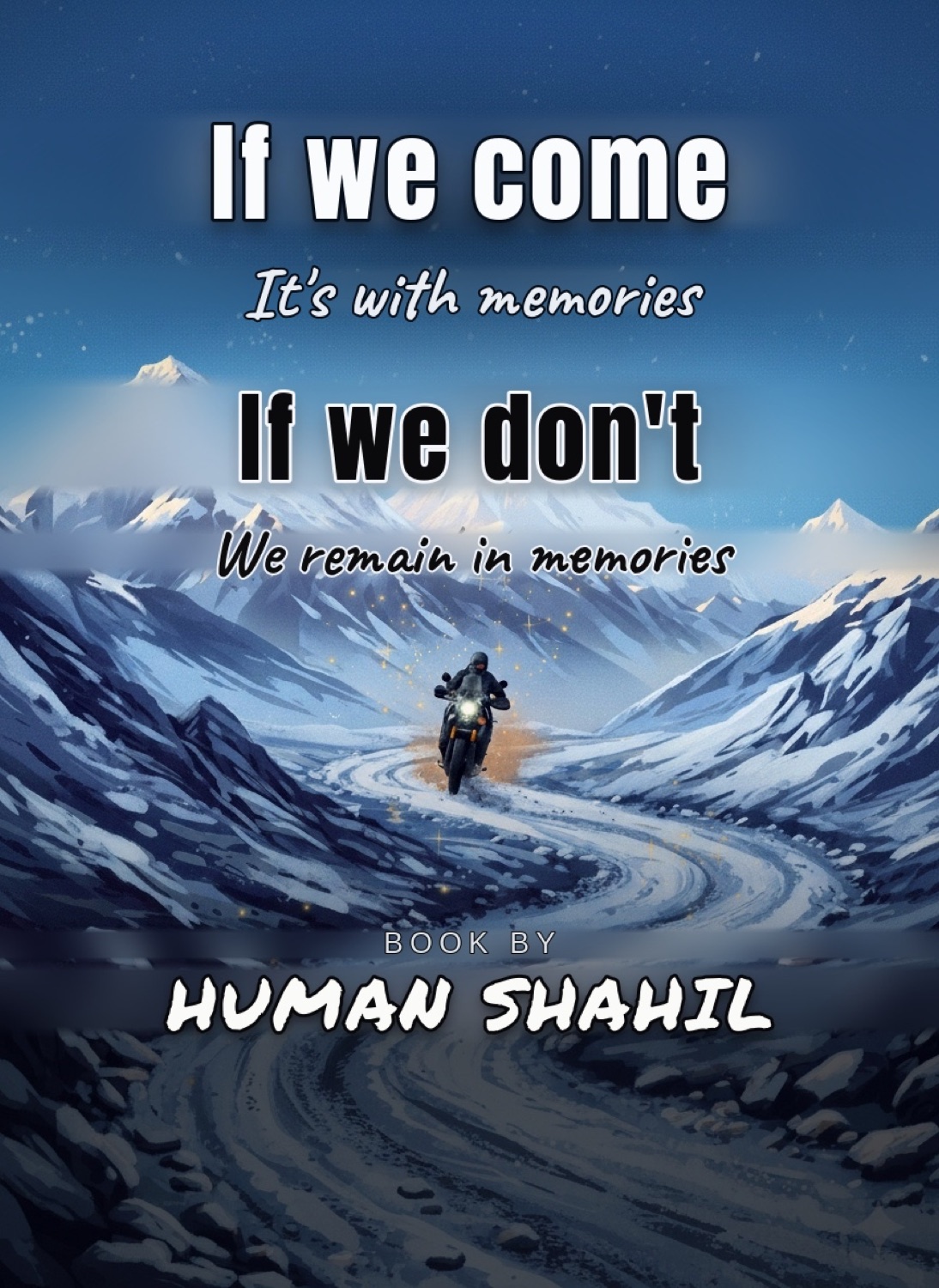
If We Come, It's With Memories; If We Don't, We Remain in Memories
New illustrated edition · Read the full book below
By Human Shahil
Audio reading
Listen to If We Come, It's With Memories; If We Don't, We Remain in Memories
Select any passage to hear it in English; with no selection, playback begins at the first line.
If We Don’t, We Remain in Memories
A Travel Memoir
by Human Shahil
If we come, it’s with memories. If we don’t, we remain in memories.
Contents
- A Word Before We Begin
- How This Book Came to Be
- A Note on Ladakh
- Part One: Before the Road
- Chapter 1 — Where It Began
- Chapter 2 — The Planning
- Chapter 3 — The Flight In
- Part Two: The Journey
- Chapter 4 — First Steps of a Leh Journey
- Chapter 5 — Roads That Taught Me Strength
- Interlude — What My Camera Saw
- Chapter 6 — Battle to Pangong
- Chapter 7 — Journey Through the Clouds, and the Fall Before the Flight
- Interlude — On Fear and Getting Back On
- Chapter 8 — Wet, Dry, and the Long Ride Back
- Interlude — The Sound of Nothing
- Chapter 9 — Roti, Kapada, Makhan
- Chapter 10 — A Bittersweet Farewell to Ladakh
- Part Three: After the Road
- Faces of Ladakh
- The Cost of the Road
- Interlude — What I Was Carrying
- Ten Things Ladakh Taught Me
- A Letter to My Younger Self
- A Letter to Javed
- Epilogue
- One More Thing
- Practical Notes for Fellow Travellers
- A Few Questions Readers Might Ask
- Acknowledgements
- About This Book
A Word Before We Begin
Every word in this book is true. The dates are real, the roads are real, the breakdowns and the kindness of strangers are real. What I’ve done, in bringing this story back to the page after two years, is simply try to tell it the way it deserved to be told the first time — without rushing past the parts that mattered, and without dressing it up in anything it didn’t need.
This isn’t a guidebook, though I’ve added a few practical notes at the end for anyone who wants to follow this same road. It’s the story of two cousins on one motorcycle, and a stretch of mountains that taught us more in eight days than we expected to learn in a lifetime.
Come along. It gets cold, it gets frightening, and it is, I promise you, worth every kilometre.
How This Book Came to Be
I didn’t write a single word of this while I was actually in Ladakh. I was too busy surviving it — too cold, too tired, too focused on the next kilometre to think about sentences. What I did have, the whole time, was Javed’s small white notebook, filled most nights with a few lines scrawled by torchlight before exhaustion won, and my own habit of narrating things to myself under my breath, the way you do when you’re trying to fix a memory in place before it slips.
For almost two years after we came home, the trip stayed exactly like that — fragments. A folder of photographs I’d open every few months and scroll through without really looking. A story I’d tell in pieces at dinners, usually just the flat-tyre part, because it was the easiest to make people laugh with. I told myself I’d write it properly one day, the way people tell themselves a lot of things they don’t quite mean to follow through on.
What actually got me to sit down and write it was much smaller than Ladakh itself. It was Jayashree, in an ordinary conversation, asking why I hadn’t shared any of it — not the whole trip, just the fact that I’d been sitting on stories worth telling and hadn’t told them. I didn’t have a good answer that day. I still don’t, entirely. But I stopped putting it off after that.
Writing it down two years later turned out to be its own strange experience. Some of it came back with startling clarity — the exact sound the bike made before it died on that empty stretch near Khardung La, the specific shade the sky turned during the sandstorm at Shanti Stupa. Other parts I had to reconstruct more carefully, cross-checking my memory against Javed’s, against the photographs, against the little I’d actually managed to jot down at the time. Where memory and detail disagreed, I’ve tried to stay honest about what I’m certain of and what I’m reconstructing as faithfully as I can. The events are real. The road we took is real. If a conversation reads slightly differently than the exact words spoken that day, it’s because two years is enough time for exact words to blur while the truth of a moment stays sharp.
This version of the book — longer, more carefully built than the draft I first put together — exists because I wanted it to be something worth handing to a stranger, not just something worth remembering for myself. I hope it reads that way.
A Note on Ladakh
Before the story starts, it helps to know a little about the place it happens in.
Ladakh sits in the far north of India, cradled between the Karakoram range and the main spine of the Himalayas, in the union territory of Jammu, Kashmir and Ladakh. It is, by most measures, a high-altitude desert — Leh, its largest town, sits at roughly 3,500 metres, and the passes that ring it climb far higher still. The air up there is thin enough that altitude sickness is a real and common risk, which is why almost every visitor is told the same thing on arrival: rest for a day before you do anything strenuous, drink more water than feels necessary, and listen to your body when it complains.
The land itself is stark and beautiful in a way that photographs never quite capture — brown mountains stripped bare of trees, sudden ribbons of green wherever a river or a spring reaches the soil, and skies so clear at night that the Milky Way looks close enough to touch. Buddhism runs deep through the region’s culture, visible in its monasteries, its prayer flags, and the quiet, unhurried pace of its people. Ladakhi hospitality has its own particular warmth — the kind that offers you tea before it asks your name.
The roads we rode — Khardung La, Chang La, the long stretch out toward Pangong Lake — are among the highest motorable roads on Earth, built and maintained largely by the Indian Army’s Border Roads Organisation, in terrain that fights back against permanence every single winter. Landslides, flash floods, and sudden weather are not rare misfortunes here; they are simply what the mountains do, and every traveller who comes this way should expect to be delayed, redirected, or humbled at least once.
Because Ladakh borders both Pakistan and China, several of its most beautiful stretches — including the road to Pangong Lake — lie inside Protected Areas that require an Inner Line Permit or a Protected Area Permit to enter, issued locally in Leh. These rules shift from time to time, so anyone planning to follow this route should check current requirements before they travel, rather than relying on what’s written here.
Ladakh’s history stretches back over a thousand years as an independent kingdom, sitting at the crossroads of old trade routes between India, Tibet, and Central Asia, before it was absorbed into the princely state of Jammu and Kashmir in the nineteenth century. That history is still visible everywhere — in the architecture of its palaces and monasteries, in a language and script closer to Tibetan than to Hindi or Urdu, and in a local cuisine built around barley, butter tea, and the same thukpa and momos you’ll find across the wider Himalayan region. Locals often refer to Ladakh as “Little Tibet,” and spend much of the year almost entirely cut off from the rest of the country once winter closes the passes, a season of near-total isolation that shapes the culture in ways a short summer visit can only glimpse.
None of this is meant to prepare you for what’s coming. Nothing quite does. But it should help to know, as you read, that when this story feels dramatic, it isn’t exaggeration — it’s simply what Ladakh is like.
Part One: Before the Road
Chapter 1 — Where It Began
To understand why Ladakh mattered so much to me, you have to go back further than that July morning in Hyderabad — back to a smaller town, a smaller version of me, and a house where money was counted carefully.
I grew up in Bapatla, a quiet town on the Andhra Pradesh coast, in a family built around discipline. My father served in the Indian Air Force, and that meant a childhood shaped by transfers, routines, and a particular kind of restraint. There wasn’t much room for extras. Pocket money wasn’t a given; it was something you understood you’d have to earn, in one way or another, and I grew up watching my father stretch a modest income across everything a family needs. I didn’t resent it. If anything, it taught me early what I still believe now — that wanting something and being handed it are two very different educations, and the second one teaches you far less.
What I wanted, for a long time, was to act. It sounds almost funny to say now, from the other side of a decade in IT, but it was serious to me then. I made a handful of short films with friends, borrowed cameras, badly lit rooms doubling as sets, dialogue we rewrote a dozen times because we thought we knew better than the page. None of it went anywhere in the way I’d hoped. Somewhere in there, quietly and without a single dramatic turning point, I understood that this particular dream wasn’t going to carry me the distance I needed it to.
So I did what a lot of us do. I turned back to my studies, finished my degree, and sat for campus placements like everyone around me. TCS picked me up, and I became, almost overnight, a QA automation engineer — a job I hadn’t dreamed about as a teenager, testing software I’d never have imagined caring about, in a career that crept up on me rather than one I’d chosen with any real conviction.
But it gave me something the film sets never had: stability. A salary. Leave days I could plan around. And, eventually, without my quite noticing it happening, a life I didn’t hate — one that even, on its better days, felt like mine.
It also gave me the means to travel, which is where the story actually starts to matter.
Photography found me somewhere in the middle of all this, almost by accident. I picked up a camera the way people pick up habits they don’t yet know will become defining — casually, without ceremony — and somewhere along the way it stopped being a hobby and became closer to a second language. My Nikon Z50 has been with me across a good part of India since. There’s something about holding a camera that changes how you see a place; you stop passing through it and start actually looking, hunting for the frame that will let you carry a moment home with you.
I still remember the first photograph I took that felt like mine, rather than just a picture I happened to be holding a phone for. It was nothing special — a stretch of coastline near Bapatla, ordinary fishing boats pulled up on wet sand, the light doing something briefly beautiful to the water. I don’t even have that photograph anymore; the phone it lived on is long gone. But I remember standing there a beat too long, adjusting my angle for no practical reason, simply because it mattered to me that the picture be right. That instinct — the small, private insistence on getting it right for no one’s benefit but my own — is the same one that would later have me climbing back onto a rock ledge in a sandstorm at Shanti Stupa, or wandering off from a broken-down motorcycle to photograph a marmot, because some part of me has never quite been able to walk past a moment worth keeping.
Travel became the other half of that same instinct. I chased it whenever work and money allowed — long weekends turned into short trips, short trips turned into an appetite for longer ones. My first trip outside India, to Dubai, still stands out in my memory as a kind of personal declaration: proof to myself that I could plan something, pay for it myself, and come back changed by it in small, private ways nobody else needed to notice.
None of this happened in isolation. My father, my mother, and my younger sister — who was, at the time of the Ladakh trip, working toward her B.Sc. in Agriculture — have been the steady ground under almost every choice I’ve made, including the reckless ones. My friends Anand, Sai, and Raju have talked me down from bad decisions and talked me into good ones in roughly equal measure, and more than once, as you’ll read later, one of them quite literally bailed me out. And it was Jayashree, in an ordinary conversation that I don’t think she remembers as clearly as I do, who first asked me the question that eventually became this book: “Why not share your experiences with the world?”
I didn’t have an answer for her that day. I think this book is the answer, a little late.
My cousin Javed deserves his own paragraph, because without him there is no story here at all. We’d grown up close, the way cousins sometimes do when the age gap is small enough to erase, and by the time Ladakh came up as an idea, we already had years of shorter trips behind us — enough to know how the other person handled stress, hunger, bad weather, and getting hopelessly lost. That kind of trust doesn’t build overnight, and it turned out to matter enormously once we were actually there, stranded on a mountain road with a dead engine and no signal, entirely dependent on each other to stay calm.
By the time Ladakh entered the conversation as a real plan rather than a someday-idea, I had already spent years chasing the same two things — new places, and new frames to put them in. But even measured against everything before it, Ladakh felt different from the first time we said the word out loud. It didn’t feel like another item on a list of states to visit. It felt like something closer to a test we were choosing to sit for, without fully knowing what would be on the paper.
I couldn’t have told you, that day, exactly what I expected to find at the end of it. I only knew that I wanted to go, badly enough to start planning immediately — and that the planning itself, as you’re about to read, would turn out to be its own small education in patience.
Chapter 2 — The Planning
Javed and I are different kinds of planners, and Ladakh is where that difference became useful.
He’s the one who trusts a trip to sort itself out once you’re inside it — pack light, stay flexible, figure out the rest on the road. I’m the one who needs the scaffolding built in advance, because I’ve learned, the hard way, that the mountains don’t negotiate with people who show up unprepared. For Ladakh, my instincts won out, mostly because the region simply doesn’t allow for much improvisation. Some of its most beautiful corners are also its most restricted, and getting into them takes more than good intentions.
The paperwork came first. Several of the routes we wanted to ride — including the road out to Pangong Lake — sit inside Protected Areas near the international border, which meant applying for Inner Line Permits and Protected Area Permits before we left, along with a shorter local process once we landed in Leh itself. It isn’t complicated, exactly, but it isn’t instant either, and I didn’t want to lose a day of an already tight itinerary standing in a permit office when we could be on the road.
Before any of that, though, came the research — weeks of it, spread across evenings after work, reading other travellers’ accounts of the same route, cross-checking road conditions, working out which stretches were usually rideable in July and which occasionally weren’t. I built a rough day-by-day plan long before we left: Leh first, to acclimatise, then Nubra Valley over Khardung La, then Pangong Lake, then a slow return. It was, on paper, a sensible, well-sequenced plan. It survived contact with the actual mountains for almost exactly two days, which I’ve since learned is about average for anyone planning a Ladakh trip with this much confidence.
Next came the bike. We settled on a Royal Enfield Himalayan, built specifically for terrain like this — high ground clearance, a frame that could take a beating, an engine designed to keep working when the air gets too thin for ordinary machines. I booked it weeks ahead, along with hotels at every stop on our route, partly out of habit and partly because peak season in Ladakh fills up fast, a fact that would come back to matter more than I expected later in the trip.
Packing, by contrast, stayed deliberately minimal. Ladakh isn’t a place that rewards vanity or excess luggage, so we kept to the essentials: thermal layers for the cold that even July couldn’t hold off at altitude, spare socks, good gloves, a basic first-aid kit, and as little else as we could manage. Every extra kilogram is a kilogram you have to carry up a mountain pass on the back of a motorcycle, and we wanted to travel as light as the terrain demanded.
There was a financial side to all this too, one I don’t think either of us said out loud until much later. Neither of us was travelling on a large budget. We’d built the trip around what we could actually afford — rental costs, permits, fuel, food, a return flight — and left ourselves only a modest cushion beyond that for anything unplanned. It felt sensible at the time, the kind of careful budgeting that responsible travellers are supposed to do. It would feel considerably less sensible a few days later, somewhere on a rain-soaked mountain road with a cancelled flight and barely six thousand rupees left between us. But that’s later in the story. For now, the budget looked fine on paper, and we trusted it.
Telling our families was its own small negotiation. My mother worried, in the specific way mothers worry about high-altitude motorcycle trips through border regions — quietly, but persistently, in a dozen small questions asked over several phone calls. My father, who understood the terrain better than any of us from his years in the Air Force, mostly wanted to know we’d applied for the right permits and packed for real cold, not the postcard version of it. I said yes to both, truthfully, and tried not to let on how much of the plan still depended on things outside our control.
At work, I put in for leave carefully — enough days to cover the trip with a small buffer either side, cleared in advance with my manager, Naga Chandan, who’d been understanding about it from the start. I didn’t know yet how much I’d end up testing that goodwill later, logging back in from a cheap hotel room in Ladakh to cover a few hours of work after a flight cancellation blew a hole through our return plans. That, too, was still ahead of us.
In the last few days before we left, the planning gave way to something closer to nervous anticipation. Every itinerary was locked in, every permit application submitted, every bag packed and repacked at least twice. There’s a particular kind of quiet that settles over you in the days just before a trip like this — not calm, exactly, but a held breath, a sense that you’ve done everything you can and now the only thing left is to actually go.
We didn’t know, sitting there with our bags half-zipped and our permits printed out on the kitchen table, how many of our careful plans would survive first contact with the mountains. Almost none of them, as it turned out. But the planning wasn’t wasted. It gave us just enough of a foundation that when everything else started going wrong — and it would, repeatedly, spectacularly — we had something steady to fall back on, and each other to fall back on besides.
Chapter 3 — The Flight In
Before I get to the airport, I want to hold onto one small scene from that morning a little longer, because it’s easy to skip past in a story this eager to reach the mountains.
My mother had woken up before either of us, the way mothers seem to manage no matter how early you try to leave unnoticed. She didn’t say much — she’d already said most of it the night before, in the particular tone she reserves for worry she’s trying not to show too plainly. Call when you land. Wear the thermal layers, don’t just pack them. Be careful on the bike. I said yes to all of it, the way I always do, and I think we both understood that the words mattered less than the fact of standing there together for a few extra minutes before the cab arrived.
My father was quieter about it, in the way Air Force men often are. He checked, once more, that we had our permit documents printed and not just saved on our phones — a small, practical worry that I understood, years later, as its own kind of love. He shook Javed’s hand, told him to look after both bikes and both of us, and that was more or less that. Neither of us are the kind of family that says a great deal out loud. We’d said what needed saying in the days before, in smaller conversations, and this final morning was really just for standing together a little longer than usual before letting the door close behind us.
It began, properly, before sunrise on the morning of 18 July 2023, in Hyderabad.
The city was still rubbing the sleep from its eyes, but Javed and I were already awake, already dressed, already running our packing list through our heads for the third time. This wasn’t just another trip. We had been talking about it for months — turning it over on phone calls, sketching routes, circling dates — and now here it was, arriving the way big things always seem to: quietly, on an ordinary morning, as if it hadn’t been waiting for us all along.
Ladakh. The land of high passes and thin air, of silence so complete it has a weight to it. We had built it up so much in our heads that it had almost stopped feeling real. And yet, in a few hours, it would be.
We had kept our packing simple on purpose, exactly as we’d planned. A couple of thermal layers, extra socks, good gloves — nothing more. Ladakh isn’t a place that rewards vanity. It asks you to strip things down to what you actually need, and we wanted to arrive already understanding that.
When the cab finally arrived to take us to the airport, there was a particular kind of quiet between us — the quiet that sits just before something big is about to happen. We looked at each other and smiled, not needing to say anything. We both knew this one was going to matter.
The ride to the airport was loud with early-morning chatter and nervous excitement, the kind that makes you talk faster than you mean to and laugh at things that aren’t really that funny. Check-in went smoothly, and once we were through security, the anticipation had nowhere left to go except up. The flight to Delhi was short, but we spent the whole of it talking about mountains we hadn’t seen yet, half-planning, half-daydreaming, watching the ground scroll by beneath us in patches of green and brown.
Delhi gave us a seven-hour layover, and it tested us before the trip had even properly started. We couldn’t find anywhere comfortable to sit, sleep was out of the question in the noise and bright light of the terminal, and by the fifth hour we were both a little frayed, snapping at each other over nothing in the particular way exhausted people do. But even that felt, looking back, like the first small taste of what Ladakh would demand of us — patience, and the ability to wait out discomfort without losing our excitement underneath it.
Then, finally, we boarded the flight to Leh.
That flight alone is something I still think about. As the plane climbed, the ground fell away and the mountains rose up to take its place — first in patches, then completely, until there was nothing below us but snow-capped peaks stacked one behind another, catching the light. I couldn’t look away from the window. Every few minutes the plane would bank and reveal another ridge, another valley, another impossible view, as if the Himalayas themselves were performing for us. Javed, who doesn’t usually get sentimental about scenery, went quiet for most of the descent, his forehead nearly against the glass. It remains, honestly, the most beautiful flight either of us has ever taken.
Leh airport, when we landed, turned out to be one of the smallest I’d ever seen — and somehow that made it feel warmer, not smaller. It began life as a military airstrip in 1961 and now carries the name of Kushok Bakula Rimpochee, a respected monk from the region. Stepping out onto the tarmac, we were ringed by brown mountains with snow still clinging to their upper slopes, and a row of army cargo planes sat parked nearby, solid and grey against all that colour. The air hit us almost immediately — thinner, colder, sharper than anything either of us was used to breathing.
It felt like the mountains themselves had come out to greet us. Whatever Ladakh had in store, it was starting well.
Part Two: The Journey
Chapter 4 — First Steps of a Leh Journey
Day 1
The moment we stepped off the tarmac, the air felt different — crisp, thin, almost sharp against the skin. We rented our bikes right there near the airport, signing paperwork with hands still stiff from the flight, and rode to our room with a mix of exhaustion and disbelief.
The room itself was simple — a modest guesthouse with thick stone walls that held the cold in even in July, a small window looking out toward a slope of bare brown hill, a kettle that took longer than usual to boil at this altitude. Neither of us cared. After a night of almost no sleep in Delhi’s terminal, the bed alone felt like a luxury, and we allowed ourselves twenty minutes of simply sitting still before the excitement of actually being in Ladakh overtook the exhaustion.
After freshening up and forcing down a little food despite neither of us feeling hungry — the altitude has a way of quietly dulling your appetite before you’ve even noticed it happening — we walked out into a town that didn’t feel like it belonged to the same country we’d left that morning.
Coming from Andhra Pradesh, the change was almost disorienting. Tibetan influence shaped everything here — the colours, the pace, the quiet — and it gave the whole town a stillness that still managed to feel alive. Prayer flags strung between buildings caught what little wind there was, snapping softly overhead. It was just Javed and me, two explorers dropped into a place that seemed to be watching us as closely as we were watching it.
We started slowly, letting the town’s charm work on us at its own pace, aware that altitude has a way of punishing anyone who rushes it. Ladakh sits inside a ring of mountains that look less like scenery and more like fortress walls, and the town itself feels small and humble underneath them — no skyscrapers, no rush, just a settlement that has learned to live modestly in the shadow of something enormous.
Our first real stop was Leh Palace, a nine-storey structure built in the seventeenth century, modelled loosely on the Potala Palace in Lhasa, though far smaller and considerably more weathered by time. The building is thick with history — old kings, old soldiers, old stories worn into its stone — and much of it stands hollow now, its upper floors closed off, its walls bare where painted murals and hangings once would have been. Inside, a small museum traced the region’s culture and dress across centuries: thangka paintings, ceremonial jewellery, old photographs of Ladakhi royalty that made the whole dynasty feel suddenly, strangely human. From the palace’s upper floors we could see the whole town laid out below us, plain and ancient and unhurried, the market’s rooftops catching the mid-morning light. We wandered into a bakery afterward for cake and biscuits, a small, ordinary pleasure that kept us going, the owner curious enough about where we’d come from to give us an extra biscuit each, on the house.
In the afternoon we visited the Hall of Fame, built by the Indian Army in tribute to the soldiers who gave their lives in the Indo-Pak wars, particularly the Kargil War of 1999. Walking through it is not like walking through an ordinary museum. Glass cases held recovered weapons, uniforms, and personal effects — a soldier’s letter home, a pair of boots, photographs of young men who never got old. Recorded accounts played on loop nearby, voices describing what these men had endured at altitudes where simply breathing is a fight. Between the war memorabilia and those recordings, the place asks something of you — gratitude, mostly, and a kind of quiet pride that stays with you long after you’ve left. Javed, usually quick with a joke to lighten any mood, didn’t say much for the twenty minutes we spent inside.
From there, about eight kilometres on, we reached Spituk Gompa, an eleventh-century Buddhist monastery set on a hill above the valley, its whitewashed walls climbing the slope in tiers. It holds a rare Kali statue that is unveiled only once a year, during the Gustor festival, kept hidden the rest of the time behind heavy curtains we weren’t permitted to draw back. Even without seeing it, we could feel the weight of the place — centuries of prayer settled into its stone, monks moving unhurried between courtyards, the low murmur of chanting drifting out from somewhere inside.
That single afternoon had carried us from deep patriotism to deep stillness, and both had left their mark.
By evening we made our way into Leh Market, the noisy, restless heart of the town. We picked up a local SIM card for five hundred rupees from a small shop tucked between two larger ones — our own network was useless up here, and we needed maps to survive the days ahead. The shopkeeper, noticing our exhaustion, threw in some free advice along with the SIM: rest well tonight, he said, the mountains don’t forgive tired riders. We’d remember that advice more than once in the days to come.
Then we climbed to Shanti Stupa just as the sun began to lower itself toward the mountains. Built in 1991 by Japanese Buddhist monks as a monument to world peace, the stupa sits on a hilltop reached by a long flight of steps that left both of us wheezing at that altitude, laughing at our own breathlessness between gasps.
We found a quiet spot near the top and let the evening settle around us. Children ran past, their laughter mixing with the notes of a flute someone was playing nearby. For a moment, everything felt suspended — the wind still, the light soft, the world holding its breath.
And then, without warning, the wind changed.
It started as a whisper, barely noticeable, and within minutes the sky had turned the colour of dust. A sandstorm rolled in off the mountains, and the air filled with fine, swirling grit, as if the peaks themselves had exhaled. People around us scrambled for cover, pulling scarves up over their faces, and Javed grabbed my arm and pulled me toward a sheltered archway before I’d fully registered what was happening. I stood there between the snow-capped ridges in the distance and the storm closing in around me, watching two seasons collide — winter’s stillness meeting the desert’s temper — and for a strange, suspended moment I felt like I had stepped into a story I’d only ever read about. Small, and somehow more alive than I had felt in years.
Then, as suddenly as it had come, it was gone. The dust settled, the wind dropped, and the evening returned to itself, leaving nothing behind but the memory of it — and the two of us grinning at each other, half-startled, half-thrilled, brushing grit out of our hair.
It was only day one, and Ladakh had already shown us how quickly it could change its mind.
After the sandstorm, we went back to freshen up — a quick wash, a warm cup of tea — before heading out again. By the time we stepped back onto the street, night had properly settled in, and Leh Market at night turned out to be an entirely different creature from Leh Market by day.
The lanes were alive. A group of young women were filming reels against the glow of the shopfronts. An elderly couple browsed the stalls together, the wife lost in the shopping, the husband trailing a step behind with the particular patience of a man who has done this before. Teenagers hunted for quiet corners to steal a kiss. Children ran shrieking between the crowds. Vendors called out over the noise, selling scarves and silver jewellery that caught the streetlight, and hand-carved prayer wheels stood beside stacks of souvenirs. Somewhere above us, a rooftop bar let soft music drift down into the street, and the smell of momos and noodles hung over everything, warm and inviting against the evening chill. Monks in maroon robes moved through the chaos without hurrying, a small reminder that tradition and noise can share the same street without either one losing itself.
It didn’t feel like a market anymore. It felt like a festival that had simply forgotten to end.
We wandered until our bags were heavier with small souvenirs, grabbed a light dinner at a stall recommended by our SIM-card shopkeeper, and headed back to the hotel, full and tired in the good way. Tomorrow, Nubra Valley was waiting — and neither of us had any idea yet what it would ask of us.
Interlude — Two Cousins, One Bike
Before I go further into the trip, I want to explain something about Javed and me that the story so far has only shown in glimpses — how two cousins ended up trusting each other enough to survive eight days of breakdowns, floods, and freezing nights on the back of a single motorcycle.
We aren’t brothers, though people who meet us together often assume we are. The age gap between us is small enough that we grew up more like siblings than cousins in the usual sense — same festivals, same summer holidays at our grandparents’ house, the same running arguments over the same childhood games. By the time we were old enough to travel on our own, we’d already spent two decades learning each other’s moods, and that turned out to matter enormously once we were sharing a single motorcycle across some of the harshest terrain in the country.
Javed is the calmer of the two of us, almost always. Where I tend to spiral a little when something goes wrong — turning a flat tyre into a small catastrophe in my head before I’ve even climbed off the bike — Javed’s first instinct is nearly always practical. What do we actually know. What can we actually do about it. I’ve come to rely on that instinct more than I think he realises, and more than once on this trip, his calm was the only thing standing between a setback and a genuine crisis.
I’d like to think I gave him something in return. I’m the planner, the one who reads the permit requirements twice and books the hotels three weeks in advance, and there’s a kind of security in that too, even if it isn’t as visible in the moment as staying calm during a breakdown. We balanced each other, mostly without discussing it, the way people do when a partnership has already been tested by enough smaller trips to know it works.
There’s a particular kind of intimacy that comes from being cold, frightened, and entirely dependent on one other person, hundreds of kilometres from anyone who could help if things went properly wrong. I don’t think either of us fully understood, before this trip, how much we trusted each other. Ladakh made that trust impossible to avoid noticing. By the time we reached Pangong Lake, planted our flag, and stood there in silence watching the last of the light leave the water, I already knew this wasn’t just a trip we’d taken together. It was proof of something we’d built long before either of us thought to call it that.
Chapter 5 — Roads That Taught Me Strength
Day 2
The second day began gently. I pulled back the curtain to find a green apple tree just outside our window, close enough to touch, the cool morning air carrying the faint smell of its leaves. They were still unripe, so I let them be and settled for a few photographs instead, smiling like a child at something this small. Javed was already up, stretching out the stiffness of the previous day’s walking, running through the route on his phone one more time even though we both knew the signal would abandon us long before we needed it most.
There was a different kind of excitement in the air, though, underneath the calm. Today wasn’t an ordinary riding day. We were going to cross Khardung La — the highest motorable road in the world, sitting at 5,359 metres, just over 19,000 feet — on a route that would carry us 160 kilometres through thinning air and switchback roads.
We kick-started the Royal Enfield Himalayan and felt it settle into its rhythm beneath us. As we rode out of Leh, the mountains stood over us like old guardians, their peaks still dusted white. Every turn in the road opened onto another view — deep valleys, raw rock, clouds that seemed almost near enough to touch. The higher we climbed, the thinner the air became, until every breath was a small reminder of how far we’d come from sea level.
Around the twenty-five-kilometre mark, we came to a sudden stop. A landslide had closed the road ahead, and nearly two hundred vehicles sat stranded behind it — the first landslide I had ever seen up close, a raw scar of loose rock and mud cutting straight across the tarmac. The army arrived quickly and began clearing it with a small excavator, working methodically while the line of vehicles grew behind us. We ended up waiting almost an hour, trading stories with other stranded travellers — a group of bikers from Bangalore, a family in a hired Innova who shared their biscuits with anyone nearby. It should have felt like a delay. Instead, it felt like the trip’s first real lesson: that in Ladakh, the road belongs to the mountain, not to you, and you wait when it tells you to wait.
Once the road cleared, we climbed higher still, and about twenty kilometres on we found a photo spot with a large frame set up against the snow-capped peaks — the kind of place that makes you feel, briefly, like you’re standing at the edge of the world. We scrambled up onto the rocks nearby and looked back. Leh was gone completely. There was nothing behind us now but clouds, stone, and sky, the road we’d climbed already swallowed by distance.
We took a short break there for tea and a simple bread omelette, cooked on a small stove inside a tin-roofed shack that seemed to exist purely for travellers like us, and it tasted like the best meal either of us had ever had. But we couldn’t linger — Khardung La was still ahead, and the thin air at that altitude doesn’t forgive delay.
Seventy kilometres in, the landscape kept transforming under us — rocky terrain one moment, clouds close enough to brush the next. The road climbed and climbed, and it began to feel less like we were riding toward the sky and more like the sky was slowly coming down to meet us. The narrow bends carried their own small thrill of fear, and that fear, mixed with the wonder of it, is what made the ride unforgettable.
Near the top, the altitude caught up with me. A headache set in, dull and insistent, tightening slowly behind my eyes, and Javed noticed before I said a word — he’d seen me go quiet, which for me is usually the first sign something’s wrong. We pulled over for hot Maggi at a stall run by a woman wrapped in three layers against the cold, and sat with the strange contradiction of it: standing at the top of the world while your own body quietly reminds you that you weren’t built for it.
That, I think, is the real shape of adventure. A little struggle, a lot of joy, and a memory that outlasts both.
We came down from Khardung La with the wind in our faces and the headache still lingering behind my eyes. A group of bikers we’d been riding alongside had helped us through a tricky water crossing earlier, and now, as we pushed on alone, they slowly disappeared ahead of us into the horizon. The road stretched out empty in front of us — no forks, no turns, no one else in sight.
We chose not to stop for tea the way the others had. Nightfall isn’t something you want to gamble with in these mountains, and Nubra Valley was still a distance off. But the road kept emptying out around us, until there was no one — not a single soul — anywhere in view. The silence had a texture to it, thick and total, broken only by the engine and the wind.
Then the bike sputtered, coughed, and died.
Silence dropped over us so completely it felt physical. I looked at Javed. He looked at me. For a moment, every ounce of the day’s joy and awe simply froze in place.
No signal. No maps. No one around. Just the two of us, stranded, with the sun already leaning toward the horizon and the temperature already beginning its evening drop.
We tried not to panic, and mostly succeeded, but underneath the calm we were both running the same silent questions — was it the altitude choking the engine? The fuel? Something worse? Every minute that passed stretched longer than the one before it. I checked my phone every thirty seconds or so, as if watching it might summon a signal into existence. What if no one came? What if the light went before we did? We’d read the stories, the way every traveller to Ladakh eventually does — of riders caught out after dark on roads like this one, of how fast the warmth leaves the air once the sun drops behind the ridgeline.
For the first time on the trip, the adventure stopped feeling like a story we were telling and started feeling entirely, frighteningly real.
After what felt like an hour of pacing and doubt — though it was closer to twenty minutes, time does strange things when you’re frightened — one single bar of signal flickered onto my phone. I don’t think I have ever been that grateful for anything so small. With my hands shaking — cold, or nerves, or both — I managed to get through to the bike’s owner back in Leh. I handed the phone to Javed, too relieved to trust my own voice, and listened as the mechanic on the other end talked us through it, step by step. Pull this switch. Check that line. Our breath hung visibly in the air as we followed his instructions with clumsy, frozen fingers, kneeling beside the bike in the fading light.
And then the engine caught, and roared, and came back to life.
I could have hugged that bike. It felt, absurdly, like the whole day had been designed to push us right to the edge of panic and then pull us back at the very last second — as if the mountain wanted to know exactly how much we could take before it let us go.
We still had kilometres left to cover and a sun that wasn’t waiting for us, but that one small victory changed the entire tone of the ride. We were shaken, but we were moving.
We pushed on toward the hotel, still twenty-five kilometres out, and just as things seemed to be settling, the sky opened and it began to rain. There’s a local belief that seeing rain in Ladakh makes you one of the luckiest people alive — it happens so rarely, once every ten or twenty years, they say. We laughed about it even as the rain soaked straight through our jackets, half-wondering whether we were lucky or simply being tested.
Then came a landslide-blocked traffic jam, and our mood dropped further. Then more rain. My headache, already stubborn from the altitude, worsened with every kilometre, a dull pressure that no amount of blinking or breathing slowly seemed to ease. By the time the army cleared the road and we finally reached the hotel, it had started raining a third time, as if to make sure we understood the joke.
The hotel staff were kind. Someone gave me tablets for the headache, and I collapsed for twenty minutes while Javed — who has always been the gentler of the two of us — gave me a head massage once I woke, along with a cup of hot tea. We sat there afterward, Javed writing in the small white notebook he’d carried along the whole trip, filling it with fragments he didn’t always read aloud, and had a quiet, honest conversation about whether I was up for going back out again.
“We’re not coming back here anytime soon,” I told him. “We’ve spent too much to waste any of it.”
The tablets were working. The headache was fading. So we picked ourselves up and planned our next stop — Diskit Monastery — hoping a short, easy outing would lift us back to where we’d started the day.
Stepping out of the hotel, I noticed for the first time how thick the area was with apple and strawberry trees, flowers scattered everywhere between them. The whole setting carried a distinct Tibetan warmth, from the architecture down to the quiet hospitality of the people running it. It felt, for a moment, like we’d wandered into another world entirely.
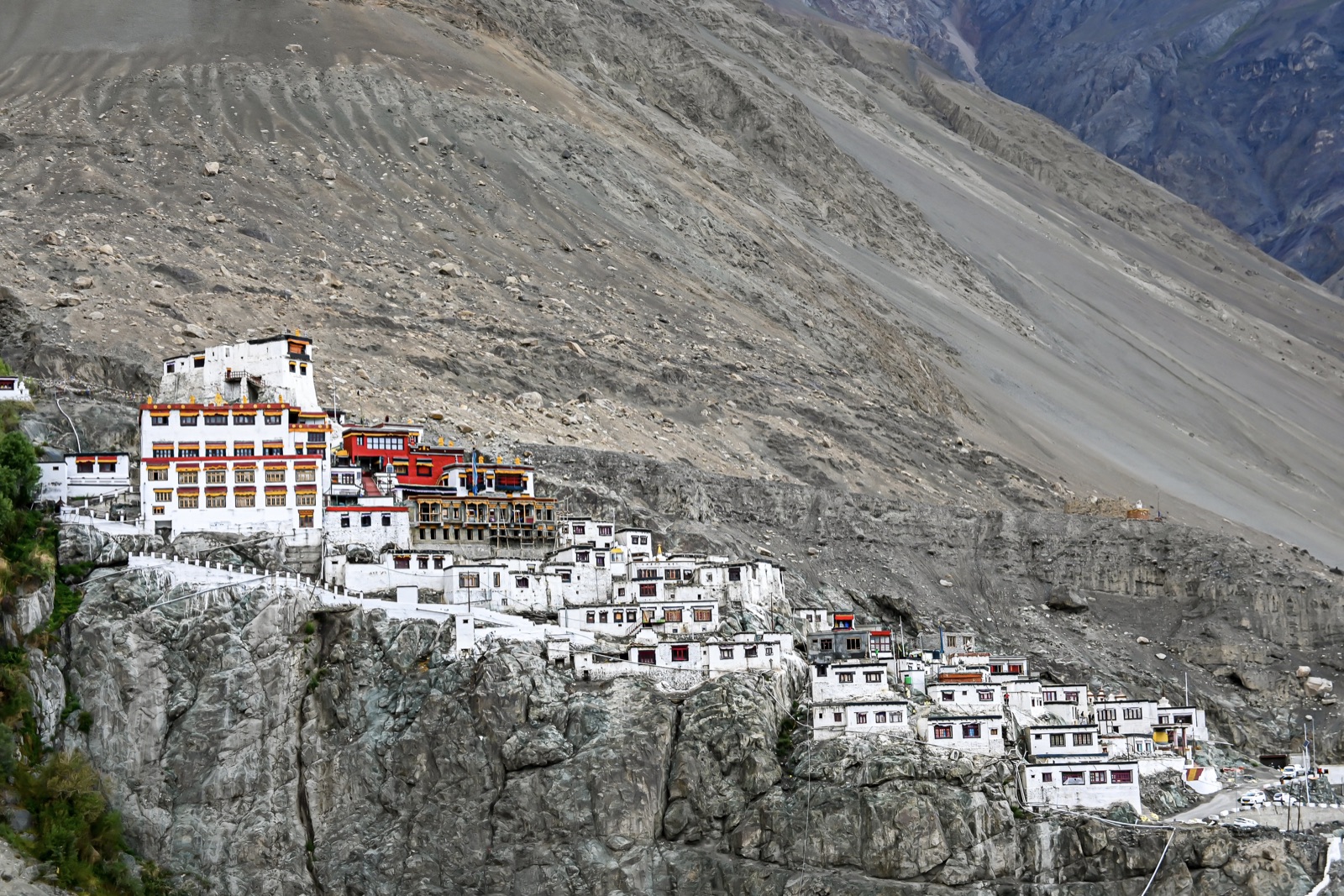
We rode the six kilometres to Diskit Monastery under arches and along climbing mountain roads that kept revealing better views the higher we went. The monastery itself, painted a deep red, stood out beautifully against the brown rock and scattered greenery around it. Inside, monks prayed in a silence so complete it felt louder than noise — the low murmur of mantras, the occasional soft ring of a bell, the smell of butter lamps burning somewhere out of sight. We took a quiet moment ourselves, asking simply for the rest of the trip to go a little easier.
From there we walked to see the monastery’s real landmark — a 106-foot statue of the Maitreya Buddha, built in 2010, facing out over the Shyok River as a symbol of peace for the whole valley. Around it, the landscape kept shifting with every glance: lush trees on one side, pale sand dunes on the other, snow-capped mountains holding the whole scene together in the distance.
We took our time there, taking photos, talking with a few other travellers — a retired schoolteacher from Pune who told us, unprompted, that she’d wanted to see this statue for eleven years before finally making the trip, and a young couple on their honeymoon who’d chosen Ladakh over Goa and seemed entirely at peace with the decision — and shared snacks with strangers who quickly stopped feeling like strangers. There’s a particular camaraderie among travellers this far from anywhere familiar; everyone seems a little more willing to talk, a little quicker to share what little they’re carrying, as if the altitude thins out more than just the air. By the time we found dinner, the sky had turned a deep, glowing orange — one of the most striking sunsets either of us had ever seen. We stood and watched it fully, letting the day’s earlier fear dissolve into something calmer, before heading back for a hot bath and a well-earned sleep.
It had been, in every sense, a day that taught us what the road expected of us — and what we were capable of giving it.
Interlude — What My Camera Saw
I’ve mentioned my Nikon Z50 a few times already, so it feels right to pause here, two days into the ride, and talk properly about what it was actually doing through all of this — because a camera changes the way you travel, and I don’t think this book would be honest without admitting that.
I don’t take photographs the way some people do, hunting for the single perfect frame and moving on. I take far too many, most of them forgettable, because I’m less interested in the perfect shot than in the habit of looking closely enough to find one. Ladakh, more than anywhere else I’d been, rewarded that habit constantly.
The photograph I go back to most often from Day 1 isn’t the wide shot of Leh Palace against the mountains, though I have several of those. It’s a much smaller frame — an old woman at Spituk Gompa, caught mid-spin of a prayer wheel, her face turned slightly away from the lens, sunlight catching the brass just enough to blur it into a soft gold smear. I didn’t ask her permission. I’m still not entirely sure that was right of me, but I like to think the photograph treats her gently, the way the moment itself felt.
From Khardung La, the photograph that matters most to me isn’t of the pass itself, though the views up there are the kind that make you understand why people call these roads legendary. It’s a photo Javed took of me, without my noticing, at the exact moment I was standing with my hand pressed to my temple, headache in full bloom, grinning anyway. He showed it to me that evening and said, “This is the real picture from today,” and he wasn’t wrong.
Pangong Lake, unsurprisingly, is where the camera and I did our best work together. The water changes colour so completely depending on the light and the angle that I ended up with a dozen photographs of the same stretch of shoreline that look, at a glance, like a dozen different lakes. My favourite isn’t the postcard-blue version everyone takes. It’s one from just after sunset, the water gone almost silver, the mountains reduced to flat grey silhouettes, and a single set of footprints — mine — leading out of frame toward where Javed was waiting with the flag.
There’s a photograph from the flat-tyre afternoon too, one I almost didn’t take because I was too relieved to think about picture-taking at all. It’s the two construction workers, mid-laugh, tools still in hand, Javed crouched beside them watching the repair. It isn’t a good photograph technically — the light’s flat, the framing’s off-centre, my hands weren’t entirely steady. But it’s the one I’d save first if I could only keep one image from the whole trip, because it holds, better than any of the scenic shots, exactly what this journey turned out to be about.
By the time we reached Day 6, with our budget cut to nothing and our days reduced to tea and butter roti, I found myself photographing less and looking more — an odd trade that I think was good for me. Some of my favourite memories from those last days aren’t photographs at all. They’re just things I saw and let stay unrecorded: the carpenter carving a prayer wheel by hand, the exact sound of the market settling into evening, the particular quality of light through the windows of that tiny hotel garden. A camera is a wonderful tool for holding on to a place. It isn’t, I learned, the only one.
Chapter 6 — Battle to Pangong
Day 3
We woke on Day 3 feeling genuinely refreshed — the headache gone, replaced by a hot bath and a cup of tea. Our destination was Pangong Lake, the trip’s centrepiece, and the plan was simple: pack up, ride out, and let the day unfold. We knew it would be long — somewhere between 150 and 170 kilometres of rough, unforgiving terrain — so we left early, just before six, riding out through a darkness that slowly gave way to a cool, quiet dawn, the sky lightening in slow bands of grey and pale gold above the ridgelines.
We filled the tank in full this time, unwilling to take chances after the day before, and covered the first forty kilometres smoothly under a sky that promised nothing but good weather. Then, without warning, we came upon fifteen or twenty bikes and a couple of trucks stopped dead in the middle of the road.
We pulled over, confused. The sky was clear. Nothing about the morning suggested trouble. But something in the air felt wrong — the kind of stillness that settles over a crowd when everyone already knows the bad news and is simply waiting for someone else to say it out loud.
That’s when we heard it. “The road was here yesterday,” one of the bikers told us, shaking his head. “Now it’s completely flooded.” We could hardly believe it. Overnight, the road had vanished beneath water ten to twenty metres deep — impassable for anything, bike or otherwise.
We stood there, stunned. The road had been fine the day before. There was no clear alternate route, no way of knowing how long the army would take to fix it, if they could fix it at all. The only real option was a detour — an extra forty-five kilometres through terrain none of us knew.
The calm of the morning evaporated. It was, for a moment, like a small heart attack — the kind of blow that catches you entirely off guard because nothing before it had hinted at it. None of us knew this stretch of land well, and the uncertainty spread through the stranded crowd like a current, voices rising, someone already turning their bike back toward Leh. A local shopkeeper eventually pointed us toward another route, warning us honestly that it wouldn’t be easy — an extra hour or more of off-roading through the roughest ground in the valley. We had no better option. We trusted him and turned the bike around.
What followed was one of the strangest hours of the trip. No signal. No functioning offline maps. Villages growing smaller and further apart with every kilometre, until they stopped altogether. The mountains on either side seemed to close in tighter the deeper we rode, and the “road” beneath us became little more than gravel and packed dirt, the bike bucking under us over stones we couldn’t see coming in time to brace for. Every bump kept us on edge, every silence made us more aware of how alone we were.
A few other bikers had chosen the same detour, and their presence gave us something to hold onto, even if it didn’t fully settle the unease sitting in my chest. There’s a particular kind of smallness that comes from being this far from anything familiar — every distant bird call, every gust through the sparse trees, felt like a question we couldn’t answer.
We pushed on because there was nothing else to do. Turning back wasn’t really an option this deep into the day. The terrain kept worsening — loose rock, narrow passes, nothing predictable — and every turn added its own small measure of suspense to what was quickly becoming the most uncertain day of the trip.
At one point the track ran so close to a drop that neither of us spoke for several minutes, both of us silently focused on keeping the bike steady over ground that shifted under the tyres without warning. I found myself doing the thing I always do when I’m frightened and trying not to show it — narrating the scenery out loud in my head, cataloguing details as if writing them down somewhere might keep the moment from going wrong. The colour of the rock. The shape of a distant ridge. Small, useless anchors against a fear that had nowhere else to go.
At one point, riding through open, empty country with no GPS and no other soul in sight, I spotted a dark shape perched on a roadside pillar ahead of us. It was large — too large, my mind insisted — and for one absurd, heart-thudding second I was certain it was something it had no business being. I told Javed to stop the bike immediately. He laughed and told me not to be ridiculous. I wasn’t so sure.
As we crept closer, the shape resolved itself into an enormous crow — bigger than any I’d ever seen, likely swollen by the harsh mountain climate into something that looked, from a distance, faintly supernatural. We laughed until our stomachs hurt, more at my nerves than at the bird itself, and it was exactly the kind of small, ridiculous moment that snaps you out of your own fear and reminds you that adventure, even at its most uncertain, still has room for comedy.
We rode on, still not entirely sure we were on the right path, but lighter for the laugh.
The isolation deepened as we went — over an hour now without seeing another human being. We had a small first-aid kit and nothing else if things went seriously wrong, and that thought sat quietly at the back of both our minds, threaded through with a strange, undeniable thrill. Eventually we reached an L-junction with a bridge to our left and no way to know which direction was right — until we noticed a stone marked with a hand-drawn arrow pointing toward the bridge. It felt, absurdly, like a gift left behind by travellers before us, guiding us forward without a word.
We crossed the bridge above a wide, raging river, its roar loud enough to drown out thought, the water below churning grey-brown with silt carried down from some glacier we couldn’t see. For one unsettled second I wondered what would happen if it gave way beneath us. Instead, it held, and on the far side, my photographer’s instinct pulled me back to the bridge one more time — just in time to see the sun rising perfectly between two mountain peaks. The light, the sound of the river, the cold morning air: for a moment it felt like something out of a film, except this one was entirely real, and I was standing inside it.
But the journey wasn’t finished with us yet. We still didn’t know exactly where to go, and the open landscape gave us no clues. In the distance, we spotted a pair of construction workers taking a tea break beside a battered flask and a small fire. Javed couldn’t get the bike over the rough ground, so I walked the last stretch alone, ten minutes over loose rock, to ask them the way. They pointed us on simply — right turn, then straight — and just as we got moving again, a car and a group of bikers appeared out of nowhere, engines and voices carrying across the emptiness like music. We weren’t alone anymore, and the relief of that alone was enough to lift us.
We rode on with that renewed courage — until two cars coming from the opposite direction flagged us down. Before we could even ask what was wrong, they were already shaking their heads. The road to Pangong was flooded too. The tide was too high. There was no way through.
The excitement we’d been carrying collapsed all at once. We would have to turn back entirely, retrace our steps to Nubra Valley, and start again from there. Around us, thirty or forty other travellers absorbed the same news in the same stunned silence, all of us asking the same unspoken question: why was everything going wrong at once?
The ride back to Nubra took another couple of hours over the same rough ground, and by the time we reached the junction, two to three hundred other travellers were already stranded there, halted by flooding on every route toward the lake. We settled in for tea and noodles, trying to think through what came next, and watched the crowd swell further — forty or fifty more bikers arriving from ahead, until the total climbed past three hundred, families and children among them, everyone tense in the same shared uncertainty. Nubra Valley, with no signal to speak of, had become a waiting room for half of Ladakh, strangers swapping theories and rumours about which route might open first.
Eventually a shopkeeper offered an alternative — not a route to Pangong, but a way back to Ladakh that would at least get everyone home safely. The whole crowd seemed to arrive at the same resigned conclusion together: the day might be lost, but at least we would be lost together, and safe.
So we set off again, back toward Khardung La, a pass I wasn’t eager to cross twice in one trip after the headache it had given me the first time. But there wasn’t much choice. The scenery was stunning even in defeat — the sky shifting through orange and green as we climbed — until, twenty kilometres in, we hit another sudden stop.
This time it wasn’t a landslide. It was an army gate, closed without explanation, a soldier standing in front of it with his rifle slung casually but his posture unmistakably firm. Word passed back through the line: a security threat the day before had shut the road entirely, and no one — not even the families and older travellers who tried pleading their case — was getting through easily.
After nearly an hour and a half of back-and-forth negotiation and calls up the chain of command, the soldiers finally relented, but only under strict terms. No photos. No videos. No stopping, once the gate opened, for any reason. This was serious, they told us — a direct order from their general — and we understood exactly how little room there was to argue.
When the gate finally lifted, everyone moved through fast and in silence, eyes forward, nobody willing to be the reason it closed again. I kept my camera zipped firmly into my jacket, resisting an instinct I hadn’t had to fight all trip.
We crossed Khardung La a second time without stopping, the thin air leaving no room for sentimentality, and made our way back toward Ladakh through a few more minor landslides and short tea breaks that helped keep our strength up. By the time we reached our old hotel, we were simply relieved to have somewhere familiar to collapse into.
I had started thinking, somewhere in that long ride back, about cancelling our Pangong hotel booking and asking for a refund. Javed wasn’t ready to give up so easily, and his stubbornness pulled me back from the edge of quitting. We went out to the market, ate, and came back to learn about a different route to Pangong — through Chang La Pass instead. It wasn’t a guarantee. But it was hope, and we packed our bags that night holding onto it, neither of us quite ready to say out loud how much we needed tomorrow to go differently.
Chapter 7 — Journey Through the Clouds, and the Fall Before the Flight
Day 4
Day 4 began with a stubbornness neither of us had felt the morning before — a quiet, renewed resolve after everything the previous day had thrown at us. We set out from Ladakh toward Pangong Lake, a route of roughly 140 kilometres over the Chang La Pass, the morning air pleasant enough to make us believe, cautiously, that today might go smoothly.
We stopped at a small bakery for tea and snacks before the climb properly began, neither of us saying much, both privately bracing for another day of obstacles even as we hoped we were wrong. The terrain unfolded in stunning layers as we rode — crisp air, sweeping mountain views, roads smooth enough that we allowed ourselves to enjoy them without bracing for the next obstacle. Javed rode while I sat behind with our luggage, and the hairpin bends demanded careful, deliberate handling. At one point we passed the wreckage of vehicles that had gone off the mountain in the past — rusted metal half-swallowed by the slope below the road — a stark, sobering reminder of exactly how much respect this road demanded.
As we climbed, clouds began drifting across the road itself. At one point a cloud crossed directly in front of us, and riding through it felt less like travel and more like trespassing somewhere we weren’t quite meant to be — somewhere closer to heaven than to any place with a name. The moisture beaded on my jacket sleeve and on Javed’s helmet, and for a few seconds visibility dropped to almost nothing before the cloud let us go again.
We fell in with a group of fellow bikers for a stretch, trading stories, before reaching a water crossing with a current strong enough to test our footing. I stepped carefully across the stones, slipped once, and felt the icy shock of the water straight through my shoes. Javed made it across too, with a hand from the other riders, and we pushed on, ten or fifteen kilometres further, toward Chang La itself — one of the highest motorable passes on earth, over 5,360 metres, where the air thinned fast and the memory of my Khardung La headache came rushing uncomfortably back.
We crossed South Pullu first, and as we climbed higher the weather turned on us — dark clouds rolling in, a cold drizzle starting, the chill sinking deeper with every metre of altitude. Just as we thought we could keep moving, a landslide forced the army to close the pass entirely, and we were left waiting in mist and drizzle, the construction crew’s distant hum the only sound besides our own huddled conversation with the other stranded bikers. Our fingers were too cold to properly hold a camera. And then, as abruptly as it had closed in, the cloud cover broke, and the sun lit the whole landscape green and gold and rock-grey all at once, the change so sudden it felt almost theatrical.
Past North Pullu, I saw my first yak — an animal I’d only ever known from textbook illustrations, suddenly real and enormous in front of me, its shaggy coat matted with mud, watching us with total indifference — alongside wild horses grazing and eagles turning slowly overhead. It was a rare pocket of stillness in a day that had already asked a lot of us.
That stillness didn’t last. A washed-out bridge forced the army to redirect us onto a rough, makeshift off-road path that tested every ounce of endurance we had left, jolting us hard enough over the exposed rock that I bit my tongue without meaning to. By the time we found a tiny roadside shop — almost a mirage, tucked into that emptiness, its tin roof weighted down with stones against the wind — we were more than ready for the steaming tea and hot Maggi it offered.
The landscape, as if apologising for the trouble it had caused, opened up into something beautiful just after — green bushes lining the road, mountains on the horizon, a thin waterfall threading down from somewhere far above. It looked, for a stretch, like we were riding straight through a painting.
And then, without warning, the bike sputtered and died again.
We stopped in the middle of nothing, and for a moment neither of us spoke. “What now,” I muttered, more to myself than to Javed, and climbed off to find the problem. It didn’t take long. The back tyre was flat — completely, unmistakably flat, the rubber sagging uselessly against the rim.
The feeling that dropped through me in that instant wasn’t panic exactly. It was something colder and more specific: the sudden, total understanding that we were stranded in remote terrain with no signal, no traffic, and no help anywhere in sight. My pulse picked up — not from excitement this time, but from the plain, physical fact of how alone we were. The wind picked up too, as if the mountain wanted to make sure we felt it, tugging at our jackets and sending grit skittering across the empty road.
We stood there next to the bike, three other riders who’d been travelling near us equally stunned into silence, all of us staring at the flat tyre as though staring hard enough might fix it. It wouldn’t. None of us knew how. And our money was tight enough that calling the rental company for a rescue truck from Leh would have wiped out most of what we had left — we were down to roughly fifteen thousand rupees, with Pangong Lake still forty kilometres away. Turning back now, after everything it had taken to get this close, felt almost unbearable.
We waited. Forty minutes passed with nothing on the road — no vehicle, no sign of help, just sand and silence stretching in every direction, the sun sliding a little further toward the western ridge with every minute that passed. We tried to convince the other stranded riders to go on without us, not wanting to cost them their own day, and they hesitated, torn between staying and moving on, one of them pacing a small circle in the dust out of nervous energy neither of us blamed him for.
Then, appearing out of nowhere the way rescues always seem to, a white truck rounded the bend toward us.
I don’t think I’ve ever been more grateful to see a vehicle in my life. We flagged it down and explained our situation, half-expecting to be waved past. Instead, the driver — without asking for a single rupee — offered to take us to the nearest place we might find help. With the other bikers’ hands to steady it, we loaded the bike onto the back of his truck, and somewhere between the gratitude and the relief, we even managed to laugh again.
I sat in the back with the bike, recording the moment on my phone, the cool wind hitting my face like the mountain itself was trying to console me. It didn’t take long before our luck turned twice in one hour — the driver spotted a small tent belonging to road construction workers and pulled over to ask on our behalf. They fixed heavy machinery tyres for a living. A motorbike’s flat was nothing to them.
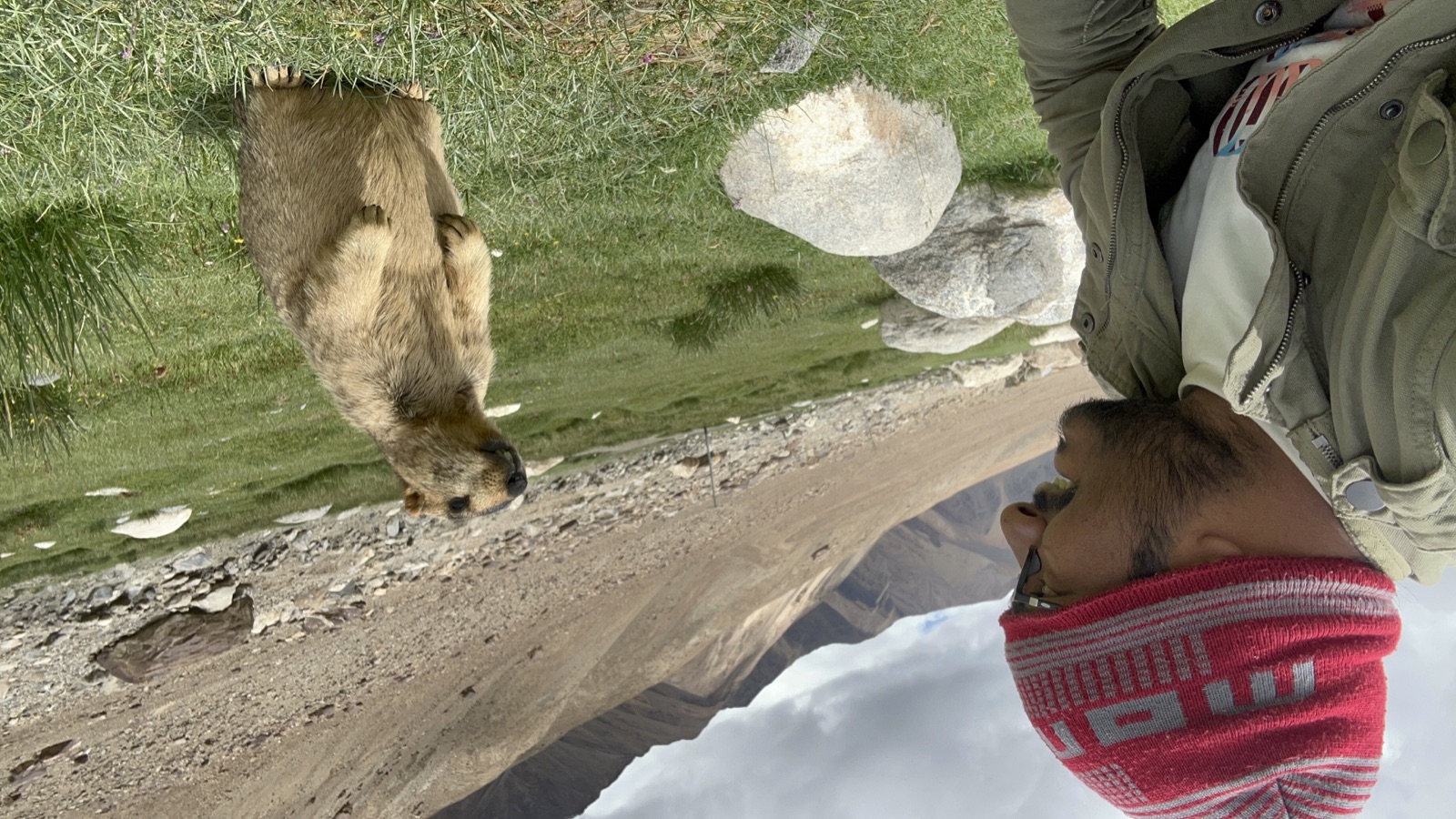
While they finished their lunch, Javed stayed with the bike, chatting easily with the workers, and I wandered off to look around. The lush green bushes nearby felt like a small reward after the day’s tension. A short distance further, I found a group of travellers photographing something with real excitement — and discovered, walking closer, a large, impossibly fluffy creature that looked halfway between a marmot and a stuffed toy come to life. It let me crouch beside it for selfies, completely unbothered, and at one point climbed straight onto someone’s leg, setting off a wave of laughter through the small crowd. I played with it for a good twenty minutes, calling Javed over so he wouldn’t miss it — a pocket of pure, uncomplicated joy dropped right into the middle of a hard day.
By the time we returned, the workers had already fixed the tyre. We braced for a steep bill, given how remote we were and how urgent our need had been. They asked for a hundred rupees. We gave them what chocolates we had left as a small, inadequate thank-you, humbled by how little they’d asked for and how much they’d given.
We got back on the bike with our spirits fully restored, the morning’s crisis folded into just another story now, and rode the rest of the way toward Pangong Lake with hearts considerably lighter than the day had any right to leave them.
After everything — the flat tyre, the detours, every setback since Day 3 — nothing prepared us for that first glimpse of the lake. The water was an impossible, crystalline blue, shifting shades with every ripple of wind across its surface, and every hardship that had brought us there seemed to dissolve the second we saw it. Javed threw his hands up in triumph, whooping loud enough that a family nearby turned to look, laughing along with him without knowing why. I understood exactly why.
Pangong Lake stretches across 134 kilometres, two-thirds of it lying in Tibet and one-third in India, sitting at an altitude of around 4,225 metres — a place where sky and water blur into each other until you can’t tell where one ends and the other begins. We spent the afternoon meeting fellow travellers, helping an elderly couple capture a photo together by the shore, letting the day’s earlier fear give way to something closer to peace. Even a simple meal of Maggi and an omelette tasted, that evening, like a genuine feast — payment, in a way, for everything we’d pushed through to earn it.
As the sun dipped, casting gold across the water, we walked the shoreline together, the mountains reflected so perfectly in the still surface that it felt like standing inside a mirror. Later, riding along the shore to find a quieter spot away from the crowds, we planted a small Indian flag into the cold, rocky ground near the water. The tricolour caught the wind and lifted, and something in my chest lifted with it — pride, not just in the two of us for making it here, but in the land itself, and the people who keep watch over it.
Around us, life carried on in its own small pockets of happiness — a young couple celebrating quietly, children dancing at the water’s edge, their laughter carrying easily across the still air. It all blended into the same feeling: that this had stopped being simply a trip, and had become something closer to a story we were living inside, made of pride and peace in equal measure.
We ate dinner slowly that evening, in no hurry to let the day end. Javed kept returning to the flat tyre story, retelling it with slightly more flourish each time, until even the hotel owner, refilling our tea, stopped to ask what exactly had happened out there. We told it together, interrupting each other over the details, the way you do with a story that’s already started turning into a memory even while you’re still living close to it.
That evening, back in our room, we ate warm jeera rice and paneer curry, food that tasted like comfort after everything the day had put us through. The temperature outside was already falling fast — from a biting minus five degrees toward something colder still — but the hotel staff had anticipated it and left us thick blankets, and we settled in, still half-lit by the magic of the lake and its enormous, star-crowded sky.
Javed wasn’t tempted to go back out into the cold for stargazing, but I couldn’t resist. I wrapped up as warmly as I could and stepped outside, where I found a few local Tibetan children playing, their faces bright despite the chill, and a friendly cat that wandered over to be photographed alongside them. Eventually Javed joined me, and together we looked up at a sky unlike anything either of us had seen before — the Milky Way stretched clean across it like a river of light, and for a long minute neither of us said a word. There’s a particular kind of smallness that comes from standing under a sky like that, and it isn’t a lonely smallness. It felt, instead, like being quietly folded into something much larger than either of us.
We didn’t stay out long — the cold eventually won — and we climbed back under our blankets with the day’s memories still moving softly behind our eyes.
We had barely drifted off when the night decided it wasn’t finished with us. Past midnight, a sudden crack of thunder tore through the silence, and by three in the morning heavy rain was lashing the windows, amplified by the mountain stillness around us. The temperature dropped hard, down toward minus ten, and the room that had felt cozy only hours earlier turned bitterly cold, every breath visible in the thin air.
We huddled under the blankets and tried to will the storm into passing. Sleep barely came. The wind howled outside for hours, rattling the window frame in its casing, and the cold found its way in regardless of how tightly we wrapped ourselves. But we endured it, the way Ladakh had already taught us to endure most things — quietly, together, waiting for the first grey light of dawn to break over the peaks and tell us the night was finally over.
Interlude — On Fear and Getting Back On
By the end of Day 4, Javed and I had broken down twice, been stranded once with no signal, and lost a tyre in the middle of nowhere. I’ve told each of those moments as its own scene, because that’s how they happened — separately, on separate days, each one arriving as its own small crisis. But sitting here now, writing about them together, I think the more honest way to describe those four days is as one long, repeated lesson in a single skill: getting back on the bike.
I don’t mean that literally, though we did, every single time. I mean something closer to what it takes to keep moving after something goes wrong in a place that offers you no easy way out. Every time the engine died, every time the tyre gave out, there was a small window — thirty seconds, maybe a minute — where the fear was completely in charge. Where the sensible-sounding voice in my head was listing every reason to feel certain that this time, we were actually in trouble.
What I noticed, looking back, is that the fear itself never really went away in those moments. We didn’t become braver as the days went on, not in the way I might have expected. What changed was how quickly we could move through the fear instead of getting stuck inside it — how fast we could get from “this is going wrong” to “here’s what we do about it.” That, I think, is closer to what courage actually is. Not the absence of fear, but a shrinking gap between feeling it and acting anyway.
Javed was better at this than I was, most days. He has a particular talent for treating a crisis as a problem to be solved rather than a disaster to be mourned, and more than once on this trip his calm dragged mine up to meet it. I’d like to think I gave him something in return — a willingness to keep going that occasionally outpaced his own — but I suspect the truth is that we simply borrowed courage from each other, in turns, exactly when the other one needed it most.
There’s a version of this story where the breakdowns and the flat tyre are just obstacles, inconveniences to be endured on the way to the real destination. I don’t think that’s true, or at least I don’t think it’s the whole truth. By the time we reached Pangong Lake on Day 4, tyre fixed, spirits restored, I understood that the getting-there had taught me something the arriving never could have: that I was more capable of handling things going wrong than I’d ever had reason to believe about myself before.
That lesson didn’t end at Pangong. If anything, Day 5 was about to ask for it again, harder than any single day before it.
Chapter 8 — Wet, Dry, and the Long Ride Back
Day 5
We woke around 6:30 on the morning of Day 5, grateful to find the rain had finally stopped. There was no hot water at the hotel, so a splash of cold water had to serve as our wash — not that it mattered much in weather too cold for a proper bath anyway. Outside, the air was crisp but oddly pleasant, and we let ourselves enjoy a short, quiet morning before the day’s demands caught up with us. A hotel child was playing nearby, chasing a ball that kept rolling further than he expected in the thin air, and I spent a few minutes with him before we ordered tea and a quick breakfast of bread omelette and Maggi, changing into riding clothes while it cooked.
Even though the sky looked clear when we set out, we layered up in raincoats and sweaters anyway, unwilling to trust Ladakh’s weather twice in one trip. We strapped our bags to the bike and rode the first two smooth kilometres along the lake, savouring our last glimpses of Pangong before the terrain roughened beneath us — the water calm and pale under the morning light, nothing like the churning grey it would become by afternoon elsewhere on our route.
It didn’t take long for the rain to return. What began as a light drizzle thickened within minutes into something heavier and colder, and Javed — driving through it — fought to keep his grip on the handlebars as the chill worked into his hands. He didn’t stop. Neither of us did.
The cold, once it set in, didn’t let go. Gloves, shoes, raincoats — none of it mattered once the wet had properly soaked through. My hands shook too hard at one point to hold onto anything steady, and Javed’s fingers stiffened enough to make the brakes and handlebars genuinely difficult to operate. Rain kept streaking across my glasses, blurring everything I tried to look at, no matter how often I wiped them clean. I wondered, more than once, whether we’d actually make it back to Ladakh without having to stop somewhere along the way.
We pushed through anyway, until an army roadblock forced us onto an unfamiliar detour with no break in the weather to soften it. By the time we reached North Pullu, we were both completely drained — soaked through, shivering constantly, having covered nearly seventy kilometres in conditions that had stopped being merely uncomfortable and become something closer to dangerous.
A small roadside shop saved us. Everyone else there had arrived by car or bus, warm and dry, watching the two of us drip our way inside, puddles forming under our boots almost immediately. We explained what had happened and asked, half-hoping, if anyone had spare socks to lend. No one did, but the sympathy was real, and we ordered every hot thing on the menu — Maggi, coffee, anything that promised warmth — and felt it slowly work its way back into our bodies as we ate, our hands wrapped so tightly around the cups that we didn’t want to let go even once the food arrived. We stayed there almost ninety minutes, letting our bodies recover before continuing, and without that stop I’m honestly not sure we could have pushed on much further.
The rain eased to a drizzle as we set out again, and we covered the next twenty-five kilometres in relative calm, passing Chang La without stopping — the thin oxygen there wasn’t worth the risk given how exhausted we already were. A hundred kilometres further on, another obstacle waited: a landslide had stopped traffic completely, stranding two to three hundred people in vehicles of every kind — trucks, army convoys, buses, bikers like us. We waited nearly two hours on the rough mountain ground, and to our own surprise, it turned into one of the more pleasant stretches of the day. Fellow travellers shared tablets for our headaches, food, and easy conversation, and a few small waterfalls cascading down the slopes nearby gave us something beautiful to look at while we waited.
Once the road cleared, we hit a handful of shorter delays — ten or fifteen minutes each — before finally making it back toward Ladakh. We stopped briefly at a monastery on the way in, grateful for its stillness after such a punishing day, and prayed simply for good health and safe travel before continuing on to our hotel.
We collapsed the moment we arrived. A quick wash, a forty-five-minute nap, and by the time we surfaced it was evening — and we were, against the odds, in decent spirits about how carefully we’d managed our money. Roughly six thousand rupees remained, split three thousand each, enough for dinner and the cab to the airport the next morning. Enough, we told each other, if nothing else went wrong.
Before that, we had to return the bike. The owner turned out to be one of the kindest people either of us had met on the whole trip — what should have been a simple handover turned into tea, snacks, and easy conversation, and we left not just having returned a rental, but having made a genuine friend in Ladakh, one who made us promise to call him if we ever came back.
He asked, once the paperwork was done, how the bike had held up, and we told him honestly — two breakdowns, one flat tyre, and more kilometres of rough off-roading than either of us had expected. He laughed, not unkindly, and said the Himalayan had probably seen worse from other riders that same season, which somehow made us feel both less unlucky and a little more ordinary in our misadventures than we’d felt while living through them.
Afterward, we walked toward Leh Market, and that walk felt like the whole trip replaying itself in fragments — Day 1, Day 2, every near-disaster and small joy, laid out between us as we talked. The market that evening was alive in the way only Ladakh seems to manage: children playing, families shopping, monks moving quietly through the crowd, travellers from every corner of the world mixing together under strings of coloured light and the soft drift of rooftop music.
We settled into a cozy restaurant, amused by a young couple nearby sharing an unguarded kiss, and ordered everything we could think of to mark our last proper evening — biryani, momos, noodles, a small feast to close out the trip. While we waited for the food, I opened the airline’s app to complete our web check-in for the next morning’s flight.
And that’s when the evening turned.
The flight was cancelled.
My stomach dropped so fast it felt physical. Javed’s face told me he’d read the same thing over my shoulder. Every good feeling from the last hour simply evaporated, replaced by a blankness neither of us could immediately think our way through. We cancelled most of what we’d ordered, forced down the momos that had already arrived out of some stubborn refusal to waste money we couldn’t spare, and sat there with our appetite gone and our minds racing through options we didn’t yet have.
We walked out and sat on the restaurant steps, staring at nothing, asking each other the same question on repeat. A quick search for replacement flights returned a price that made both our jaws drop — fifty thousand rupees per person, nearly our entire trip budget for one ticket. We kept searching and eventually found something at twenty-five thousand each. Still absurd. Still, given the circumstances, the only option we had.
Out of cash and out of easy options, I called Anand, one of my closest friends back home, and he offered his credit card without hesitation so we could book the new tickets. It’s the kind of thing you don’t forget, the kind of thing that reminds you exactly who you can call at midnight when everything’s gone wrong.
By then we were running on nothing — mentally, physically, emotionally spent. We went back to the hotel hoping to extend our stay by two more days.
It was fully booked.
We had to check out the next morning regardless, and for a moment it felt like every possible thing had chosen that exact evening to go wrong at once. We sat on the hotel steps with no plan and no energy left to make one, the trip’s earlier triumphs feeling suddenly very far away.
There was nothing to do but ask the hotel to hold our luggage safely and start walking. We covered three or four kilometres, knocking on every door we passed, but it was peak season and Ladakh’s weekends fill up fast. The rooms that were available sat well outside what we could afford, and every conversation followed the same pattern — an apologetic manager, a shrug, a closed door. Each “sorry, no vacancy” chipped away a little more at whatever resolve we had left.
But we kept going, because the alternative was standing in the cold with nowhere to sleep. After close to an hour of searching, we found a small hotel a couple of kilometres from our old one. We explained everything — the cancelled flight, the dwindling cash, the exhaustion plainly written across both our faces — and the person at the desk, understanding exactly what kind of night we’d had, offered us a room for seventeen hundred rupees for two nights. It felt, in that moment, like being handed a lifeline.
We walked back to collect our luggage, checked out properly, and moved into the new room, too tired by then to feel much beyond relief. We lay down not knowing what the next two days would look like, but grateful, at least, to have a roof and a bed to face them from.
Interlude — The Sound of Nothing
People ask what Ladakh sounds like, and the honest answer is that it sounds like almost nothing. That was the strangest part of it for me.
I live in a city where silence is a rare and slightly suspicious thing. There is always a horn, an engine, a neighbour’s television, a notification. In Ladakh the noise fell away in layers. First the traffic, once we left Leh behind. Then the voices, once the other riders pulled ahead of us. Then, on certain stretches of road, everything but the wind and the low, steady note of the engine beneath us.
I remember the silence on the road near Khardung La, after the bike died. It was not peaceful at that moment. It was heavy, and it pressed on both of us until the phone finally found a signal. I remember the roar of the river at the bridge on Day 3, so loud it drowned out thought, and how quiet it felt the moment we rode away from it. I remember the low murmur of monks at Diskit, a sound so soft it made the silence around it feel deeper.
And I remember Pangong, at night, with the Milky Way overhead and the cold pressing against my face. That silence was different again. It was not empty. It felt like being listened to.
I have tried, since coming home, to bring a little of that back with me. Ten minutes without the phone. A walk without earphones. It never quite matches what the mountains did on their own, but it reminds me what I was given, and that it is worth protecting.
Chapter 9 — Roti, Kapada, Makhan
Day 6
Day 6 had been meant, originally, as our last — a simple cab ride to the airport and a flight home to Hyderabad, on schedule, as planned. Instead, the budget airline we’d booked with had gone bankrupt overnight, cancelling the flight without warning. We should probably have looked more carefully into the airline before booking it, but mistakes like that are how travel teaches you anything at all.
We woke to a genuinely beautiful morning at the hotel — a garden bright with pink, red, and violet flowers, grape and strawberry and apple trees scattered through it, the kind of place that felt like a small hidden reward despite everything. After freshening up, the day’s real challenge set in: money. With our budget stretched thin, every rupee mattered now, and the day became, almost accidentally, a lesson in restraint.
We sat down that morning and did the math properly for the first time on the trip, laying out what little cash we had left against two more days in Ladakh and a flight home we still had to actually afford. It wasn’t a comfortable conversation, but it was a necessary one, and by the end of it we had a plan: eat simply, walk instead of hiring cabs, spend on nothing that wasn’t food or shelter, and treat the next two days less like a holiday and more like an exercise in seeing how far a small amount of money could genuinely stretch.
Javed and I walked the narrow lanes of Leh Market, hunting for something cheap and good, and the deeper we went the more authentic — and affordable — the food became. After about an hour, we found a small, unmarked place offering breakfast at a price that seemed almost impossible: a cup of tea, roughly seventy-five millilitres, and two plain buttered rotis, meant to be dipped and eaten together. It cost ten rupees. It remains, honestly, one of the best breakfasts either of us has ever had — proof that the price of a meal has very little to do with how much it means to you.
There’s a particular kind of clarity that comes from having very little money in your pocket in an unfamiliar place. You stop window-shopping. You stop wandering into things out of idle curiosity. You start noticing, instead, the things that don’t cost anything at all — the exact colour the light turns in Leh Market by mid-morning, the way an old man near the vegetable stalls hummed the same three notes over and over while he worked, the particular quiet of a lane one street back from the main bazaar, where the noise dropped away almost entirely and the mountains suddenly felt very close again.
After breakfast we walked the town properly, the way a local might, discovering corners and lanes we’d have missed entirely if money hadn’t forced us to slow down and look closer. We passed a small carpentry shop where an old craftsman was carving a prayer wheel by hand, unhurried, entirely absorbed in the work, and stood and watched him for longer than we probably needed to. Back at the hotel, lunch was more tea and butter roti — four each this time — followed by a proper nap to recover, the kind of deep, dreamless sleep that only comes after several days of accumulated exhaustion finally catch up with you.
That evening we talked with a few fellow travellers, wandered back to the market, and found a quiet Buddha temple to sit in for a while, grateful for a place that asked nothing of us except stillness. Dinner was simple fried rice at a budget spot, a deliberate break from the tea-and-roti routine our stomachs were beginning to protest, eaten slowly, savoured in a way a fancier meal earlier in the trip hadn’t quite earned. Back in our room that night, I logged in to cancel the leave I’d taken from work, since there wasn’t much left to see, and put in a few hours helping my colleagues before logging off around midnight. My manager, Naga Chandan, was understanding about the whole situation — which made the small return to routine easier to accept, even from a cheap hotel room thousands of kilometres from my desk.
It was a strange kind of evening, half travel and half routine, my laptop open on a hotel bed in Ladakh while a test suite ran in the background and Javed read quietly on the other bed, notebook open beside him. There’s something almost funny, looking back, about troubleshooting a software bug at nearly eleven thousand feet, mountains outside the window I wasn’t looking at because I was busy staring at a screen instead. But it also felt, oddly, like a small proof that the ordinary parts of life and the extraordinary ones aren’t as separate as they sometimes feel — that you can be having the adventure of your life and still owe someone a status update by end of day.
It wasn’t a dramatic day. But it was an honest one — simple pleasures, careful spending, and a trip slowly, quietly teaching us how little we actually needed. Looking back, Day 6 might be the day I think about most often when people ask what Ladakh was really like. Not the mountains. Not the lake. A ten-rupee breakfast, and how completely content we were with it.
Interlude — The White Notebook
I’ve mentioned Javed’s notebook several times now without ever really explaining it, and by Day 6 it had become something close to a third presence on this trip — a small, battered, white-covered thing he carried in his jacket pocket and pulled out most evenings, usually after I’d already given up and gone quiet with exhaustion.
I never read it properly, and I’m glad I didn’t. Whatever he wrote in there was his own way of holding on to the trip, separate from mine, and I think it would have changed something between us if I’d treated it as material for this book rather than his private record of the same eight days. What I can tell you is what I saw from the outside: the particular focus on his face while he wrote, pen moving steadily even when his hands were still half-numb from the cold; the way he’d sometimes stop, look up at nothing in particular, and then keep going, as if he’d just found the right word for something he’d been circling.
I asked him once, on our last evening in Leh, what was actually in it — half-joking, half-genuinely curious after watching him fill so many pages. He shrugged the way he does when he doesn’t want to make something sound bigger than it is, and said some of it he wanted to remember exactly, not the way memory usually softens things over time. I think that’s the most honest thing either of us has said about why we told this story at all — me through photographs and, eventually, this book; him through a small white notebook that, as far as I know, still sits somewhere on his shelf, unpublished and entirely his own.
I like that there are two versions of this trip out there, his and mine, and that only one of them is written down for anyone else to read. It feels right that Ladakh, which gave us so much to share, also left each of us something private to keep.
Chapter 10 — A Bittersweet Farewell to Ladakh
Day 7
This was the last full day of our Ladakh adventure, and after everything the week had thrown at us, it felt like a quiet, deliberate goodbye rather than an ending. We started the way Day 6 had — the same walk to the same stall for tea and butter roti, a meal that had gone, somewhere along the way, from novelty to something close to home. The woman running the stall recognised us by then, and gave us an extra roti each without being asked, waving off Javed’s attempt to pay for it.
With our time and budget both limited, we stayed close to the Ladakh Market, letting the town’s everyday rhythm carry us through the morning — its shopkeepers, its wandering monks, its endless small conversations.
We didn’t buy much. A small prayer wheel for my mother, a scarf Javed picked out for his sister after nearly twenty minutes of careful deliberation between two nearly identical options. Mostly we just walked, slower than we had all week, letting the market be background rather than destination — content, for once, simply to be somewhere without needing it to give us anything more than itself. We stopped at the same bakery we’d visited on Day 1, and the owner remembered us, asking with real interest how the rest of the trip had gone. We told him the short version — the floods, the flat tyre, the cancelled flight — and he laughed and told us that was simply what Ladakh did to first-time visitors, as if testing them was part of the welcome.
After a short nap back at the hotel and another lunch of butter roti, rationed as carefully as everything else by then, we spent the evening simply talking — to monks, to tourists, to locals who had stories of their own to share. One elderly local, sitting outside his shop as the light went gold over the rooftops, told us about winters here that shut the whole region off from the rest of the country for months at a time, and about a life built entirely around knowing when to travel and when to simply wait the season out. That, more than any single landmark, is Ladakh’s real charm: the people who pass through it, and the ones who never leave.
We closed the day with two full plates of egg fried rice, determined to leave on a full stomach before the long journey home the next morning. Even so, there was a heaviness under the relief of finally getting to go back. Ladakh had become something we hadn’t expected it to become — not just a place we’d visited, but one we already missed before we’d even left it. Sitting on a bench that evening, watching children play and vendors call out to passing shoppers, we both felt it: the quiet ache of leaving somewhere that had asked so much of us and given back even more.
Javed spent that last evening filling the pages of his white notebook, trying to hold onto everything before it slipped away. I asked him once, half-joking, what he was even writing at this point — we’d been over every part of the trip a dozen times already. He just shrugged and said some of it he wanted to remember exactly, not the way memory usually softens things. Ladakh has a way of making you want to write down every detail, fill every page, and still feel like it isn’t enough.
We packed our bags that night and lay down with the whole week replaying behind our eyes — every breakdown, every kindness, every landscape that had stopped us mid-sentence. It was emotional in a way neither of us had fully expected, but underneath it sat something steadier: gratitude, plain and complete, for every part of it.
Day 7 closed quietly on what had become an unforgettable chapter of both our lives. We don’t know when we’ll go back. But when we do, it will feel less like visiting somewhere new and more like returning to a second home.
Day 8
As the plane lifted off on Day 8, leaving the mountains and their impossibly clear skies behind us, I found myself running back through everything we’d lived through in eight days. Ladakh hadn’t just been a destination. It had been a teacher, and at times an adversary, testing us at nearly every turn.
The hotel staff had sent us off that morning with an unasked-for breakfast, packed simply but generously, pressed into our hands at the door with a warmth that summed up the whole trip better than any single landmark could. The cab ride to the airport was quiet. Neither of us said much. We didn’t need to.
From the thrill of landing on that first morning to the altitude sickness at Khardung La, the bike stranded in sudden rain, the flood that turned us back from Pangong twice before it finally let us through — every one of those moments had shaped a story neither of us would trade away, hardship included.
We had learned, day by day, to adapt. When money ran short, tea and butter rotis stopped being simply food and became something closer to comfort — proof that joy doesn’t require very much to survive on. When plans collapsed — a flight cancelled, a hotel fully booked — we found our footing anyway, and made something out of the uncertainty instead of being flattened by it.
As the plane climbed higher, the memories came in a rush — Nubra Valley’s raw stillness, the serenity of Pangong under a sky full of stars, the hotel staff who’d sent us off with a small, unasked-for farewell breakfast, and the long list of strangers who had, in ways large and small, helped carry us through the week: a mechanic’s voice on a crackling phone line, a truck driver who wouldn’t take a rupee, two construction workers who fixed a tyre for the price of a handful of chocolates, a bike-rental owner who became, by the end, something like a friend.
This journey was never really about reaching a destination. It was about learning to stay inside the difficulty long enough to get something honest out of it. If Ladakh taught us anything, it’s that a traveller’s real strength doesn’t come from comfort. It comes from resilience, from curiosity, and from a willingness to be humbled by a road that owes you nothing.
As Ladakh faded below the clouds, I understood that this wasn’t quite a goodbye. It was a promise — to come back, someday, to a place that had already left its mark on both of us for good.
The END.
Part Three: After the Road
Faces of Ladakh
Some places stay with you because of what you saw. Ladakh stays with me, just as much, because of who I met along the way. I’ve mentioned most of them in passing already, but they deserve a moment on their own, because none of this trip would have gone the way it did without them.
The mechanic on the phone. I never saw his face. I only know his voice — patient, unhurried, talking two frightened, freezing cousins through a dead engine on a mountain road neither of us could name, without once sounding impatient with how badly our hands were shaking. He runs the bike rental business we booked through, and to this day I don’t think he knows how much that one phone call mattered.
The white-truck driver. He didn’t ask our names. He didn’t ask for money. He saw two exhausted travellers standing next to a bike with a flat tyre in the middle of nowhere, and he simply stopped and loaded us in, the way you’d help family. We never learned much about him beyond that he made this same remote drive often enough to know exactly which construction camp could fix a tyre.
The construction workers at the tyre camp. They’d spent the morning fixing machinery meant to move mountains, and somewhere in their lunch break they found the time to fix a stranger’s motorcycle tyre for a hundred rupees — a price so low it felt less like payment and more like a formality. Their kindness, and their skill, got us to Pangong Lake that evening.
The bike rental owner in Leh. What should have been a two-minute handover on our last day turned into tea, snacks, and easy conversation with a man who’d clearly seen hundreds of travellers pass through his shop and still treated us like we mattered individually. He made us promise to call before our next trip. I intend to keep that promise.
The hotel owner who gave us a room at midnight. After the flight cancellation, after the fully booked hotel, after nearly an hour of doors closing in our faces, he looked at two soaked, exhausted strangers and simply said yes — seventeen hundred rupees, two nights, no questions asked beyond whether we were alright. I think about that kindness more than almost anything else from the trip.
The SIM-card shopkeeper. He sold us a five-hundred-rupee local SIM on our very first evening in Leh, and threw in a piece of advice along with it — rest well, the mountains don’t forgive tired riders — that we didn’t fully appreciate until we were living out exactly what he’d warned us about, two days later on a dead-engine road near Khardung La. Small kindness, correctly timed, can matter more than people realise.
The newlywed couple at Diskit. We never learned their names. They’d chosen Ladakh over the usual honeymoon destinations, and seemed entirely at peace with that decision, sharing their snacks with us as easily as if we’d known each other for years. There’s something about meeting other people mid-adventure, all of you far from home at the same time, that erases the usual distance between strangers almost instantly.
The hotel child at Pangong. I never learned his name either, only that he was fast enough to chase a ball across ground that had both of us wheezing after a single flight of stairs, and that his laughter, echoing off the water in the last of the evening light, is one of the small sounds I still associate most strongly with that lake.
The elderly local on Day 7. Sitting outside his shop as the light went gold over the rooftops, he told us, unprompted, about winters that shut Ladakh off from the rest of the country for months at a stretch — a life built entirely around knowing when to travel and when to simply wait the season out. I think about that conversation often, usually whenever I catch myself complaining about a delayed flight back home.
Javed. I’ve saved him for last because he doesn’t fit neatly into a paragraph the way the others do — he was there for every single one of these moments, the steady half of every decision we made together. He is the reason there even is a “we” in this book instead of an “I.” Whatever this journey gave me, it gave to both of us, and I’m not sure I’d have come home with the same version of these memories if I’d made this trip alone.
Ladakh’s landscapes are the reason people go. Its people are the reason they come back.
The Cost of the Road
I’ve mentioned money more times in this book than I expected to when I started writing it, and I think that’s worth sitting with for a moment rather than glossing over.
We didn’t travel to Ladakh with much room for error. We’d budgeted carefully, the way two people early in their careers usually have to, and for the first few days that budget held up fine on paper. Then the flight got cancelled, and the maths of the whole trip changed in about ten minutes flat — a twenty-five-thousand-rupee replacement ticket each, against a shared pool of cash that had already been stretched thinner than either of us wanted to admit out loud.
I think a lot about how differently that evening could have gone. If Anand hadn’t answered his phone, or hadn’t offered his card without hesitation. If the hotel owner who gave us a room at midnight had turned us away like the others had. Money trouble in an unfamiliar place has a way of narrowing your options fast, and it was only the people around us — some of them friends of years, some of them strangers we’d known for a single conversation — who kept those options open when they easily could have closed.
There’s a version of privilege in even being able to tell this story lightly, I know that. We always had a safety net, however stretched — a friend’s credit card, a manager who understood, a family that would have found a way to help if it came to that. Not everyone travelling with a small budget has that net underneath them, and I don’t want to make Day 6’s ten-rupee breakfast sound purely romantic. It was also, plainly, us being careful because we had to be.
What I took from it, in the end, wasn’t a lesson about money exactly. It was a clearer sense of how much of travel — the real, unglamorous kind, not the postcard version — depends on the goodwill of people who have no obligation to give it. A construction crew charging a hundred rupees for a tyre repair they could have priced at ten times that. A truck driver who wouldn’t take a single note. A hotel owner willing to trust two exhausted strangers with a room at midnight. None of them owed us anything. Ladakh, it turned out, runs on more generosity than its budget travellers usually manage to thank it for.
Interlude — What I Was Carrying
Every traveller packs two bags. One is the one you can see, zipped and strapped to the bike. The other is the one you carry inside, and it does not go through security.
Mine, when I left Hyderabad, was heavier than I admitted to anyone. I was a few years into a job I had not dreamed of, still carrying the quiet disappointment of a dream I had put down. I was good at my work, and grateful for it, but some part of me kept asking whether this was all there would be.
I did not go to Ladakh to answer that question. I went because I wanted to see it. But mountains have a way of rearranging what you thought you were carrying.
Somewhere between the first breakdown and the last cold night, the question got smaller. Not solved, exactly, but lighter. I had been so busy measuring my life against the one I imagined at seventeen that I had stopped noticing the one I was actually living, with its own problems and its own strange, stubborn beauty.
When we landed back in Hyderabad, my inner bag was still there. But I could lift it more easily than before. That, I think, is the real souvenir I brought home, and no shop in Leh Market could have sold it to me.
Ten Things Ladakh Taught Me
I didn’t set out to collect lessons. But somewhere between the sandstorm on Day 1 and the ten-rupee breakfast on Day 6, they piled up anyway. These are the ten I still carry.
1. The road belongs to the mountain. You can plan, book, and prepare, but you do not get a vote. The sooner you accept that, the less the waiting hurts.
2. Panic is loud, but it is short. Every time something broke, the fear arrived first and left first. What stayed was the next small step: check the switch, call the owner, wave down the truck.
3. Kindness travels faster than help. A stranger’s calm voice on a bad phone line did more for us than any rescue vehicle could have, because it arrived when we needed it, not an hour later.
4. Cheap is not the same as poor. A ten-rupee breakfast can be a feast when you have nowhere to rush off to and someone to share it with.
5. Your body keeps its own schedule. The headache at Khardung La did not care about my itinerary. Listening to it, instead of arguing with it, is what got me to the next hotel.
6. The right companion is worth more than the right plan. My plans fell apart within two days. Javed did not. If I had to keep only one of the two, I would not hesitate.
7. Ask for help early. We lost precious time on Day 3 hoping the road would sort itself out. It rarely does. People want to help far more often than we let them.
8. Small comforts are not small. Hot Maggi at a roadside shop. A dry pair of socks. A blanket left on the bed before you asked. At altitude and in cold, these are the things that hold a day together.
9. Not every day has to be a peak. Day 6 had no summit, no lake, no drama. It taught me as much as any of the days that did.
10. Coming home is part of the trip. The story does not end when the plane lands. It keeps changing shape as you tell it, and as you realise which parts mattered most.
A Letter to My Younger Self
Dear Shahil,
You are in Bapatla, and you are sure that if the acting does not work out, everything else will fall apart. I want to tell you gently that it does not.
You will not become the actor you imagine. You will sit in a different kind of chair, in a different kind of office, and for a while you will feel like you are living someone else’s life. Be patient with that feeling. It is not a verdict on you.
What you will find, slowly, is that the things you loved about those short films never left. The looking closely. The wanting to hold on to a moment. They will come back through a camera, through long roads, and one day through words on a page.
You will stand at 5,359 metres, cold and dizzy and stubborn, and you will realise you are exactly where you were meant to be, even though no one planned it for you. You will also stand on a hotel step in the rain with no room and almost no money, and you will survive that too.
So take the pocket money you never got and the dreams that did not work out, and understand that they were not taken from you. They were teaching you how to keep going.
Go easy on yourself. The road is long, and it is worth it.
A Letter to Javed
Javed,
You will probably read this before anyone else, and you will probably say it is too much. So let me keep it short.
Thank you for the head massage when I could barely open my eyes. Thank you for not letting me cancel the Pangong booking when I was ready to give up. Thank you for laughing at the crow, and for not letting me forget it.
Thank you for staying calm when the engine died, and for being the reason I could stay calm too.
I know you keep the white notebook to yourself, and I know why. But if you ever decide to read a page of it aloud, I will be the first one listening.
Wherever Ladakh takes us next, I want it to be with you on the bike.
Your cousin, Shahil
Epilogue
I wrote most of this book from memory, months after Hyderabad had swallowed me back into its traffic and its deadlines. It’s strange, writing about mountains from a desk. But Ladakh has a way of staying with you long after the altitude sickness fades and the last of the rented gear goes back to its owner.
What I carried back wasn’t the flag we planted by the lake, or the photographs on my Nikon, though I still look through both often. It was something quieter — the memory of standing beside a dead bike in the middle of nowhere, certain for a few minutes that things were genuinely going wrong, and finding out that they weren’t, not permanently. That the signal came back. That the truck appeared. That the tyre got fixed for a hundred rupees by men who had every reason to charge us more and didn’t.
I think that’s the real lesson Ladakh had for me, underneath all the landscapes and the near-misses: most of what feels like disaster in the moment is just the story asking you to be patient a little longer. The flood that blocked us from Pangong twice eventually let us through. The flight that got cancelled led us to a stranger’s kindness and a friend’s credit card. Even the coldest night, at ten below zero with the wind screaming outside our window, ended the way every night does — in a grey, ordinary dawn.
I don’t know that I’ve fully carried that lesson home with me. Deadlines still make me anxious. I still catch myself expecting the worst before it’s actually arrived. But somewhere underneath that, there’s a version of me now who has stood at 5,359 metres with a headache and a flat tyre and come out the other side laughing about it — and that version of me is a little harder to rattle than the one who left Hyderabad that July morning, half-certain and half-terrified of what he was walking into.
I don’t know yet when Javed and I will go back. But I like that the question stays open, that Ladakh isn’t a closed chapter so much as one I’ve paused partway through.
There’s also a quieter thing this trip gave me that took longer to notice. I went to Ladakh as a photographer chasing frames, and I came back a little more interested in the stories behind them — the mechanic’s voice, the truck driver’s silence, the ten-rupee breakfast that meant more than any restaurant meal I’ve had before or since. This book exists because of that shift, more than because of any single photograph in it.
Jayashree asked me once why I don’t share my experiences with the world. This is my answer, a little late and, I hope, worth the wait.
If you’ve made it this far, thank you for riding along with Javed and me — through the sandstorms, the floods, the cold, and the strange, stubborn joy underneath all of it. If we ever get the chance to come back to Ladakh, it will be with memories already in hand. And if we don’t, well — we’ll remain in them, and so, now, will you.
One More Thing
A small memory, before the practical part of this book takes over.
A few weeks after we got back to Hyderabad, Javed came over one evening and we sat on my floor with my laptop between us, going through the Ladakh photographs properly for the first time — not the quick scroll I’d been doing alone for months, but a real look, frame by frame, each one pulling up a piece of the story we’d already half-forgotten how to tell in order. We laughed at the marmot photos longer than they probably deserved. We went quiet at the one of the lake at sunset. Javed found the photo of me at Khardung La, headache and all, and said again what he’d said that evening on the mountain — that it was the real picture from that day.
We didn’t plan to write a book that night. We just wanted to remember properly, together, before the details started slipping the way details do. I think that evening, more than the trip itself, is where this book actually started — two cousins on a bedroom floor, turning a folder of photographs back into a story worth telling.
Practical Notes for Fellow Travellers
I’m not a travel agent, and this isn’t a substitute for proper research closer to your travel dates — Ladakh’s rules and road conditions shift from season to season. But if this book has put Ladakh on your list, here’s what I wish someone had told me before we went, gathered from what actually helped us and what we learned the hard way.
When to go. We travelled in mid-July, which sits comfortably inside Ladakh’s main tourist season, roughly May through September, when the high passes are open and the worst of the winter snow has cleared. Outside that window, several of the roads we rode — including Khardung La and Chang La — can close entirely. Even within the season, expect sudden weather: rain, landslides, and cold snaps are normal, not exceptions.
Permits. Several of Ladakh’s most striking routes, Pangong Lake among them, sit inside Protected Areas near the international border and require an Inner Line Permit or Protected Area Permit to enter. These are usually arranged through a local travel agent or online shortly before or after you arrive in Leh, and requirements do change, so confirm the current process before you travel rather than relying on what worked for us in 2023.
Altitude. Leh itself sits above 3,500 metres, and the passes climb far higher — Khardung La at 5,359 metres, Chang La above 5,360. Give yourself at least a full day in Leh before any strenuous activity, drink more water than feels necessary, and take altitude sickness seriously if it appears: headaches, nausea, and breathlessness are your body’s way of asking you to slow down, not a challenge to push through.
Getting around. We rented a Royal Enfield Himalayan, built for exactly this terrain, and I’d recommend the same or something similar over a standard road bike. Book your rental and your hotels ahead of time if you’re travelling in peak season — we learned the hard way, after a cancelled flight, just how quickly Ladakh’s hotels fill up with no notice at all.
Money. Keep more cash on hand than you think you’ll need, and keep it split between people if you’re travelling in a pair or group, the way we did. ATMs are limited outside Leh itself, card payments aren’t reliable in remote areas, and a flat tyre or a cancelled flight has a way of arriving exactly when your budget is thinnest.
Weather gear. Even in July, nights at altitude can drop well below freezing, and rain — rare as it is — turns roads treacherous fast. Pack proper thermal layers, waterproof gloves, and a good raincoat regardless of the season, and don’t assume a clear morning means a clear day.
Respect the land and the army. Several of the routes we travelled pass through military-controlled areas, and checkpoints can close without warning for reasons that are rarely explained to travellers. When a soldier tells you not to stop, not to film, or not to argue, that instruction exists for real reasons. Patience at a checkpoint costs you an hour. Arguing at one can cost you the whole day, or worse.
Slow down. This is the one piece of advice I’d underline twice. Ladakh punishes travellers who try to rush it — through altitude sickness, through missed turns, through the sheer exhaustion of trying to see everything in too few days. Build slack into your itinerary. The mountains will use it, one way or another, and you’ll be glad you left the room.
The Places at a Glance
A quick reference for the main places in this story:
- Leh — the largest town in Ladakh, at roughly 3,500 metres. Base for almost every route, and the best place to rest and acclimatise.
- Khardung La — a high pass at 5,359 metres on the road between Leh and Nubra Valley.
- Nubra Valley — a high-altitude valley beyond Khardung La, with sand dunes, orchards, and Diskit Monastery.
- Diskit Monastery — the oldest and largest monastery in Nubra, home to the 106-foot Maitreya Buddha statue, built in 2010.
- Chang La — a pass above 5,360 metres on the road from Leh toward Pangong Lake.
- Pangong Lake — about 134 kilometres long, with roughly one-third in India and two-thirds in Tibet, at around 4,225 metres.
Respecting Local Culture
Ladakh’s Buddhist heritage is visible everywhere you go, and a little awareness goes a long way. Ask before photographing monks or worshippers up close, keep your voice down inside monasteries, and follow the lead of locals on small customs — walking clockwise around chortens and prayer wheels, for instance, rather than against the direction others are moving. Dress modestly when visiting religious sites, and remember that for the people who live here, these are not tourist attractions first — they’re places of ongoing, daily faith.
Health and Safety Basics
Beyond altitude sickness, which I’ve already mentioned, keep a basic first-aid kit with you at all times, along with any personal medication you might need — pharmacies thin out fast once you leave Leh. Mobile signal is unreliable to nonexistent across large stretches of the route, so tell someone your rough itinerary before setting out each day, and don’t rely on your phone for navigation once you’re well outside town. If you’re riding rather than travelling by car, take the hairpin bends slowly, respect closed roads and army checkpoints without arguing, and never assume a route that was open yesterday is open today — as we learned, more than once, the hard way.
A Sample Packing List
We travelled light on purpose, and this is roughly what filled our bags:
- Two to three thermal layers, for evenings and high passes
- A proper waterproof riding jacket and gloves — ours weren’t quite waterproof enough, and we paid for it on Day 5
- Extra socks, more than feels necessary; wet feet at altitude are miserable
- A basic first-aid kit, including altitude sickness tablets
- A power bank, charged fully before every ride — signal is scarce, but you’ll still burn battery on maps and photos
- Copies of our permits, both physical and photographed on our phones
- Sunglasses and sunscreen — the sun at altitude is stronger than it looks on a cold day
- A reusable water bottle, refilled whenever we found clean water, to keep ahead of dehydration
What we didn’t bring, and were glad of it: anything we didn’t strictly need. Every extra kilogram on a bike like ours, on roads like these, makes itself known eventually.
What We’d Do Differently
Looking back with two years of distance, a few things stand out as changes I’d actually make, rather than just things that happened to go wrong:
We’d build a bigger financial buffer into the budget, specifically for the kind of unplanned costs that hit hardest — a cancelled flight, an extra night’s stay — rather than assuming the trip would go roughly to plan. We’d also add a spare day or two around Pangong Lake, so a single flood or closed pass couldn’t threaten to derail the whole itinerary the way it nearly did on Day 3. And we’d research our airline a little more carefully before booking — the budget carrier that cancelled on us is a reminder that a little more research before booking can save a lot of trouble later.
What we wouldn’t change is harder to list, because it’s most of the rest of it. The breakdowns, the cold, the long stretches of uncertainty — they’re not things I’d edit out even if I could, because they’re the parts of the story that actually taught us something.
Our Route, Day by Day
For anyone who wants the itinerary in one place rather than pieced together from the story, here is roughly what our eight days looked like, start to finish:
- Day 1 — Hyderabad to Delhi to Leh by flight (with a long Delhi layover), then Leh Palace, the Hall of Fame, Spituk Gompa, Leh Market, and Shanti Stupa.
- Day 2 — Leh to Nubra Valley over Khardung La, with a stop at Diskit Monastery.
- Day 3 — An attempted run to Pangong Lake from Nubra, turned back twice by flooding, ending back in Leh.
- Day 4 — Leh to Pangong Lake over Chang La Pass, with a flat tyre en route.
- Day 5 — Pangong Lake back to Leh, through heavy rain and cold.
- Day 6 — A low-budget day in Leh, after our return flight was cancelled.
- Day 7 — A final day exploring Leh at a slower pace.
- Day 8 — The flight home to Hyderabad.
Your own version of this route could easily be spread across more days, especially if you’d rather not repeat Khardung La twice in one trip the way we ended up doing.
A Rough Sense of Budget
Costs change every season, so treat these only as a rough shape rather than exact numbers to plan against. Between flights, permits, a multi-day bike rental, hotels at every stop, fuel, and food, our eight-day trip ran to a modest, carefully managed budget for two people — one that had almost no cushion left in it by the time our flight was cancelled and we had to book replacement tickets on short notice. If I were planning this trip again, I would build in a larger emergency buffer than we did, specifically to cover the possibility of a cancelled flight or an unplanned extra night, both of which cost us far more, at far shorter notice, than anything else on the trip.
A Few Photography Notes
If you’re bringing a camera, my only real advice is to spend less time chasing the obvious postcard shots and more time watching for the smaller moments around them — the way I found, on this trip, that some of my favourite photographs weren’t of the mountains at all, but of the people I met along the way. Bring spare batteries and keep them warm; cold drains them fast at altitude. And ask before you photograph someone up close. Most people in Ladakh are generous about it, but it’s their face, not yours, and the photograph is better for the asking.
A Small Glossary
A few words that appear throughout this book, for anyone unfamiliar with them:
- La — Ladakhi and Tibetan for “pass,” as in Khardung La or Chang La — the high mountain crossings this whole trip was built around.
- Gompa — a Buddhist monastery, usually built on high ground, often centuries old.
- Stupa — a dome-shaped Buddhist monument, typically containing relics or built to mark a sacred site; Shanti Stupa is one of the more famous examples in Leh.
- Chorten — a smaller shrine or monument, similar in spirit to a stupa, often seen along roadsides and at monastery entrances.
- Thangka — a traditional Tibetan Buddhist painting, usually on cotton or silk, depicting deities or mandalas.
- ILP / PAP — Inner Line Permit and Protected Area Permit, the paperwork required to enter certain restricted border zones in Ladakh, including the road to Pangong Lake.
- Thukpa — a warming Tibetan noodle soup, a common sight on menus throughout Ladakh, especially welcome after a cold day on the road.
A Few Questions Readers Might Ask
Would you do this trip again the same way? Mostly, yes — though I’d build in a bigger financial cushion, and I’d give ourselves an extra day or two of slack in the itinerary, especially around Pangong Lake, so a single flood or landslide couldn’t cost us an entire day the way it did on Day 3. I’d keep almost everything else the same, breakdowns included. Strange as it sounds, the parts that went wrong are the parts I’d be least willing to trade away.
What was the hardest moment of the whole trip? Not the flat tyre, and not even the freezing night at Pangong Lake, though both were difficult in the moment. The hardest was standing outside a fully booked hotel on Day 5, soaked through, our flight just cancelled, with no clear plan and very little money left. That was the one point on the trip where I genuinely didn’t know what we were going to do next.
What was the best moment? Honestly, it’s not the obvious one. Pangong Lake at sunset was extraordinary, and I don’t want to undersell it. But if I’m being truthful, the ten-rupee breakfast on Day 6 — tea and butter roti, eaten slowly, with nowhere we needed to rush off to — is the memory that makes me smile fastest when I think back on the trip.
Why did you wait two years to write this book? Mostly a mix of ordinary life getting in the way and not quite believing the story was worth telling until someone else — Jayashree — said out loud that it was. I think a lot of good stories sit unwritten for exactly that reason: not because they aren’t worth telling, but because the person who lived them hasn’t yet been asked the right question by the right person.
Would you recommend this trip to someone who isn’t an experienced rider? With real caution, and proper preparation. Ladakh’s roads are demanding even for confident riders, and altitude sickness doesn’t care how experienced you are on a bike. I’d recommend building up to a trip like this with shorter mountain rides first, and never underestimating how much the terrain, the cold, and the thin air can take out of you, however fit you think you are.
For Book Clubs and Discussion Groups
A few questions, if you’re reading this with others:
- Shahil describes courage as “a shrinking gap between feeling fear and acting anyway.” Do you agree with that definition? Where have you seen it play out in your own life?
- Several strangers — the truck driver, the construction workers, the hotel owner — extend real kindness to Shahil and Javed with nothing asked in return. What do you think Ladakh’s isolation has to do with that generosity?
- Money trouble reshapes the second half of the trip, from the flat tyre to the cancelled flight. How does the book’s tone change once the budget tightens, and what does that shift reveal about the two travellers?
- The book ends without a clear resolution to some of its bigger questions — when the cousins will return, what the trip ultimately “meant.” Did that ending satisfy you, or did you want something more conclusive?
- If you’ve travelled somewhere that changed how you see yourself, what was it, and what made the difference?
Acknowledgements
This book exists because of a handful of people who never once made it feel like a solo effort, even though the writing itself was.
To my parents, for a childhood that taught me the value of what I have before I ever had very much of it. To my sister, working steadily toward her own degree while cheering mine on from a distance. To Anand, Sai, and Raju, for more late-night phone calls and unhesitating favours than any friendship should reasonably require — Anand especially, for a credit card offered without a second thought on the worst night of this whole trip. To Jayashree, for one offhand question that somehow became an entire book. To Naga Chandan, for the patience of a manager who let a stranded employee log in from a Ladakh hotel room and never made it feel like a burden.
And to Javed — cousin, co-rider, and the steadiest presence in every single chapter of this book. None of it happens without you, and none of it would have been worth writing down if you hadn’t been there to live it with me.
Thank you, all of you, for the memories. This book is really just my attempt to hand a few of them back to you.
About This Book
When Human Shahil set out for Ladakh, he expected an adventure — but the mountains had other plans. From sudden sandstorms and flooded roads to quiet, star-filled nights beside Pangong Lake, every turn became a lesson in patience, friendship, and wonder. Through breakdowns, cancelled flights, and the unasked-for kindness of strangers, he discovers that the real destination was never a place — it was the strength he found within himself. For anyone who has ever longed to chase freedom and meaning on the road, this is your map.
All rights reserved to Human Shahil.
Reader's corner
What stayed with you?
Leave a reaction or a short note for Human Shahil. Comments are reviewed before appearing publicly.
This book is the copyrighted work of Human Shahil. No part may be reproduced, distributed, or transmitted without prior written permission, except for brief quotations used in reviews or other uses permitted by law.
From the road
A visual postscript
Photographs from the Ladakh journey that lives beyond these pages.